


Rapid Fire
Centre’s Power to Scrutinise Citizenship is Limited: EC tells SC
- 03 Dec 2025
- 3 min read
The Election Commission of India (ECI) has clarified its authority in matters of electoral roll registration (Special Intensive Revision (SIR)), particularly refuting opposition claims that only the Union Government has the exclusive right to scrutinise citizenship.
Key Legal Provisions & Controversy Regarding ECI’s Role
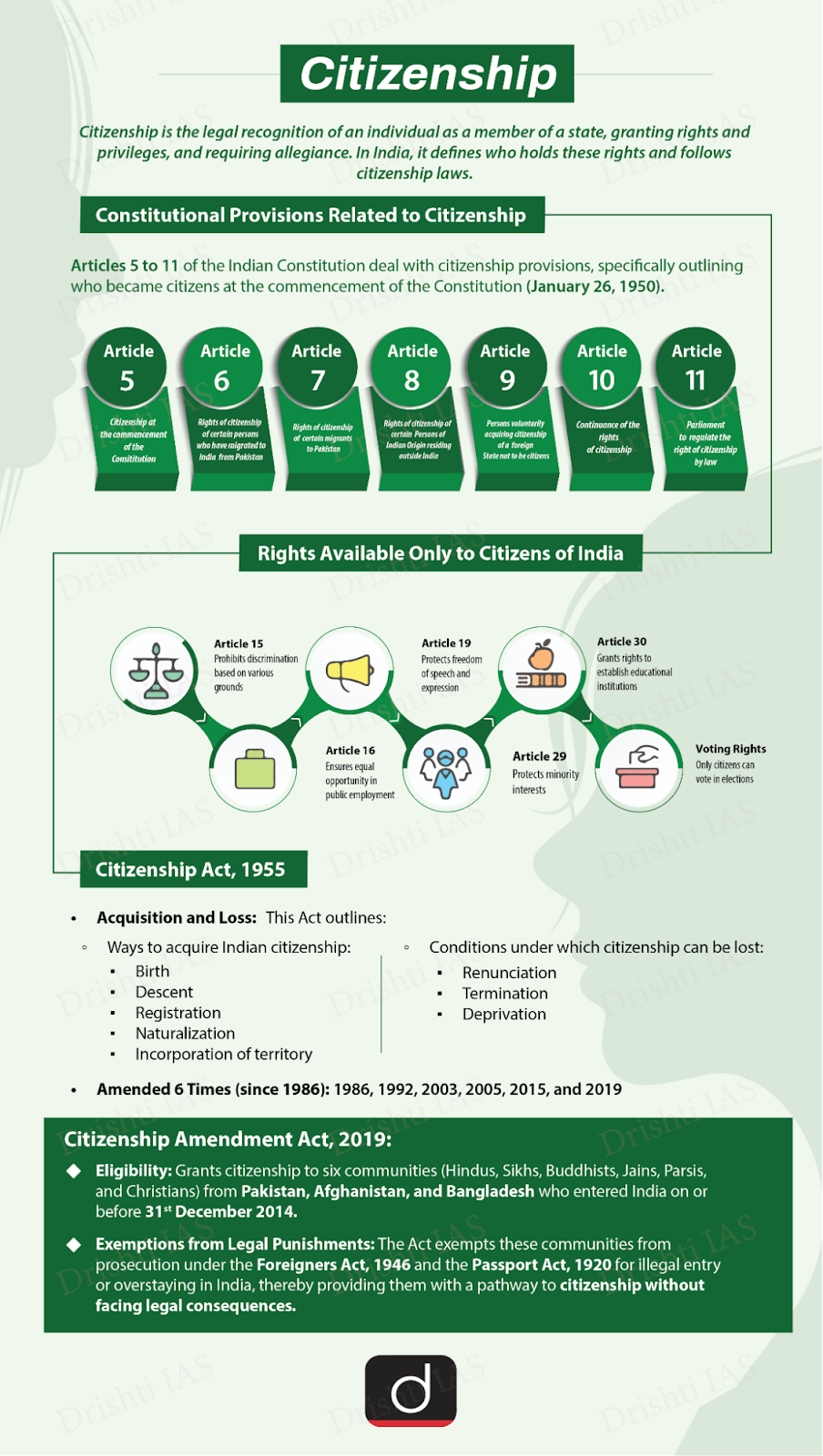
- Section 9, Citizenship Act, 1955: Grants the Centre power to terminate citizenship only in cases where Indian citizens voluntarily acquire foreign citizenship.
- ECI's Clarification: This power is narrow and does not prevent other authorities, including the ECI, from verifying citizenship for purposes such as electoral enrolment.
- Constitutional and Statutory Basis for EC’s Role:
- Article 324: Grants ECI supervisory powers over elections.
- Article 326: Makes Indian citizenship a constitutional requirement to vote.
- Article 327: Allows Parliament to make laws on elections, which must align with ECI’s constitutional authority.
- Representation of the People Act (RPA), 1950:
- Section 16: Non-citizens are disqualified from voter lists.
- Section 19: Voters must be ordinarily resident in their constituency.
- Section 21(3): Empowers ECI to conduct SIR when necessary.
- ECI’s Jurisdictional Limits: The ECI’s role is confined to verifying citizenship for the purpose of including or excluding names in electoral rolls under Sections 16 and 19 of the RPA, 1950.
SIR
- The SIR, under Section 21(3) of the Representation of the People Act, 1950 (RPA), is an intensive revision of electoral rolls prompted by “felt necessities” to maintain accuracy.
- It ensures the purity of rolls, essential for free and fair elections. SIR does not determine citizenship, only verifies voter registration eligibility.
- Controversy: Opposition parties in several states allege SIR of electoral rolls is a covert citizenship test.
| Read More: Special Intensive Revision of Electoral Rolls |



