Governance
11 Years of Pradhan Mantri MUDRA Yojana
For Prelims: Pradhan Mantri Mudra Yojana (PMMY), Small Industries Development Bank of India (SIDBI), Credit Guarantee Fund for Micro Units (CGFMU), Account Aggregator.
For Mains: Significance of PMMY in promoting financial inclusion and entrepreneurship, achievements, and associated challenges.
Why in News?
The Prime Minister of India commended the success of the Pradhan Mantri Mudra Yojana (PMMY) on its 11th anniversary.
Summary
- PMMY has expanded financial inclusion by providing collateral-free loans to micro and small enterprises, boosting entrepreneurship, women's participation, and formalization of the economy.
- Challenges remain in scaling and impact, with issues like dominance of small loans, NPAs, and low value-addition; strengthening through a ‘credit-plus’ approach and Tarun Plus can enable sustainable growth.
What is the Pradhan Mantri MUDRA Yojana (PMMY)?
- About: Launched on 8th April 2015, PMMY is a flagship scheme of the Government of India aimed at providing collateral-free institutional credit to non-corporate, non-farm micro and small enterprises (MSEs).
- Objective: It focuses on promoting self-employment and bringing grassroots entrepreneurs into the formal financial system.
- The scheme acts as a cornerstone for India's financial inclusion program, which is built on three pillars: Banking the Unbanked, Securing the Unsecured, and Funding the Unfunded.
- Implementing Agency: It operates under the Department of Financial Services, Ministry of Finance.
- Funding Provision: Loans are extended by Member Lending Institutions (MLIs) such as Scheduled Commercial Banks (SCBs), Regional Rural Banks (RRBs), Non-Banking Financial Companies (NBFCs), and Micro Finance Institutions (MFIs).
- MUDRA (Micro Units Development & Refinance Agency Ltd.), a subsidiary of SIDBI, provides refinance support to these lending institutions but does not lend directly to borrowers.
- Credit Guarantee: The Credit Guarantee Fund for Micro Units (CGFMU) provides guarantee coverage for PMMY loans, mitigating the risk for lending institutions.
- Eligible Beneficiaries: Include individuals, proprietary concerns, partnership firms, private and public limited companies, and other legal entities.
- MUDRA Card: It provides a flexible, hassle-free credit facility to meet the working capital needs of small entrepreneurs.
- It functions as a RuPay debit card with an overdraft feature, allowing easy withdrawals, payments, and cost-effective credit usage.
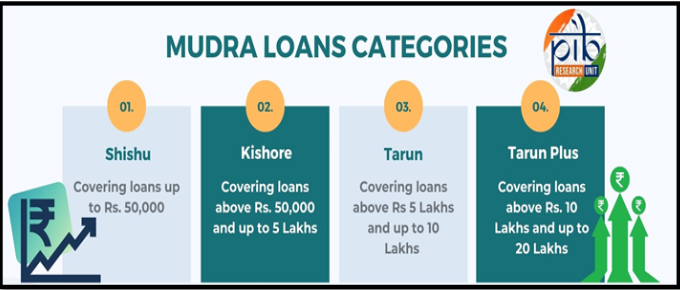
- Loan Categories under PMMY:
|
Category |
Loan Amount Range |
Share in Total Loans |
Purpose |
|
Shishu |
Up to Rs 50,000 |
74% |
Starting a business (very small scale, basic setup) |
|
Kishor |
Rs 50,000 – Rs 5 lakh |
24% |
Expanding early-stage business (buying tools, inventory) |
|
Tarun |
Rs 5 lakh – Rs 10 lakh |
2% |
Scaling established business (increase production, hire workers) |
|
Tarun Plus |
Rs 10 lakh – Rs 20 lakh |
0.004% |
Announced in the Union Budget 2024–25 it strengthens the objective of “Funding the Unfunded” by enabling further expansion of successful businesses that have already repaid their Tarun loans. |
What are the Key Achievements of PMMY?
- Massive Credit Outreach: Over the past decade, the scheme has sanctioned over 57 crore loans amounting to more than Rs. 40.07 lakh crore.
- Promoting Women Entrepreneurship: The scheme has been a major driver of Nari Shakti; women account for 67% (two-thirds) of all loan beneficiaries.
- Empowering Marginalized Communities: PMMY promotes social equity, with over 51% of the beneficiaries belonging to Scheduled Castes (SC), Scheduled Tribes (ST), and Other Backward Classes (OBC).
- Transition to Formal Economy: Over 12 crore accounts belong to first-time entrepreneurs, successfully pulling them out of the informal credit networks of local moneylenders and integrating them into the formal banking system.
- Unprecedented Scale: Since its inception in the 2015-16 financial year, the scheme has grown consistently, peaking at 6.67 crore loans sanctioned in 2023-24 ( Rs 5.41 lakh crore) and maintaining strong numbers with Rs 5.65 lakh crore sanctioned by March 2026.
- Vision for 2047: The continued financial security and confidence instilled by these 57.79 crore loans align directly with the government's goal of achieving inclusive growth and transitioning India into a developed nation (Viksit Bharat) by 2047.
What are the Challenges Associated with the PMMY?
- Structural Asymmetry: Historically, over 70% of the loan volume has remained clustered in the 'Shishu' category.
- This indicates a failure to graduate micro-units into sustainable small and medium enterprises, perpetuating a "missing middle" in India's industrial landscape and stalling upward economic mobility.
- Credit-Absorption Capacity Deficit: The scheme heavily prioritizes capital infusion but overlooks the borrower's credit-absorption capacity.
- Without concurrent capacity building (financial literacy, business acumen, market access), borrowers often fail to deploy funds productively, leading to high micro-enterprise mortality rates.
- Sectoral Skewness and Low Value-Addition: MUDRA loans are predominantly concentrated in the trading and services sectors, with negligible penetration in manufacturing.
- This structural bias limits the employment multiplier effect and contributes minimally to Gross Fixed Capital Formation (GFCF).
- Rising Non-Performing Assets (NPAs): Due to the collateral-free nature of the loans and occasionally inadequate creditworthiness checks, NPAs and loan defaults remain a concern for public sector banks.
- Debt-Substitution vs. Asset Creation: A significant portion of the credit disbursed is utilized by beneficiaries to refinance existing, high-cost debt from informal moneylenders rather than for capital expenditure or creating new productive assets, thereby dampening the scheme's intended economic impact.
What Measures can Strengthen PMMY?
- Transition to Cash-Flow Based Lending: Banks must leverage India’s Digital Public Infrastructure (DPI), specifically the Account Aggregator (AA) framework and GST Network (GSTN), to shift from traditional, collateral-focused lending to dynamic, cash-flow-based credit assessment.
- This allows for real-time monitoring of business health and mitigates NPA risks.
- Adopting a 'Credit-Plus' Approach: Policy must pivot from mere "credit dispensation" to holistic "enterprise development."
- This requires institutional convergence between PMMY and platforms like ONDC (Open Network for Digital Commerce) and the Skill India Mission to provide borrowers with end-to-end handholding, from skill upgradation to market linkages.
- Granular End-Use Monitoring: Lending institutions should deploy data analytics and AI-driven Early Warning Signals (EWS) to track the end-use of disbursed funds.
- This will prevent the diversion of business loans toward personal consumption and identify financial stress before accounts turn into NPAs.
- Incentivizing Micro-Manufacturing: To align MUDRA with the broader goals of 'Make in India' and demographic dividend utilization, specialized incentives (such as enhanced interest subventions or priority guarantee coverage) should be introduced explicitly for micro-manufacturing units.
- Deepening NBFC and MFI Integration: Traditional commercial banks often lack the underwriting models for the informal sector.
- The scheme must further empower Non-Banking Financial Companies (NBFCs) and Micro Finance Institutions (MFIs), which possess superior "last-mile" connectivity and specialized expertise in grassroots credit appraisal.
Conclusion
PM MUDRA Yojana has expanded access to the unfunded sector, promoting enterprise, earning, and empowerment (3Es). Through a credit-plus approach and initiatives like Tarun Plus, it enables small units to grow and create jobs. Overall, it strengthens financial inclusion, inclusive growth, and the vision of Atmanirbhar Bharat.
|
Drishti Mains Question: Discuss the significance of the Pradhan Mantri MUDRA Yojana (PMMY) in driving financial inclusion and women empowerment in India. |
Frequently Asked Questions (FAQs).
1. What is Pradhan Mantri MUDRA Yojana (PMMY)?
It is a flagship scheme (2015) providing collateral-free loans to non-corporate, non-farm micro and small enterprises.
2. What are the loan categories under PMMY?
Shishu (up to ₹50,000), Kishor (₹50,000–₹5 lakh), Tarun (₹5–10 lakh), and Tarun Plus (₹10–20 lakh).
3. What is the role of MUDRA Ltd.?
It provides refinance support to lending institutions but does not lend directly to borrowers.
4. What is the significance of PMMY?
It promotes financial inclusion, women entrepreneurship (67% beneficiaries), and formalization of the informal sector.
5. What are the major challenges of PMMY?
Dominance of small loans, rising NPAs, low manufacturing share, and weak credit absorption capacity.
UPSC Civil Services Examination, Previous Year Question (PYQ)
Prelims
Q. Pradhan Mantri MUDRA Yojana is aimed at (2016)
(a) bringing the small entrepreneurs into formal financial system.
(b) providing loans to poor farmers for cultivating particular crops.
(c) providing pensions to old and destitute persons.
(d) funding the voluntary organizations involved in the promotion of skill development and employment generation.
Ans: (a)
International Relations
Role of Mediation in US–Iran Ceasefire
For Prelims: 2026 West Asia crisis, Mediation, Strait of Hormuz, Permanent Court of Arbitration, United Nations
For Mains: Significance of the US–Iran Ceasefire for India, Relevance of Mediation in International Relations, India’s Approach to International Mediation
Why in News?
The US and Iran have agreed to a two-week ceasefire to the 2026 West Asia crisis, facilitated through mediation by Pakistan, easing tensions and reopening the Strait of Hormuz while underscoring the importance of mediation in resolving complex global conflicts.
Summary
- The US–Iran ceasefire (Islamabad Accord) eased global tensions, reopened the Strait of Hormuz, and prevented an energy and economic crisis for India while ensuring safety of its diaspora.
- Mediation acted as a key conflict-resolution tool by breaking escalation, stabilizing the global economy, and enabling dialogue, though challenges like sovereignty concerns and lack of enforcement remain.
What is the Significance of the US–Iran Ceasefire for India?
- The US–Iran Ceasefire: The deal, tentatively dubbed the “Islamabad Accord,” marks a significant breakthrough with a two-week ceasefire between the United States, Israel, and Iran after weeks of intense military escalation.
- Brokered by Pakistan, it emerged from competing proposals, with the U.S. offering a 15-point plan and Iran countering with a 10-point framework seeking sanctions relief and regional de-escalation.
- At its core lies a strategic economic trade-off: the US paused military strikes in exchange for Iran reopening the Strait of Hormuz, helping restore disrupted global energy supply and trade flows.
- Significance for India:
- Averting a Crippling Energy Crisis: India is heavily dependent on the Gulf, importing roughly 60% of its energy needs from the region. Iran’s closure of the Strait of Hormuz had practically blocked this supply line.
- The reopening of the Strait prevents severe energy shortages, spiralling fuel prices, and a broader economic slowdown.
- Safety of the Diaspora and Remittances: The Gulf region is home to approximately 1 crore (10 million) Indians, making it the largest concentration of the Indian diaspora globally.
- They are crucial to the Indian economy, contributing almost 40% of the country’s total inward remittances.
- A protracted war would have threatened their lives (eight Indians had already died in the crossfire) and forced India into a massive, logistically near-impossible evacuation operation.
- Averting a Crippling Energy Crisis: India is heavily dependent on the Gulf, importing roughly 60% of its energy needs from the region. Iran’s closure of the Strait of Hormuz had practically blocked this supply line.
What is the Role of Mediation in the 2026 West Asia Conflict?
- Acts as the Ultimate "Circuit Breaker": When heavily armed nations are trapped in an escalation cycle, neither wants to be the first to blink. Mediation provided the necessary pause (the two-week ceasefire).
- Rescues the Global Economy: The Strait of Hormuz is the choke point for a fifth of the world's energy.
- Mediation prevents a massive global oil shock that would have crippled energy-dependent economies like India's.
- Bypasses a Paralyzed UN Security Council: In this era, traditional mechanisms of global peace (like the UN) are frequently deadlocked by superpower vetoes.
- Informal, agile mediation is proving to be the only functional tool for immediate, real-world conflict resolution.
- Elevates "Middle Powers" to Peacemakers: The crisis highlights a massive shift in the global order.
- Superpowers are no longer the only ones brokering peace. Middle powers like Pakistan and potentially China or Gulf states are highly relevant because they can leverage their unique transactional, economic, and military ties with both sides to force a dialogue.
- Provides a "Face-Saving" Exit: In hyper-nationalist political climates, direct surrender is political suicide. Mediation allowed both the US President and the Iranian Supreme Leader to sell the ceasefire as a "diplomatic victory" to their domestic audiences, rather than a retreat.
What is Mediation in International Relations?
- Mediation: It is a peaceful method of dispute resolution that involves a third party facilitating dialogue between conflicting sides. It aims to reduce tensions and help reach mutually acceptable agreements.
- With roots dating back nearly 4000 years, mediation continues to be a central tool in diplomacy and global governance.
- Theoretical Foundations of Mediation:
- The Contingency Model: Developed by Jacob Bercovitch, this model argues that successful mediation depends on the nature of the conflicting parties, the characteristics of the dispute, and the mediator's credibility, intelligence, and patience.
- The Theory of Ripeness: Introduced by I. William Zartman, this theory posits that mediation only works when a conflict is "ripe" for resolution, specifically when both sides reach a "Mutually Hurting Stalemate" where continuing the conflict costs more than ending it (e.g., the 1979 Lancaster House Agreement for Zimbabwe's independence).
- Biased Mediation: This concept challenges the idea that mediators must be perfectly neutral. Often, a mediator's power, economic leverage, and ability to offer incentives or exert pressure are more important than strict neutrality.
- International Legal Framework for Mediation:
- Hague Conventions (1899 & 1907): These foundational treaties legitimized third-party involvement in disputes and established the Permanent Court of Arbitration (PCA), laying the groundwork for modern peaceful conflict resolution.
- UN Charter (Chapter VI, Article 33): The United Nations explicitly mandates that conflicting parties must first seek solutions through peaceful means, including negotiation, conciliation, and mediation.
- The UN General Assembly Resolution 65/283 (2011) and the 2012 UN Guidance for Effective Mediation outline key principles such as inclusivity, consent, impartiality, and national ownership.
- The UN frequently pairs mediation initiatives with its peacekeeping operations (having launched over 70 missions since 1948) to maintain stability while talks progress.
- Examples of Successful Mediation:
- Opening Backchannels: Norway successfully facilitated the secret Oslo backchannel negotiations between Israel and Palestine, opening lines of communication that were absent during the open conflict.
- Creating Political Space: The US brought deep enemies Egypt and Israel together to sign the Camp David Accords in 1978.
- Managing Time and Information: The US -led Dayton Agreement (1995) in Bosnia utilized tightly controlled negotiations to end the war.
- Building Trust and Power-Sharing: Former US Senator George Mitchell built crucial trust to secure the Good Friday Agreement (1998) in Northern Ireland, while Kofi Annan’s intervention in Kenya (2008) prevented further instability through a power-sharing pact.
- Reshaping Perceptions: The Colombian Peace Process (2016) successfully shifted the focus from military approaches to political solutions.
What is India’s Approach to International Mediation?
- Bilateralism as a Priority: India firmly rejects third-party mediation in neighborhood disputes to prevent the internationalization of sensitive issues like Kashmir, strictly adhering to bilateral frameworks established by the Shimla Agreement (1972) and the Lahore Declaration (1999).
- Selective Mediation by India: India follows a pragmatic approach to mediation. It supports UN-led or multilateral mediation and promotes dialogue and diplomacy in broader global crises, such as those in West Asia.
- At the same time, India clearly distinguishes between general international conflicts where mediation may be acceptable and core issues of national sovereignty, where any external mediation is firmly rejected.
- Strategic Autonomy: Rooted in its legacy of Non-Alignment, India avoids alignment with power blocs, ensuring it retains independent diplomatic engagement and high policy flexibility.
- India’s Role as a Facilitator: Leveraging its growing global stature and ties across divides (e.g., Iran and Israel), India prefers acting as a neutral dialogue facilitator rather than an assertive mediator.
- Historical Precedent: India successfully established its global mediation credibility during the Korean War by advocating for a ceasefire at the UN, chairing the Neutral Nations Repatriation Commission (NNRC), and deploying the Custodian Force of India (CFI).
- India's foreign policy consistently champions diplomatic engagement and absolute respect for sovereignty and territorial integrity over military escalation.
What are the Concerns with International Mediation?
- Sovereignty Concerns: States often resist third-party involvement, viewing mediation as interference in internal or bilateral matters and a threat to national autonomy.
- Trust Deficit & Mediator Bias: Mediation depends on neutrality, but mediators may have geopolitical or strategic interests, leading to mistrust among parties.
- Lack of Enforcement: Mediated agreements rely on voluntary compliance, with no binding enforcement mechanism, making them fragile and reversible.
- Power Asymmetry: Unequal power between parties can skew outcomes, allowing stronger states to impose unfair terms, resulting in temporary rather than durable peace.
- Geopolitical Complexity: Involvement of multiple actors, major powers, proxies, and non-state groups makes consensus difficult and prolongs conflicts.
- Mediation as a Delay Strategy: Parties may use mediation to buy time for regrouping, rearming, or reducing external pressure instead of genuinely pursuing peace.
What Measures can Strengthen International Mediation?
- Strengthen Multilateral Frameworks: Promote mediation through institutions like the United Nations and regional bodies such as ASEAN and African Union for greater legitimacy and contextual understanding.
- Promote Multi-Track Diplomacy: Combine official (Track I) negotiations with informal dialogues (Track II) and grassroots efforts (Track III) to build trust at multiple levels.
- Ensure Inclusivity: Include women, youth, and marginalized groups, in line with UN Security Council Resolution 1325, to achieve more sustainable peace outcomes.
- Create Incentives for Compliance: Link agreements with incentives like reconstruction aid, debt relief, and phased sanctions removal to ensure adherence.
- Professionalize Mediation: Develop trained mediators with expertise in negotiation, international law, and cultural sensitivity to enhance credibility and effectiveness.
- Address Root Causes: Move beyond ceasefires to tackle underlying issues such as inequality, resource conflicts, and historical grievances for long-term peace.
Conclusion
In the 2026 West Asia Crisis, mediation is functioning as the critical "circuit breaker." It is transforming a dangerous military standoff into a diplomatic process, substituting the exchange of missiles for the exchange of proposals. While it does not guarantee permanent peace, it successfully converts an acute, immediate crisis into a manageable political negotiation.
|
Drishti Mains Question: “Mediation is emerging as the most effective tool for conflict resolution in a multipolar world.” Discuss |
Frequently Asked Questions (FAQs)
1. What is mediation in international relations?
Mediation is a peaceful dispute resolution method where a third party facilitates dialogue to help conflicting sides reach an agreement.
2. What is Article 33 of the UN Charter?
It mandates peaceful settlement of disputes through methods like negotiation, mediation, arbitration, and judicial settlement.
3. What is the Theory of Ripeness?
Proposed by I. William Zartman, it states that mediation works when parties reach a “Mutually Hurting Stalemate.”
4. Why is the Strait of Hormuz important?
It is a critical chokepoint through which nearly one-fifth of global energy supplies pass, making it vital for global energy security.
5. How does mediation benefit India in the West Asia crisis?
It ensures energy supply stability, protects the Indian diaspora, and prevents economic disruption.
Important Facts For Prelims
India’s Fisheries Sector
Why in News?
India has emerged as the world’s 2nd-largest fish-producing nation (after China), accounting for approximately 8% of global output and establishing the fisheries sector as the fastest-growing segment within agriculture and allied activities.
What are the Key Facts Regarding India's Fisheries Sector?
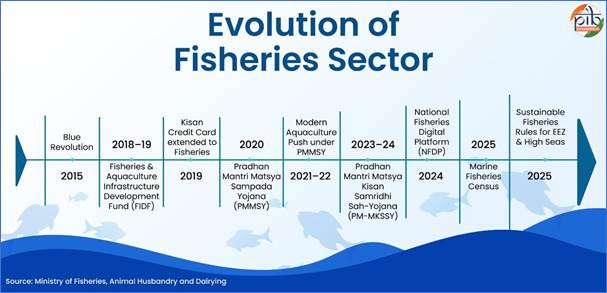
- Economic Contribution: Fisheries account for 7.43% of Agricultural Gross Value Added (GVA), with total production doubling to 197.75 lakh tonnes in FY 2024–25.
- Export Performance: Seafood exports reached Rs 62,408 crore in FY 2024–25, dominated by frozen shrimp, with the US and China as primary markets.
- Budgetary Support: The Union Budget 2026–27 allocated a record Rs 2,761 crore to the sector, with Rs 2,500 crore specifically earmarked for the Pradhan Mantri Matsya Sampada Yojana (PMMSY).
- Infrastructure & Credit: The Fisheries and Aquaculture Infrastructure Development Fund (FIDF) and the extension of Kisan Credit Cards (KCC)—with limits raised to Rs 5 lakh—have institutionalized credit and boosted processing capabilities.
- Technological Shift: Rapid adoption of high-efficiency models like Recirculatory Aquaculture Systems (RAS) and Bio-floc technology is driving sustainable, high-density farming.
- RAS is a high-density fish farming technology that uses a closed-loop filtration system to treat and continuously reuse water, minimizing environmental impact and land requirements.
- Bio-floc Technology is a sustainable aquaculture method where a carbon source is added to the water to grow beneficial microbial protein (floc), which simultaneously treats waste and serves as a direct food source for the fish.
- Digital Governance: The National Fisheries Digital Platform (NFDP), launched in 2024, provides digital identities to over 30 lakh stakeholders, streamlining access to insurance and subsidies.
- Formalization: The Pradhan Mantri Matsya Kisan Samridhi Sah-Yojana (PM-MKSSY), with an outlay of Rs 6,000 crore, focuses on formalizing the unorganized fisheries value chain and enhancing traceability.
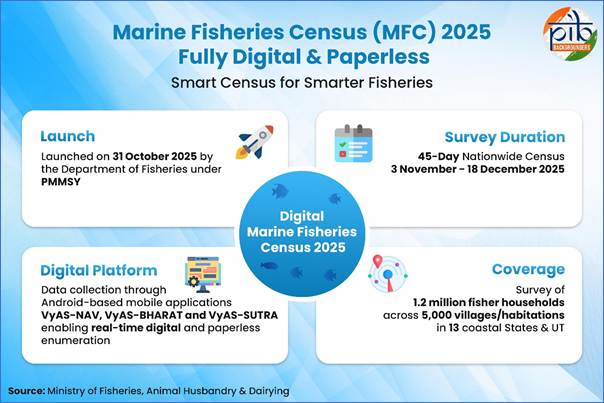
- Resource Management: The Marine Fisheries Census 2025 and new rules for the Exclusive Economic Zone (EEZ) ensure data-driven governance and alignment with Sustainable Development Goal 14 (Life Below Water).
- Inland Potential: Integration of 500 reservoirs and 1,222 Amrit Sarovars into the fisheries value chain is targeting rural livelihood diversification.
- Fisheries-related schemes since 2014–15 have generated an estimated 74.66 lakh direct and indirect employment opportunities.
- Regulatory Framework: The 2025 Rules for Sustainable Harnessing of Fisheries in the EEZ and High Seas ensure international compliance and long-term resource security for India's 24 lakh sq. km EEZ.
What is Pradhan Mantri Matsya Sampada Yojana?
- About: PMMSY is a flagship scheme launched in September 2020 to bring about a "Blue Revolution" through the sustainable and responsible development of the fisheries sector in India.
- It is implemented by the Department of Fisheries (Ministry of Fisheries, Animal Husbandry, and Dairying) and was originally designed for a five-year period (FY 2020-21 to FY 2024-25). It is extended up to 2025-26.
- The government has further introduced the Pradhan Mantri Matsya Kisan Samridhi Sah-Yojana (PMMKSSY). This is a sub-scheme of PMMSY focused specifically on formalizing the unorganized fisheries sector and supporting micro-enterprises with an additional investment of over Rs. 6,000 crore.
- It is being implemented for 4 years from FY 2023-24 to FY 2026-27 across all the States and UTs.
- Financial Allocation: PMMSY has a total estimated investment of Rs 20,050 crore. It operates as an umbrella scheme with two main components:
- Central Sector Scheme (CS): Fully funded by the Central Government.
- Centrally Sponsored Scheme (CSS): Jointly funded by the Centre and States/UTs, further divided into beneficiary-oriented and non-beneficiary-oriented activities.
- General Category: 40% subsidy for individuals/groups.
- SC/ST/Women Category: 60% subsidy to encourage inclusive growth.
- Core Components: The PMMSY focuses on several "activity clusters" to modernize the sector:
- Inland & Marine Fisheries: Promoting cage culture, seaweed farming, and ornamental fisheries.
- Technology Infusion: Support for modern systems like RAS and Bio-floc technology.
- Infrastructure: Building "Fishing Harbours," "Landing Centers," and "Cold Chain" facilities to improve market links.
- Fisher Welfare: Providing insurance coverage for fishing vessels and fishers, as well as support during "lean periods" (fishing bans).
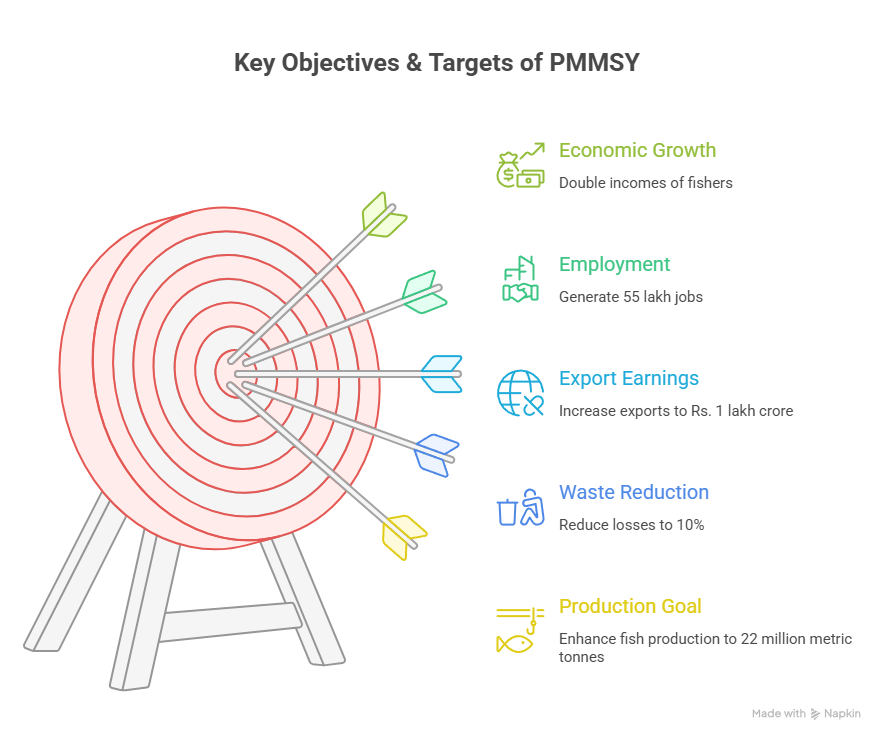
- Key Objectives & Targets:
Frequently Asked Questions (FAQs)
1. What is the significance of the fisheries sector to India's Agricultural GVA?
Fisheries contribute 7.43% to the Agricultural GVA, making it the fastest-growing allied sector and a critical pillar for rural employment and nutritional security.
2. How do RAS and Bio-floc technologies support sustainable aquaculture?
RAS conserves water through closed-loop filtration, while Bio-floc converts organic waste into nutrient-rich feed; both enable high-density farming with minimal environmental footprints.
3. What is the primary focus of the PM-MKSSY sub-scheme?
It is a Central Sector sub-scheme aimed at formalizing the unorganized fisheries sector, enhancing traceability, and supporting micro-enterprises through a ₹6,000 crore outlay.
UPSC Civil Services Examination Previous Year Question (PYQ)
Q. Under the Kisan Credit Card scheme, short-term credit support is given to farmers for which of the following purposes? (2020)
- Working capital for maintenance of farm assets
- Purchase of combine harvesters, tractors and mini trucks
- Consumption requirements of farm households
- Post-harvest expenses
- Construction of family house and setting up of village cold storage facility
Select the correct answer using the code given below:
(a) 1, 2 and 5 only
(b) 1, 3 and 4 only
(c) 2, 3, 4 and 5 only
(d) 1, 2, 3, 4 and 5
Ans: (b)

Rapid Fire
CAPF (General Administration) Act, 2026
The notification of the Central Armed Police Forces (General Administration) Act, 2026, has triggered protests by retired personnel and families, raising concerns over service conditions, cadre rights, and leadership structure in India’s internal security forces.
- Protests: Demonstrations were held at Raj Ghat on 9th April 2026 coinciding with CRPF Valour Day (commemorating the 1965 Battle of Rann of Kutch). Protesters are demanding the restoration of the Old Pension Scheme (OPS), time-bound promotions, and dignified career progression.
CAPF (General Administration) Act, 2026
- The Act legally cements the reservation of top leadership posts for Indian Police Service (IPS) officers across all five CAPFs (BSF, CRPF, CISF, ITBP, and SSB). Specifically, it mandates:
- 50% of posts at the Inspector General (IG) rank.
- At least 67% of posts at the Additional Director General (ADG) rank.
- 100% of posts at the Special DG and Director General (DG) ranks.
- The legislation designates the Ministry of Home Affairs (MHA) as the defining administrative body. It states that rules made under this Act regarding recruitment, deputation, and service conditions will explicitly override any other existing laws, orders, or court judgments.
- Govt Rationale: The Centre argues that because CAPFs must frequently work in close coordination with state police and civil administrations (which are led by IPS and IAS officers), having IPS officers lead the CAPFs ensures smooth operational synergy.
- The government claims the umbrella law is necessary to provide legislative clarity and preserve the operational distinctiveness of the forces.
- Concerns: The CAPF personnel argue that the Act undermines the 2025 Supreme Court directive asking the Centre to “progressively reduce” IPS deputation up to the IG rank within two years, impacting force morale.
- Around 13,000 Group A officers face severe promotion delays, often waiting 15–18 years due to limited senior posts. They also highlight that CAPF officers handle frontline combat while IPS officers occupy senior roles.
| Read more: Central Armed Police Force (CAPF) |

Rapid Fire
8th Poshan Pakhwada
The Ministry of Women and Child Development has launched the 8th edition of Poshan Pakhwada (9th April to 23th April, 2026), a fortnightly nationwide campaign, to institutionalize nutrition and early childhood care as a Jan Andolan (People's Movement).
- Core Theme: The 2026 edition focuses on “Maximizing Brain Development in the First Six Years of Life,” acknowledging that over 85% of brain development occurs by age 6.
- The campaign emphasizes that the first 1,000 days are the most critical period for physical growth, mental well-being, and cognitive mapping.
- Mission Poshan 2.0: Observed under the umbrella of Mission Poshan 2.0, the initiative seeks to converge efforts across all Union Ministries and States to improve nutritional outcomes through Jan Bhagidari (Community Participation).
- It is part of Poshan Abhiyaan launched in 2018 to improve nutritional outcomes in the country.
- Strategic Focus Areas:
- Maternal and Child Nutrition: Promotion of exclusive breastfeeding and age-appropriate complementary feeding.
- Early Stimulation (0–3 years): Advocacy for responsive caregiving and early learning interactions.
- Play-Based Education (3–6 years): Transitioning toward school readiness through holistic developmental activities.
- Lifestyle Management: Encouraging parents and communities to minimize screen time for young children.
- Reach and Scale: The campaign mobilizes Anganwadi Workers, ASHAs, Auxiliary Nurse-Midwife (ANM), and Self-Help Groups (SHGs) to take the vision of a Viksit Bharat to every household.
- India’s 14 lakh Anganwadi Centres currently serve nearly 8.9 crore beneficiaries, including pregnant women, lactating mothers, and adolescent girls.
- Aspirational Districts: Special emphasis is placed on strengthening performance and adopting best practices in Aspirational Districts to bridge developmental gaps.
| Read More: Poshan Abhiyan |

Rapid Fire
Hydropower Projects in Arunachal Pradesh
Recently, the Cabinet Committee on Economic Affairs approved investments of about ₹40,175 crore for two major hydroelectric projects in Arunachal Pradesh—the 1,720 MW Kamala Hydro Electric Project and the 1,200 MW Kalai‑II Hydro Electric Project.
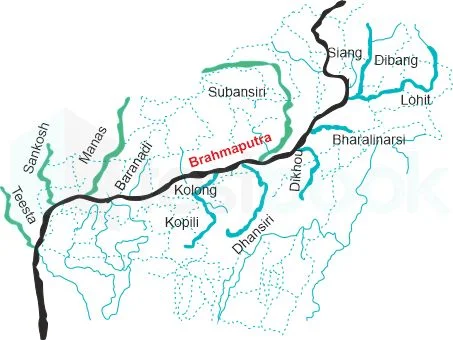
- Kamala Project: The Kamala project, on the Kamala River(tributary of the Subansiri River) across Kamle, Kra Daadi and Kurung Kumey districts, is expected to generate about 6,870 million units annually and will be developed by NHPC Limited in a joint venture with the Arunachal Pradesh Government.
- Kalai-II Project: The Kalai‑II project, on the Lohit River(a major tributary of the Brahmaputra) in Anjaw district, is expected to generate around 4,853 million units annually and will be implemented as a joint venture between THDC India Ltd and the State Government.
- Significance: Arunachal Pradesh will receive 12% free power along with an additional 1% earmarked for the Local Area Development Fund (LADF).
- The projects will support peak demand management, grid balancing, renewable energy integration, and flood moderation in the Brahmaputra basin, thereby strengthening India’s clean energy capacity and promoting the strategic development of the Northeast region.
| Read more: India's Water Stress and Hydropower |
Rapid Fire
National Maritime Day
Recently, the 63rd National Maritime Day was observed on 5th April 2026, highlighting India’s rich maritime heritage and the contribution of the maritime sector to trade and connectivity.
- Historical Significance: The day commemorates the maiden voyage of SS Loyalty (1919), the first Indian-owned ship to sail from Mumbai to London, marking the beginning of India’s indigenous shipping industry led by pioneers like Walchand Hirachand.
- The day also marks the culmination of Merchant Navy Week, celebrated since 1964.
- Recognition of Seafarers: It honours the contribution of seafarers and maritime stakeholders towards the growth of India’s shipping industry.
- Awards: The Sagar Samman Awards are conferred to recognise outstanding contributions in the maritime sector.
- International Conventions: India is a signatory to key maritime conventions:
- STCW Convention (1978): Sets global standards for training, certification and watchkeeping of seafarers.
- Maritime Labour Convention (2006): Ensures standards for working and living conditions of seafarers.
- Significance: Around 90% of India’s trade by volume and about 77% by value is carried through maritime routes, underscoring the sector’s importance for economic growth, connectivity and strategic security.
| Read more: 61st National Maritime Day |