


Important Facts For Prelims
White-bellied Heron and Kalai-II Project
- 09 Jan 2026
- 6 min read
Why in News?
The environmental clearance (EC) for the 1,200-MW Kalai-II hydropower project on the Lohit River in Arunachal Pradesh (AR) has triggered concerns over serious omissions in the Environmental Impact Assessment (EIA), particularly regarding the critically endangered white-bellied heron.
What are White-bellied Herons?
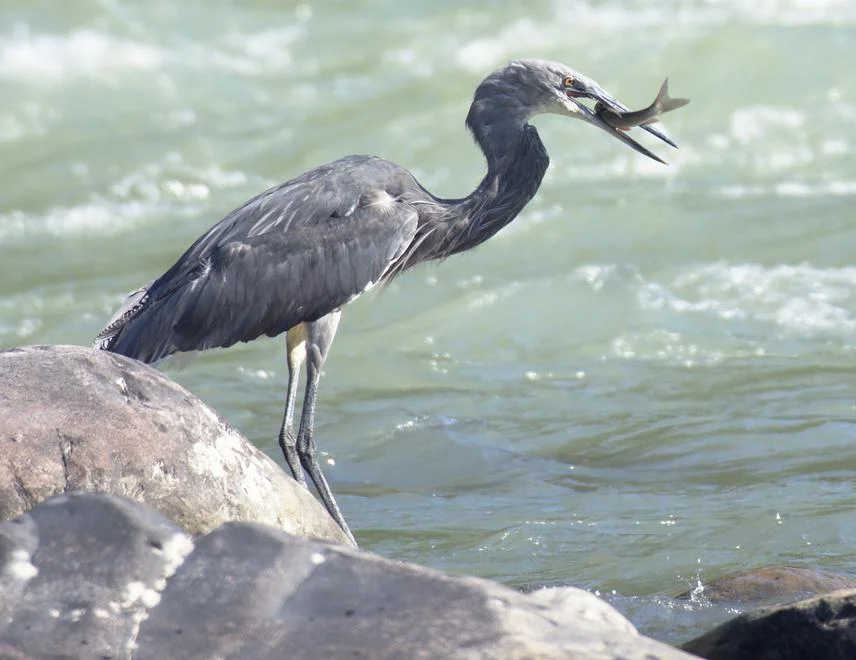
- About: The White-bellied Heron (Ardea insignis), also known as the imperial heron or great white-bellied heron, is a large species of heron in the family Ardeidae. It is recognized as the 2nd-largest heron in the world.
- Habitat: Strictly dependent on free-flowing, fast-flowing eastern Himalayan riverine habitats with low human disturbance. Feeds mainly on fish found in river rapids, making it highly sensitive to dams and flow alterations.
- Morphological Features: Longer, flexible neck with razor-sharp serrated bill for catching fish in deep waters.
- Compact body with shorter legs for stability in fast currents. Extended toes to grip slippery rocks—an adaptation to turbulent river habitats.
- Conservation Status: Critically Endangered species as per the IUCN Red List.
- Schedule-I species (highest legal protection in India) under the Wildlife Protection Act, 1972.
- Global & Regional Population: Distributed across ~165,000 km² of Himalayan freshwater ecosystems spanning Bhutan, India, Myanmar, China, and Bangladesh. Fewer than 60 individuals survive in the wild today.
- Bhutan hosts ~45% of the global population, with 3–5 active breeding pairs, making it the species’ last stronghold.
- It is considered extinct in Nepal and possibly Bangladesh.
- Distribution in India: It is found in Arunachal Pradesh (Lohit, Anjaw, and Changlang districts). Recorded in and around Namdapha Tiger Reserve (AR) and Kamlang Tiger Reserve (AR). Sightings recorded along the entire Lohit River stretch.
- Behavior: It is largely solitary, vocalizing with deep croaks mainly at dawn and dusk, and nests in tall trees.
-
Ecological Significance: It serves as a bio-indicator for the Himalayan freshwater ecosystem, reflecting factors like water quality, fish populations, pollution, and habitat integrity. Its decline signals broader ecosystem degradation and collapsing food chains.
- Major Threats: Hydropower dams (habitat fragmentation, altered river flows), habitat loss, hunting, and anthropogenic disturbances. Very small gene pool and restricted distribution range.
What is the Kalai-II Hydropower Project?
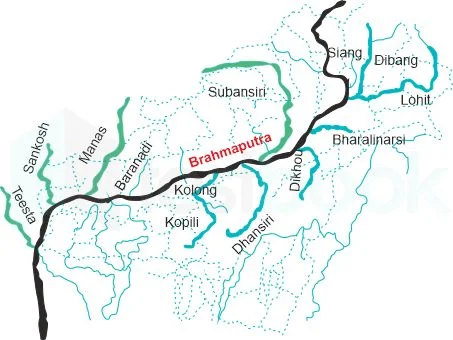
- About: It is a proposed 1,200 MW run-of-river hydroelectric project with pondage (small storage capacity) on the Lohit River, a major tributary of the Brahmaputra, located in Anjaw district, Arunachal Pradesh.
- It is being developed by Tehri Hydro Development Corporation India Limited.
- Development History: Initially allotted to a private developer, the project stalled for years before being revived in 2023–24 and transferred to THDC India Limited by the Arunachal Pradesh government.
- It is among 13 stalled hydropower projects reassigned to central PSUs for faster execution.
Lohit River
- About: The Lohit River is a right-bank tributary of the Brahmaputra River, originating in the Kangri Karpo range of eastern Tibet, where it is known as Zayul Chu.
- Course: It enters India near Kibithu in Arunachal Pradesh (India’s easternmost inhabited point), flows southward through the Mishmi Hills in Anjaw and Lohit districts, and emerges into the Assam plains near Parasuram Kund and Sadiya.
- It flows through protected areas such as Kamlang Wildlife Sanctuary (AR) and Mehao Wildlife Sanctuary (AR).
- Confluence: It joins the Siang (upper Brahmaputra) and Dibang rivers near Kobo in Assam to form the main Brahmaputra stem.
- Hydroelectric Power Projects: Kalai-II Hydroelectric Project (1,200 MW), Demwe Lower Hydroelectric Project (1,750 MW, now stalled), Hutong (proposed), Demwe Upper (proposed).

Frequently Asked Questions (FAQs)
1. What is the conservation status of the White-bellied Heron?
It is Critically Endangered (IUCN Red List) and a Schedule-I species under the Wildlife Protection Act, 1972.
2. Where is the White-bellied Heron found in India?
Mainly in Arunachal Pradesh—Lohit, Anjaw, and Changlang districts, including Namdapha and Kamlang Tiger Reserves.
3. How do hydropower dams threaten the White-bellied Heron?
By altering river flow, fragmenting habitats, reducing fish availability, and increasing human disturbance.
UPSC Civil Services Examination, Previous Year Questions (PYQs)
Q. With reference to India’s Desert National Park, which of the following statements are correct? (2020)
- It is spread over two districts.
- There is no human habitation inside the Park.
- It is one of the natural habitats of Great Indian Bustard.
Select the correct answer using the code given below:
(a) 1 and 2 only
(b) 2 and 3 only
(c) 1 and 3 only
(d) 1, 2 and 3
Ans: (c)
Q. Which one of the following National Parks has a climate that varies from tropical to subtropical, temperate and arctic? (2015)
(a) Khangchendzonga National Park
(b) Nandadevi National Park
(c) Neora Valley National Park
(d) Namdapha National Park
Ans: (d)



