


Biodiversity & Environment
India’s Groundwater Crisis
- 23 Jan 2026
- 15 min read
For Prelims: Groundwater, Sustainable Development Goals, UNESCO, Minimum Support Price (MSP), Southwest Monsoon, Heavy Metals, Jal Jeevan Mission, Central Ground Water Board (CGWB), PMKSY, Atal Bhujal Yojana, Direct Benefit Transfer (DBT), VB-G RAM G.
For Mains: Key facts regarding groundwater and reasons for its exploitation, Steps taken by the government for groundwater conservation and further steps needed.
Why in News?
Groundwater is central to India’s water security, supporting agriculture and drinking water needs, but escalating extraction and quality deterioration demand urgent and sustainable management.
Summary
- Groundwater supplies 62% irrigation, 85% rural and 50% urban water needs, yet faces depletion and contamination.
- Drivers include free electricity, water-intensive cropping, urbanization, climate change, and weak legal framework.
- Government measures include the Model Groundwater Bill, JSA: CTR, JSJB, NAQUIM 2.0, Atal Bhujal Yojana, and Mission Amrit Sarovar.
What are Key Facts Regarding Groundwater?
- About: Groundwater is freshwater stored in underground layers called aquifers, making up nearly 99% of Earth's liquid freshwater. It can seep into the ground, be extracted through wells, and emerge naturally.
- Groundwater Dependency: In India, groundwater serves as the primary foundation of agricultural activity and drinking water supply, meeting nearly 62% of irrigation needs, 85% of rural consumption, and 50% of urban demand.
- Status of India's Groundwater Usage: Annual groundwater extraction is 245.64 BCM (Billion Cubic Meters), representing a national extraction rate of 60.47% and indicating aggregate use remains within the annual replenishment capacity.
- Total annual recharge is 446.90 BCM and has shown a consistent upward trend since 2017 due to conservation efforts.
- Governance & Management: Water governance primarily rests with State Governments, while the Central Government provides facilitative support through technical and financial schemes.
- This cooperation is essential for advancing Sustainable Development Goals, 6 (Clean Water and Sanitation), 11 (Sustainable Cities and Communities), and 12 (Responsible Consumption and Production).
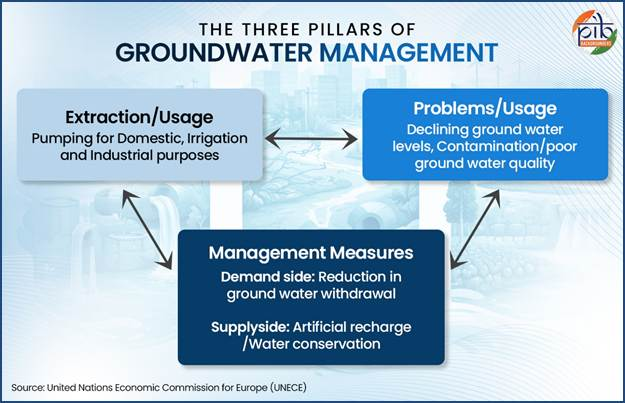
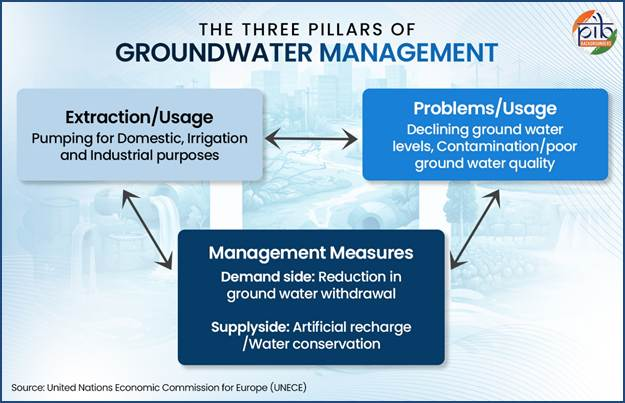
- Core foundations of groundwater management are the functions and uses of groundwater (aquifers), the problems and pressures (threats), and the impact of management measures.
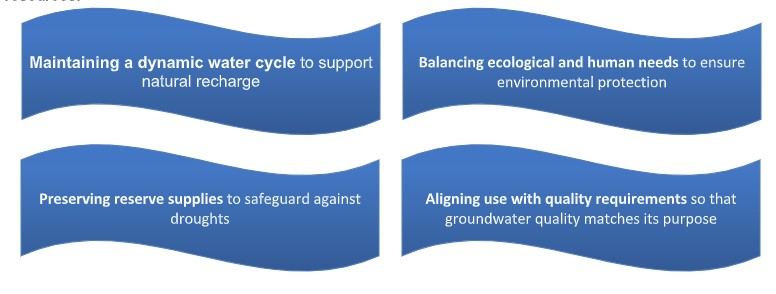
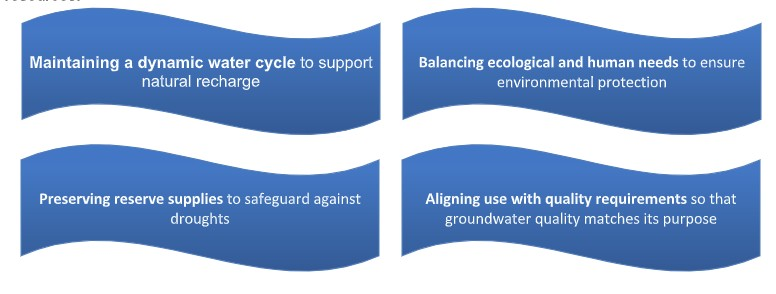
- As per UNESCO, effective groundwater management needs 4 key priorities, which are:
What are the Key Factors Driving Groundwater Depletion in India?
- Distorted Economic and Policy Incentives: Free electricity for agriculture incentivizes unregulated groundwater pumping, while the Minimum Support Price (MSP) system favors water-intensive crops like paddy and sugarcane. This creates a policy-driven incentive to deplete aquifers for farming.
- Demographic and Urban Pressures: Rapid urbanization and population growth (from 1.29 to 1.45 billion between 2016–2023) convert natural recharge zones into impermeable surfaces. This "concrete sealing" drastically reduces rainwater infiltration while concentrated urban and industrial pumping creates severe cones of depression, leading to land subsidence in cities like Chennai and Delhi.
- Climate Change and Hydrological Disruption: Climate change is altering the Southwest Monsoon, which provides ~60% of India's recharge, by increasing rainfall variability and reducing aquifer replenishment. Simultaneously, rising temperatures increase evaporation and crop water demand, creating a vicious cycle where climate adaptation accelerates groundwater depletion.
- Pervasive Contamination: Fertilizer runoff and industrial effluents, such as those from Kanpur's tanneries, contaminate aquifers with nitrates, heavy metals (like chromium, uranium, and lead), and fluoride, making water unsafe in many areas. In coastal Gujarat, over-pumping combined with rising sea levels causes saline intrusion, contaminating freshwater aquifers in 28 out of 33 districts.
- Archaic Legal Framework: The core of the governance failure stems from the Indian Easements Act, 1882, which treats groundwater as a private property right of the landowner, not a common-pool resource. This prevents effective collective management.
- Institutional Fragmentation: Agencies such as the CGWB, CPCB, SPCBs, and Ministry of Jal Shakti operate in silos, resulting in a fragmented and uncoordinated approach to groundwater management.
- It is worsened by the Water (Prevention and Control of Pollution) Act, 1974, which has insufficient groundwater provisions, lax enforcement, and regulatory loopholes that encourage pollution.
What are the Key Government Initiatives for Groundwater Management and their Achievements?
- Regulatory Framework: The Model Groundwater Bill, 2017 provides a framework for States to regulate extraction. 21 States/UTs, including Bihar, Punjab, Haryana, and Himachal Pradesh, have adopted it. Coordination is facilitated through the National Interdepartmental Steering Committee (NISC).
- Nationwide Conservation Campaigns:
- Jal Shakti Abhiyan- Catch the Rain (JSA: CTR): It focuses on water conservation, geo-tagging water bodies, setting up Jal Shakti Kendras, and revitalising abandoned borewells.
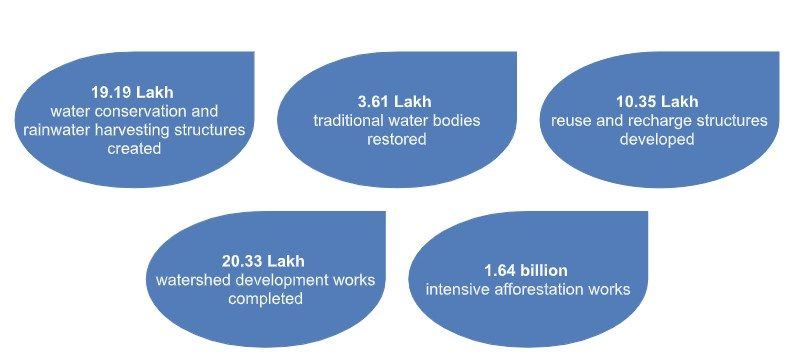
- Jal Sanchay Jan Bhagidari (JSJB): It has completed 39,60,333 artificial recharge works as of January 2026, using scalable models for local groundwater recharge.
- Jal Shakti Abhiyan- Catch the Rain (JSA: CTR): It focuses on water conservation, geo-tagging water bodies, setting up Jal Shakti Kendras, and revitalising abandoned borewells.
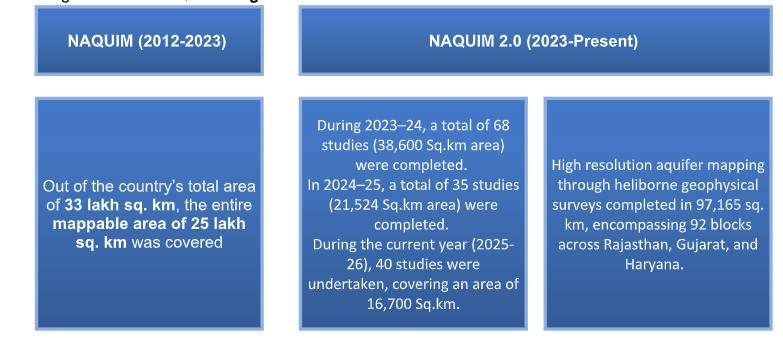
- Scientific Assessment & Planning: National Aquifer Mapping and Management Programme (NAQUIM & NAQUIM 2.0): It aims to characterise aquifers, assess availability/quality, and prepare aquifer maps for management plans, now delivering Panchayat-level data.
- Master Plan for Artificial Recharge to Groundwater-2020: It envisions 1.42 crore structures to channel 185 BCM of additional recharge using terrain-specific techniques.
- Community-Led & Targeted Schemes:
- Atal Bhujal Yojana (Atal Jal): It promotes community-led groundwater management in 7 water-stressed, linking incentives to outcomes to support Jal Jeevan Mission and doubling farmers’ income.
- Mission Amrit Sarovar: It aims to create ponds (minimum 1 acre, 10,000 cubic metre capacity) to enhance water conservation and groundwater recharge across all districts.
- Monitoring Infrastructure: India maintains a network of 43,228 groundwater monitoring stations operated by the Central Ground Water Board (CGWB) for nationwide surveillance.
What are the Key Strategies for Achieving Effective Groundwater Management in India?
- Water-Smart Agricultural Practices: Promoting drip irrigation, micro-irrigation, zero tillage, and precision farming can substantially reduce agricultural groundwater extraction. Accelerating adoption in stressed areas can be achieved by converging PMKSY with the Atal Bhujal Yojana.
- Institutional Re-engineering: Effective groundwater management must shift from political to hydrogeological boundaries, adopting a public trust doctrine where the state is the custodian. Decentralized Aquifer Management Committees (AMCs) should be empowered with legal authority to use NAQUIM 2.0 data for setting and enforcing local extraction limits.
- Digital Water Command System: Establish a national IoT sensor network for real-time monitoring of groundwater levels, quality, and extraction, linked to a central AI platform like 'Bhu-Neer'. This would enable predictive analytics on aquifer stress and illegal extraction, shifting governance from static to proactive.
- Financial Restructuring to Incentivise Conservation: Decouple power subsidies from groundwater extraction by switching to a Direct Benefit Transfer (DBT) model for electricity subsidies with smart metering for agriculture. Implement a Groundwater Security Cess on industrial users to fund an Aquifer Recharge Fund, which provides incentives for community-led water conservation.
- Scaling Nature-Based and Advanced Recharge Solutions: Deploy Managed Aquifer Recharge (MAR) tailored to specific terrains, such as combining MAR with solar desalination in coastal areas and using biochar filtration for agricultural runoff. Mandate treated wastewater recycling and enforce Rainwater Harvesting (RWH) bylaws in urban areas to create a multi-pronged recharge ecosystem.
- Fostering Climate Resilience: Empower communities by investing in hydrogeology literacy and providing simplified Water Budgeting Tool. Integrate climate-resilient crops (e.g., millets, pulses) into procurement policies and link VB-G RAM G works with aquifer recharge to build local stewardship.
Conclusion
- Achieving groundwater sustainability in India requires an integrated approach combining policy reforms (subsidy rationalization, legal overhaul), technological adoption (AI, IoT for management), and community-led action (recharge, conservation), all underpinned by robust aquifer-level governance and climate-resilient strategies.
|
Drishti Mains Question: Discuss the key drivers of groundwater depletion in India and suggest adaptive groundwater management strategies for India. |
Frequently Asked Questions (FAQs)
1. What is the current status of groundwater extraction in India?
India’s annual groundwater extraction is 245.64 BCM, with a national extraction rate of 60.47%, indicating overall extraction remains within annual replenishment capacity.
2. Why is groundwater management critical for Sustainable Development Goals?
Groundwater management supports SDG 6, SDG 11, and SDG 12, ensuring clean water access, sustainable urbanization, and responsible resource use.
3. How does NAQUIM 2.0 support groundwater sustainability?
NAQUIM 2.0 provides high-granularity aquifer data, enabling Panchayat-level planning, and targets water-stressed, coastal, urban, and industrial regions for effective management.
UPSC Civil Services Examination, Previous Year Question:
Prelims
Q. Which one of the following ancient towns is well known for its elaborate system of water harvesting and management by building a series of dams and channelizing water into connected reservoirs? (2021)
(a) Dholavira
(b) Kalibangan
(c) Rakhigarhi
(d) Ropar
Ans: (a)
Q. With reference to ‘Water Credit’, consider the following statements: (2021)
- It puts microfinance tools to work in the water and sanitation sector.
- It is a global initiative launched under the aegis of the World Health Organization and the World Bank.
- It aims to enable the poor people to meet their water needs without depending on subsidies.
Which of the statements given above are correct?
(a) 1 and 2 only
(b) 2 and 3 only
(c) 1 and 3 only
(d) 1, 2 and 3
Ans: (c)
Q. Which of the following can be found as pollutants in the drinking water in some parts of India? (2013)
- Arsenic
- Sorbitol
- Fluoride
- Formaldehyde
- Uranium
Select the correct answer using the codes given below.
(a) 1 and 3 only
(b) 2, 4 and 5 only
(c) 1, 3 and 5 only
(d) 1, 2, 3, 4 and 5
Ans: (c)
Mains
Q.1 What are the salient features of the Jal Shakti Abhiyan launched by the Government of India for water conservation and water security? (2020)
Q.2 Suggest measures to improve water storage and irrigation system to make its judicious use under the depleting scenario. (2020)



