


Important Facts For Prelims
Subhash Chandra Bose
- 23 Jan 2026
- 7 min read
Why in News?
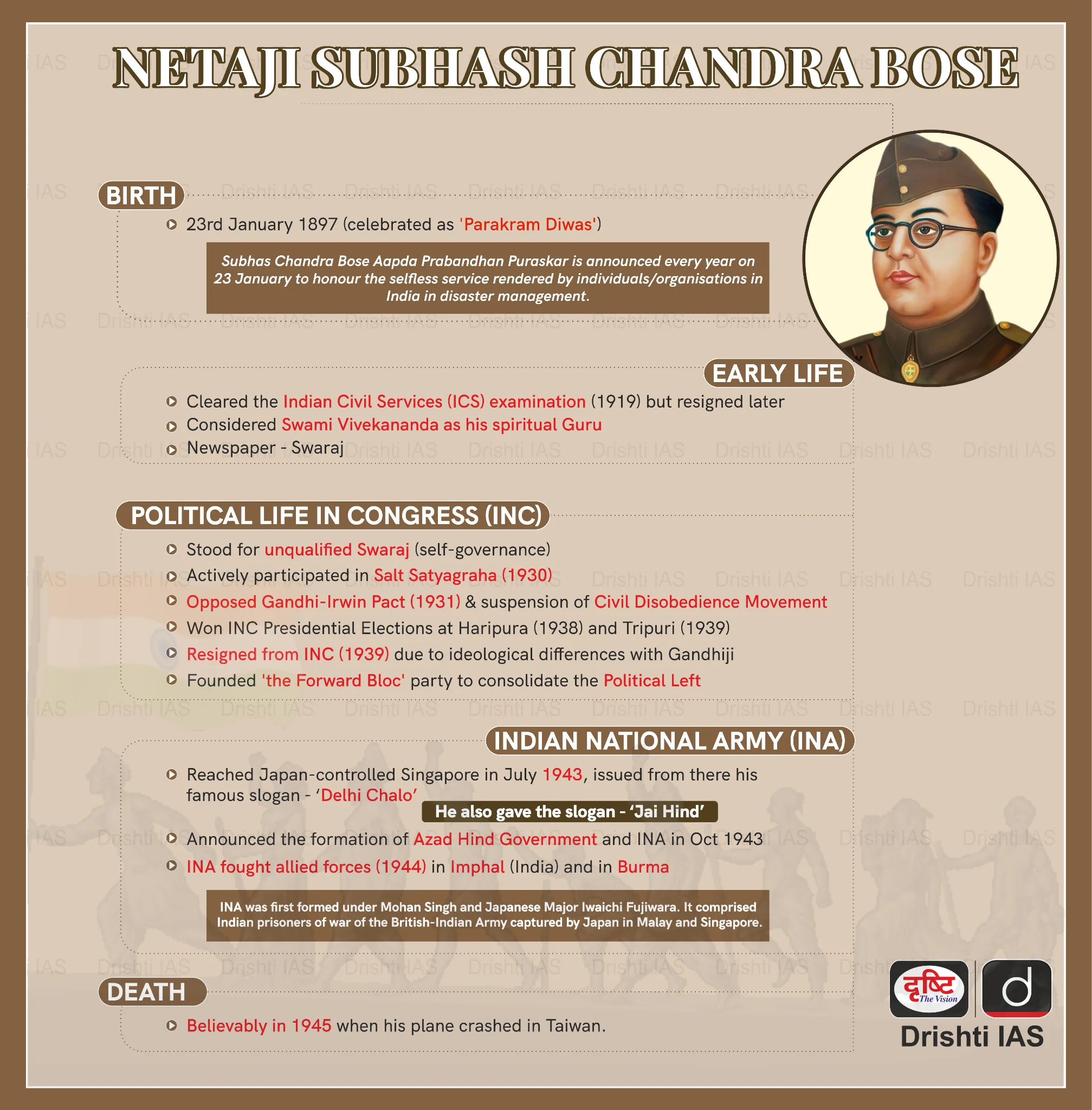
Recently, Parakram Diwas was observed to commemorate the birth anniversary of Subhash Chandra Bose.
What is Parakram Diwas?
- About: Parakram Diwas (Day of Valor) is celebrated annually on 23rd January to honor the birth anniversary of Netaji Subhash Chandra Bose, one of India’s greatest freedom fighters.
- Parakram Diwas 2026 is being celebrated on the 129th birth anniversary of Subhash Chandra Bose (SC Bose).
- Past Celebrations:
- 2021: The first Parakram Diwas was held at Kolkata's Victoria Memorial.
- 2022: A hologram statue of Netaji was unveiled at India Gate, New Delhi.
- 2023: 21 islands in Andaman and Nicobar were named after Param Vir Chakra awardees like Major Somnath Sharma, Nayak Jadunath Singh etc.
- 2024: The event was inaugurated at Red Fort, Delhi, marking the site of the INA trials.
- 2025: The event was held at Barabati Fort, Cuttack, marking his birthplace with a national-level cultural event.
- Significance: The day symbolizes the courage, valor, and patriotism of Netaji Subhas Chandra Bose, who led the Indian National Army (INA) and advocated for complete independence.
- It also serves as a reminder of Netaji’s famous slogan, "Give me blood, and I will give you freedom," which inspired millions in the fight for India's independence.
What are Key Facts About SC Bose?
- Early Life: Born in 1897 in Cuttack (now in Odisha, then in Bengal), to Janakinath and Prabhavati Bose, Netaji was raised in a family that valued English education and Hindu customs.
- He attended Ravenshaw Collegiate School and later studied at Presidency College, Calcutta, where he became involved in anti-British activism.
- Ideological Foundations: He was inspired by the teachings of Ramakrishna Paramhansa and Swami Vivekananda, as well as the themes of Bankim Chandra Chatterjee's Ananda Math.
- He developed a unique synthesis of Western and Indian cultures, focused on India's freedom and revival.
- Early Political Involvement: SC Bose passed the Indian Civil Service exam in 1920 but resigned in 1921 to join the Indian freedom struggle.
- In 1921, Netaji met Mahatma Gandhi in Bombay but disagreed with his approach to independence, particularly his patience and commitment to non-violence.
- Disagreements with Congress: In 1938, Netaji was elected Congress president at the Haripura session, and advocated for swaraj and opposed an Indian federation under the Government of India Act, 1935.
- In 1939, Netaji was re-elected as Congress president in the Tripuri session, defeating Gandhi-backed Dr Pattabhi Sitaramayya. Gandhi saw this as a personal defeat, leading to the resignation of 12 out of 15 Working Committee members, including JL Nehru, Patel, and Rajendra Prasad.
- Bose attempted to form a new working committee but failed, leading to his resignation and replacement by Rajendra Prasad.
- Bose resigned from the chairmanship of the party on 29th April, 1939 and proposed the Forward Bloc to unite the radical-left Congress members, offering an alternative leadership based on anti-imperialism and socialism after independence.
- In 1939, Netaji was re-elected as Congress president in the Tripuri session, defeating Gandhi-backed Dr Pattabhi Sitaramayya. Gandhi saw this as a personal defeat, leading to the resignation of 12 out of 15 Working Committee members, including JL Nehru, Patel, and Rajendra Prasad.
- Death: After the atomic bombing of Hiroshima and Nagasaki during WW II, the Japanese surrendered on 16th August 1945, Bose left South East Asia on a Japanese plane and headed toward China. However, the plane allegedly crashed, leaving SC Bose badly burned, but still alive, according to some accounts.
- Legacy: Bose’s leadership, ideology, and call for complete independence made him one of the most influential figures in India’s freedom struggle.
Frequently Asked Questions (FAQs)
1. Why is Parakram Diwas observed?
Parakram Diwas is observed on 23rd January to commemorate the birth anniversary of Subhash Chandra Bose and honour his courage, sacrifice, and leadership in India’s freedom struggle.
2. When was Subhash Chandra Bose Congress President?
He was elected Congress President twice, in 1938 (Haripura Session) and 1939 (Tripuri Session).
3. Why did he resign from the Congress presidency?
He resigned in 1939 due to ideological differences with the Congress leadership, especially over methods to achieve independence.
UPSC Civil Services Examination, Previous Year Questions (PYQs)
Prelims
Q. The Ghadr (Ghadar) was a (2014)
(a) revolutionary association of Indians with headquarters at San Francisco
(b) nationalist organization operating from Singapore
(c) militant organization with headquarters at Berlin
(d) communist movement for India’s freedom with headquarters at Tashkent
Ans: (a)
Q. During the Indian Freedom Struggle, who of the following raised an army called ‘Free Indian Legion’?(2008)
(a) Lala Hardayal
(b) Rashbehari Bose
(c) Subhash Chandra Bose
(d) V.D. Savarkar
Ans: (c)



