


Indian Economy
Achieving Sustainability in Rice Production
- 06 Jan 2026
- 11 min read
For Prelims: Rice, Kharif Crop, Golden Rice, CRISPR-Cas9, Methane, GHG, Particulate Matter, Millets, Oilseeds, Minimum Support Price (MSP), System of Rice Intensification (SRI), Drip/sprinkler Irrigation, Genome-edited Crops, FPOs, SDGs, Soil Health Cards, Pradhan Mantri Fasal Bima Yojana (PMFBY),
For Mains: Key facts regarding rice, concerns associated with rice farming, and steps needed for sustainable agriculture.
Why in News?
India has overtaken China to become the world’s largest rice producer in 2025, and now accounts for 40% of global rice exports, with shipments crossing 20 million metric tonnes.
- However, it also raises concerns over rice being a water-intensive crop and a form of virtual water export, especially in water-stressed regions.
Summary
- India has become the world’s largest rice producer and exporter, supplying 40% of global exports, but rice occupies 25% cropped area and is highly water-intensive.
- Groundwater depletion, emissions, residue burning, and climate stress make rice-centric farming unsustainable.
- Subsidy reform, diversification, DSR/SRI, and climate-resilient genome-edited crops are vital for sustainable food security.
What are Key Facts Regarding Rice?
- About: Rice is the staple food for most Indians, with about 65% consuming it daily and approximately 25% of the total cropped area under its cultivation.
- India is the world’s largest producer and exporter of rice, followed by China (2nd) and Bangladesh (3rd).
- Climatic & Soil Requirements: It is a kharif crop (sown in June-July and harvested in September-October).
- Requires high temperature (>25°C), optimal at 30°C day/20°C night, tolerating up to 40°C briefly.
- Needs high humidity and above 100 cm of rainfall. Given India’s predominantly tropical monsoon climate, rice is cultivated in most regions, primarily through irrigation.
- Thrives in soils with a pH of 5.5–6.5 and good water-holding capacity and drainage.
- Cropping Intensity: In southern states and West Bengal, two or three crops (e.g., Aus, Aman, Boro in West Bengal) can be grown annually.
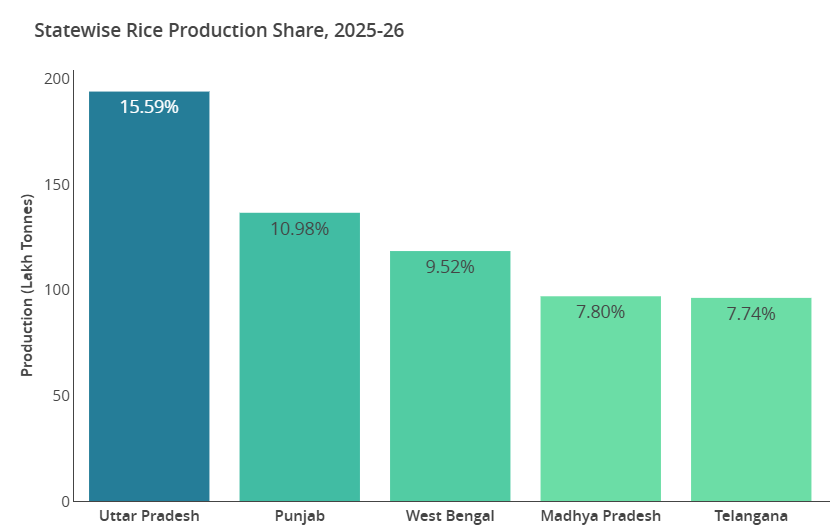
- In 2025–26, the top three states by rice production share are Uttar Pradesh, Punjab, and West Bengal.
- Cultivation Techniques:
- Traditional Transplantation: Seeds sown in a nursery; seedlings transplanted to the main field after 25–35 days. Labour and water-intensive, requiring around 25–27 irrigations, but maximizes yield. This is widely practiced across India.
- Direct Seeding of Rice (DSR): Pre-germinated seeds are directly drilled into the field using a machine that saves water and labour. Best suited for heavy/medium-textured soils (high clay content) with good water retention and rich in plant-available iron.
Government Initiatives Regarding Sustainability
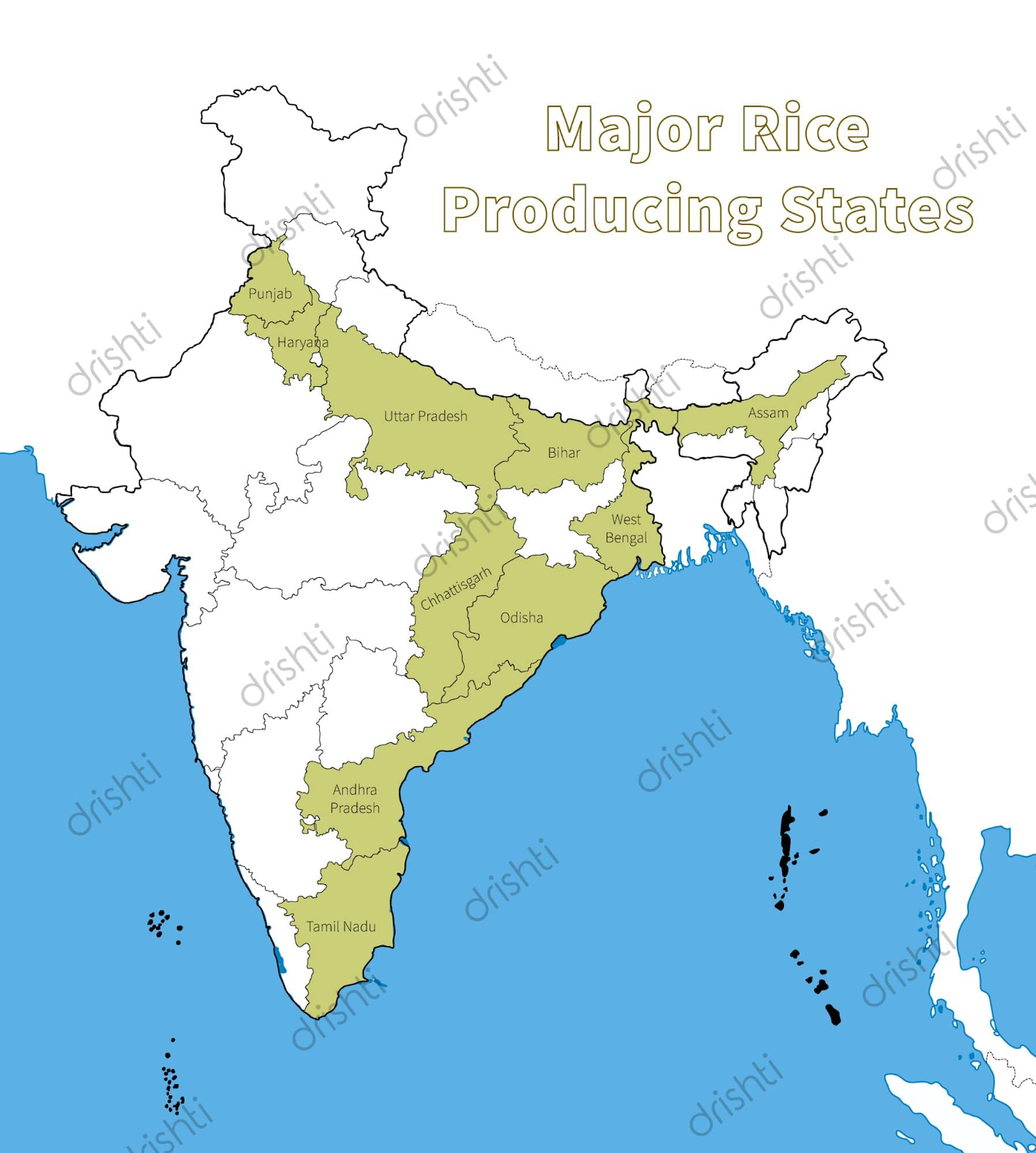
- Water-Smart Agriculture Push: Government promotes Direct Seeded Rice (DSR), micro-irrigation, and crop diversification away from water-intensive paddy in Punjab–Haryana under Pradhan Mantri Krishi Sinchayee Yojana (PMKSY) and state action plans.
- Climate-Resilient Varieties: ICAR is scaling drought, salinity, and heat-tolerant rice varieties under the National Innovations in Climate Resilient Agriculture (NICRA).
- Millets vs Rice Policy Signal: Through International Year of Millets (2023) follow-up, the government is encouraging diversification from rice in water-stressed regions to improve sustainability.
- Fortified Rice Rollout: Fortified rice distribution under NFSA and PM-POSHAN has been expanded nationwide to address anaemia and micronutrient deficiency.
- Methane Reduction Focus: India has begun integrating Alternate Wetting and Drying (AWD) and improved paddy practices into climate action to reduce methane emissions from rice cultivation.
What are the Key Concerns Associated with Rice Cultivation in India?
- Rapid Decline in Water Table: Producing 1 kg of rice in India consumes 3,000–4,000 litres of water, 20–60% higher than the global average. In major rice states like Punjab and Haryana, groundwater has plummeted from ~30 feet to 80–200 feet, with most aquifers classified as over-exploited or critical due to extracting 35–57% more than is recharged annually.
- Groundwater-intensive rice cultivation represents an inter-generational equity issue, as it transfers ecological debt to future generations through aquifer depletion.
- Environmental Concerns: Flooded rice paddies, by creating anaerobic soil, are a major source of methane, contributing 10–20% of India's agricultural GHG emissions. Post-harvest residue burning in Punjab and Haryana further exacerbates air pollution by releasing particulate matter and carbon monoxide.
- Health Concerns: Flooded rice cultivation in regions with arsenic-contaminated groundwater leads to high arsenic uptake in grains, linking consumption to serious health risks like cancer. Concurrent heavy pesticide use compounds toxicity, with studies confirming elevated arsenic levels in staple foods (rice, wheat, and potatoes) across 11 hotspot districts in Bihar.
- Economic Concerns: Farmers are forced into debt to fund costly deeper borewells and pumps, with smallholders hit hardest as these costs severely dent their meagre incomes. Punjab spends about Rs 39,000 per hectare on fertiliser and power subsidies for rice.
- Prolonged flooded rice monoculture causes soil micronutrient imbalances (such as zinc and iron deficiency) leading to a growing need for higher fertiliser use over time.
- Climatic Concerns: Climate change, through rising temperatures and erratic rainfall, threatens to reduce rice yields by 6–10% or more, with northern and eastern India's rainfed systems most susceptible to production failures.
- World Bank and Nature Sustainability studies highlight that rice cultivation in north-west India fuels a vicious energy–water–climate cycle, where subsidised electricity promotes groundwater over-extraction, raises carbon emissions from pumping, and locks farmers into unsustainable practices.
- Global Food Security Implications: As the supplier of 40% of the world's rice exports, any significant reduction in India's production due to water scarcity would have major implications for global food security and prices.
What Steps Are Needed to Promote Sustainable Agriculture in India?
- Reforming Subsidy Structures: Shift from input-heavy subsidies to direct income and ecosystem-service payments that reward water saving, soil carbon enhancement, and crop diversification. Furthermore, guarantee a Minimum Support Price (MSP) and robust government procurement for diversified crops like millets, pulses, and oilseeds.
- Technological Adoption and Water Conservation: Scale up water-efficient techniques like System of Rice Intensification (SRI), and drip/sprinkler irrigation while fast-tracking the adoption of genome-edited crops (e.g., drought-tolerant Kamala rice). Combining precision irrigation with digital advisory services (AI-based weather, soil moisture sensors) can reduce water use by 30–40% without yield loss.
- Strengthening Policy Frameworks: Enforce bans on new borewells in critical zones and promote participatory groundwater management, while strengthening FPOs and cooperatives for collective action to cut costs. Community-led groundwater governance (including water budgeting and crop planning) is more effective than top-down regulation alone.
- Resilience Against Climate Change: Actively promote crop diversification and agroforestry to break the rice–wheat monoculture and enhance climate resilience. Support in-situ residue management and ex-situ utilization alongside soil health cards, as these are low-cost, high-impact adaptation strategies for smallholders.
- Enhancing Farmer Income and Risk Mitigation: Facilitate loans for adopting sustainable technology and scale up the Pradhan Mantri Fasal Bima Yojana (PMFBY), while supporting food processing for better price realization. Furthermore, develop cold chains, warehouses, and agro-processing units in rural clusters to reduce post-harvest losses and generate non-farm employment.
Conclusion
India’s rise as the world’s leading rice producer underscores the urgent water–energy–climate–health nexus, where short-term food security must be balanced with long-term sustainability. Achieving this requires subsidy reforms, crop diversification, and the adoption of water-efficient, climate-resilient practices to protect farmer welfare and environmental health.
|
Drishti Mains Question: Q. India’s dominance in global rice production has intensified groundwater stress. Examine the causes and suggest sustainable policy solutions |
Frequently Asked Questions (FAQs)
1. Why is rice cultivation a concern in India?
Because rice requires 3,000–4,000 litres of water per kg, leading to over-exploited aquifers and rapid groundwater decline.
2. What is Direct Seeding of Rice (DSR)?
A water- and labour-saving technique where seeds are directly sown, reducing irrigation needs and emissions.
3. Why does India’s rice production matter globally?
India supplies 40% of global rice exports, so any production shock can significantly affect global food prices and food security
UPSC Civil Services Examination, Previous Year Question (PYQ)
Prelims
Q. In the context of India, which of the following is/are considered to be practice(s) of eco-friendly agriculture? (2020)
- Crop diversification
- Legume intensification
- Tensiometer use
- Vertical farming
Select the correct answer using the code given below:
(a) 1, 2 and 3 only
(b) 3 only
(c) 4 only
(d) 1, 2, 3 and 4
Ans: (a)
Mains
Q. Suggest measures to improve water storage and irrigation systems to make its judicious use under the depleting scenario. (2020)
Q. Elaborate on the impact of the National Watershed Project in increasing agricultural production from water-stressed areas. (2019)



