


Agriculture
Climate-Resilient Agriculture in India
- 02 Jan 2026
- 14 min read
For Prelims: BioE3 Policy, Agroforestry, National Innovations in Climate Resilient Agriculture , National Mission for Sustainable Agriculture
For Mains: Climate-Resilient Agriculture, Climate-Resilient Agriculture as an adaptation strategy, Role of biotechnology and digital tools in agricultural resilience
Why in News?
There is renewed focus on Climate-Resilient Agriculture (CRA) as a strategic necessity for ensuring India’s food security, safeguarding farmer livelihoods, and achieving long-term sustainability.
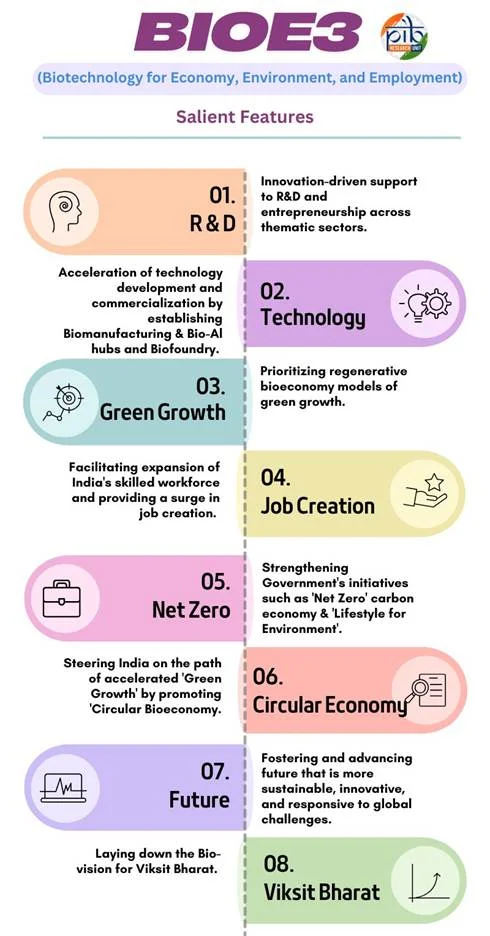
- Recent policy signals, including the BioE3 Policy (Biotechnology for Economy, Environment, and Employment) Policy, underscore the need for a coherent national CRA roadmap to scale climate-resilient agricultural solutions across the country.
Summary
- Climate-Resilient Agriculture (CRA) is essential for India to safeguard food security, farmer livelihoods, and environmental sustainability amid rising climate risks, especially given the country’s heavy dependence on rainfed agriculture and projected crop yield losses.
- While India has a strong CRA foundation through initiatives like NICRA, NMSA, digital agriculture missions, and the BioE3 framework, scaling requires a coherent national roadmap, global cooperation, digital inclusion, and strengthened soil–water management.
What is Climate-Resilient Agriculture?
- About: Climate-Resilient Agriculture (CRA) is an approach to farming that strengthens the ability of crops, soils, and farming systems to withstand climate variability and extreme events while sustaining productivity and environmental health.
- Objective: To ensure food security, stabilise farm incomes, reduce dependence on chemical inputs, and build long-term resilience of agriculture against climate change.
- Key Strategies of Climate-Resilient Agriculture:
- Climate-Adapted Crops: Planting varieties specifically bred to survive high temperatures, high salinity (salt), or prolonged droughts (e.g., "Scuba Rice" that can survive underwater for weeks), to reduce climate-induced crop losses.
- Water Stewardship: Adoption of drip irrigation, rainwater harvesting, and precision irrigation to optimise water use during dry periods.
- Soil Health Management: Practices like no-till farming, cover cropping, and organic inputs to prevent erosion, enhance moisture retention, and increase soil carbon.
- Agroforestry Systems: Integration of trees with crops and livestock to provide shade, wind protection, and improved microclimate.
- Crop Diversification: Moving away from monocropping to multiple crops, spreading climate risk and stabilising farm income.
- Early Warning and Digital Tools: Use of weather forecasts, AI-based advisories, and climate alerts to support timely sowing, harvesting, and risk management.
Why does India Need to Switch Towards Climate-Resilient Agriculture?
- Vulnerability of Agriculture: Indian agriculture is increasingly exposed to erratic monsoons, droughts, floods, heat stress, and declining soil and water health, making conventional farming practices less reliable under changing climate conditions.
- Dependence on Rainfed Farming: Nearly 51% of India’s net sown area is rainfed and produces about 40% of the country’s food, leaving a large share of agricultural output highly vulnerable to climate variability, demanding resilient farming systems.
- Threat to Food Security: Climate projections indicate that without adaptation measures, rainfed rice yields in India may decline by 47% (2080), while irrigated rice could fall by 5% (2080).
- Wheat yields are projected to drop by 40% (2080), and kharif maize by 23% (2080). Overall, climate change lowers crop productivity and nutritional quality, posing serious food security risks.
- India’s growing population places sustained pressure on agriculture to deliver higher, stable, and reliable productivity, even as climate stress intensifies.
- Limits of Conventional Farming: Input-intensive and chemical-heavy farming methods are increasingly unsustainable, as rising input costs and environmental degradation reduce their ability to cope with climate stress.
- Economic, Strategic and Environmental Imperatives: Climate-resilient agriculture can reduce India’s dependence on food imports, protect farmer livelihoods, and strengthen the country’s strategic autonomy in the food sector.
- By promoting efficient use of water, soil, and nutrients, climate-resilient agriculture supports productivity while reducing environmental damage and agricultural emissions.
What are the Key Government Initiatives to Promote Climate-Resilient Agriculture?
- National Innovations in Climate Resilient Agriculture: India acknowledged climate risks to agriculture early, with the launch of National Innovations in Climate Resilient Agriculture (NICRA) by Indian Council of Agricultural Research (ICAR) in 2011 to build resilience against climate variability.
- Under NICRA, location-specific climate-resilient practices such as zero-till wheat, direct-seeded rice, and climate-tolerant varieties have been demonstrated in over 448 climate-resilient villages.
- National Mission for Sustainable Agriculture (NMSA): The NMSA promotes climate adaptation through integrated farming, soil health management, water-use efficiency, and resource conservation, especially in rainfed areas.
- Paramparagat Krishi Vikash Yojana (PKVY) and Mission Organic Value Chain Development for North Eastern Region (MOVCDNER): Promote organic farming by supporting the use of biofertilizers,, biopesticides, and microbial soil enhancers, thereby reducing dependence on chemical inputs, improving soil health, and strengthening sustainable agricultural practices,
- Digital Agriculture: India’s digital agriculture ecosystem is expanding rapidly through initiatives like the Digital Agriculture Mission, AgriStack, NAMO Drone Didi and Kisan Drones, Kisan Suvidha App, and Soil Health Card.
- Alongside private projects such as Project FarmVibes, enabling data-driven farming decisions, though adoption remains uneven due to the digital divide.
- Biotechnology and Research: India has robust CRA research capacity supported by ICAR, the Department of Biotechnology (DBT), and the Indian Agricultural Research Institute (IARI), with increasing focus on climate-tolerant and genome-edited crops.
- BioE3: The BioE3 framework positions CRA as a priority area, signalling intent to scale biotechnology-led solutions through a national roadmap.
What are the Key Challenges in Scaling Climate-Resilient Agriculture in India?
- Low Adoption among Small and Marginal Farmers: Small and marginal farmers constitute ~86% of India’s farm holdings, yet many lack awareness, credit access, and affordability to adopt CRA technologies, limiting large-scale uptake.
- Quality and Trust Deficit in Bio-inputs: Despite rapid growth, quality inconsistencies in biofertilizers and biopesticides persist, undermining farmer trust.
- Slow Rollout of Climate-Resilient and Genome-Edited Seeds: Although climate-tolerant varieties exist (around 109 field and horticultural crop varieties developed by ICAR), their coverage on ground remains limited.
- For example, stress-tolerant crop varieties still account for only a small share of total seed adoption, while genome-edited crops are at an early regulatory stage.
- Digital Divide Limiting Precision Agriculture: Although 95.15% of villages have access to 3G/4G mobile connectivity, India faces a major digital literacy gap, with only 38% of households digitally literate, which constrains the effective use of AI-based advisories, digital platforms, and precision farming tools critical for CRA.
- Soil and Water Stress: Nearly 30% of India’s land is degraded, and over 60% of districts face groundwater stress, reducing the effectiveness of CRA interventions unless resource restoration accompanies technology adoption.
- Fragmented Policy and Institutional Coordination: CRA efforts are spread across agriculture, biotechnology, climate, and digital missions, leading to overlaps and gaps that slow scaling in the absence of a unified national CRA roadmap.
What Measures can Further Promote Climate-Resilient Agriculture in India?
- National CRA Roadmap: Develop a coherent national CRA roadmap under the BioE3 framework, aligning biotechnology, climate adaptation, and agricultural policy to deliver resilience at scale.
- It ensures policy coherence across ministries and states, enables scaling of proven technologies beyond pilot projects, balances productivity, sustainability, and farmer welfare, and positions Indian agriculture to withstand accelerating climate volatility while meeting future food demand.
- Global Cooperation and Best Practices: Partner with the Food and Agriculture Organization (FAO) for climate-smart technologies, crop breeding, and knowledge transfer (e.g., FAO’s Climate-Smart Agriculture programme).
- Adapt successful CRA models from the US, EU, and China to Indian conditions.
- The US advances CRA through the USDA Climate-Smart Agriculture and Forestry initiative with large-scale investments, the EU embeds CRA in the Green Deal and Farm to Fork Strategy to cut chemical use, China focuses on climate-tolerant crops, water-saving irrigation, and digital agriculture.
- Scale Digital and Precision Agriculture: Expand access to AI-based advisories, precision irrigation, and climate risk alerts while addressing the digital divide through digital literacy through Bhashini.
- Improve Soil and Water Management: Promote soil health restoration, micro-irrigation, water-saving technologies, and watershed development to address land degradation and groundwater stress.
Conclusion
CRA is essential for safeguarding India’s food security, farmer livelihoods, and ecological sustainability in the face of accelerating climate risks. A coherent national CRA roadmap aligned with SDG 2 (Zero Hunger), SDG 12 (Responsible Consumption and Production), and SDG 13 (Climate Action) can enable resilient, productive, and sustainable agriculture at scale.
|
Drishti Mains Question: Q. “Climate-Resilient Agriculture is central to India’s food security and climate adaptation strategy.” Discuss |
Frequently Asked Questions (FAQs)
- What is Climate-Resilient Agriculture (CRA)?
CRA is an approach that enhances the ability of crops and farming systems to withstand climate variability while sustaining productivity and environmental health. - Why is CRA crucial for India?
With 51% rainfed farmland and rising climate risks, CRA is vital to protect food security, stabilise farm incomes, and reduce vulnerability to extreme weather. - What are the key initiatives supporting CRA in India?
Major initiatives include NICRA, the National Mission for Sustainable Agriculture, the Digital Agriculture Mission, and policy support under the BioE3 framework.
UPSC Civil Services Examination, Previous Year Question (PYQ)
Prelims:
Q. In the context of India’s preparation for Climate -Smart Agriculture, consider the following statements:(2021)
- The ‘Climate-Smart Village’ approach in India is a part of a project led by the Climate Change, Agriculture and Food Security (CCAFS), an international research programme.
- The project of CCAFS is carried out under Consultative Group on International Agricultural Research (CGIAR) headquartered in France.
- The International Crops Research Institute for the Semi-Arid Tropics (ICRISAT) in India is one of the CGIAR’s research centres.
Which of the statements given above are correct?
(a) 1 and 2 only
(b) 2 and 3 only
(c) 1 and 3 only
(d) 1, 2 and 3
Ans: (d)
Q. With reference to the ‘Global Alliance for ClimateSmart Agriculture (GACSA)’, which of the following statements is/are correct? (2018)
- GACSA is an outcome of the Climate Summit held in Paris in 2015.
- Membership of GACSA does not create any binding obligations.
- India was instrumental in the creation of GACSA.
Select the correct answer using the code given below:
(a) 1 and 3 only
(b) 2 only
(c) 2 and 3 only
(d) 1, 2 and 3
Ans: (b)
Mains:
Q. How far is the Integrated Farming System (IFS) helpful in sustaining agricultural production? (2019)



