


Science & Technology
Remote Sensing and India’s IRS Programme
- 09 Jan 2026
- 15 min read
For Prelims: Remote sensing, Synthetic Aperture Radar, Normalised Difference Vegetation Index, Hyperspectral sensors, Yuktdhara geoportal
For Mains: Role of remote sensing in sustainable natural resource management, Indian Remote Sensing (IRS) Programme, Applications of satellite technology in agriculture, water, and forestry
Why in News?
Remote sensing is gaining importance as it enables scientists and policymakers to map, monitor, and manage Earth’s valuable natural resources from space, offering faster, cost-effective, and environmentally sustainable insights into forests, water, minerals, and energy resources.
What is Remote Sensing?
- About: Remote sensing is the science of observing and analysing the Earth from space or air using satellites and drones that detect reflected or emitted electromagnetic radiation.
- Since different materials reflect energy differently, each object has a unique spectral signature, allowing scientists to identify vegetation, water, minerals, rocks, and soil without direct physical contact.
Applications of Remote Sensing
- Vegetation, Crops, and Forests: Healthy plants absorb red light and reflect near-infrared light due to chlorophyll.
- Using this property, satellites compute the Normalised Difference Vegetation Index (NDVI) to assess crop health, stress, and disease.
- NDVI measures vegetation health by comparing reflected near-infrared light and absorbed red light. Higher values indicate healthy vegetation, while lower values show stress or sparse cover.
- Spectral analysis helps distinguish tree species and plant communities across large forests.
- Forest mapping enables estimation of biomass and carbon storage, crucial for climate change mitigation.
- Using this property, satellites compute the Normalised Difference Vegetation Index (NDVI) to assess crop health, stress, and disease.
- Surface Water Mapping and Flood Monitoring: To map water bodies from space, scientists use optical indices and Synthetic Aperture Radar (SAR).
- Optical sensors detect water using the Normalised Difference Water Index (NDWI), which is based on reflected sunlight.
- The method relies on the fact that water reflects visible green light but strongly absorbs near-infrared and shortwave-infrared radiation, allowing NDWI to clearly distinguish water bodies from land surfaces.
- Modified NDWI (MNDWI) improves water detection in urban areas by separating water from building shadows.
- Since optical sensors cannot work at night or through clouds, SAR, which uses active radio waves, is used to map floods during cyclones and heavy rainfall, with calm water appearing dark in radar images.
- SAR-based flood maps support early warning systems for floods, droughts, cyclones, and landslides, and help governments plan evacuations, relief logistics, and insurance payouts.
- Satellites also assess water quality by detecting differences in reflectance caused by sediments, pollution, and algal blooms.
- Optical sensors detect water using the Normalised Difference Water Index (NDWI), which is based on reflected sunlight.
- Mineral Exploration: Hyperspectral sensors split sunlight into hundreds of narrow wavelengths, generating a spectral signature for every pixel.
-
This allows identification of specific minerals such as copper, gold, lithium, limestone, and granite.
- Satellites map alteration zones, where underground heat and fluids modify surface rocks, aiding mineral exploration.
-
- Oil and Gas Exploration: Hydrocarbons may leak upward through micro-seepage, where small hydrocarbon leaks subtly alter soil chemistry and vegetation health, helping identify areas with potential underground reserves, which satellites can detect.
- When micro-seepage is absent, satellites cannot detect oil directly, so they focus on identifying geological structures that can trap oil, such as anticlines and sedimentary basins.
- Using surface rock imagery, gravity, and magnetic data, satellites map thick sedimentary layers and underground formations that indicate areas capable of holding oil and gas, not their confirmed presence.
- It is used to monitor coral bleaching, mangroves, shoreline erosion, and oil spills, and supports the Blue Economy and coastal zone regulation through continuous, large-scale environmental monitoring.
- When micro-seepage is absent, satellites cannot detect oil directly, so they focus on identifying geological structures that can trap oil, such as anticlines and sedimentary basins.
- Groundwater Monitoring: Large underground aquifers exert a stronger gravitational pull.
- Gravity-measuring satellites can estimate groundwater storage by detecting tiny changes in Earth’s gravity field.
- Remote sensing has revealed severe groundwater depletion, especially in North India, due to excessive irrigation.
- It enables site-specific irrigation, fertiliser use, and pest control, improving crop yields while reducing water use and chemical runoff.
- Sustainable Resource Management: Remote sensing makes exploration faster, cheaper, and environmentally safer by reducing random drilling and excavation.
- It enables continuous monitoring of forests, water, and aquifers to prevent over-exploitation.
- It supports sustainable development by tracking urban heat islands, land-use change, and informal settlement growth, aiding climate-resilient urban planning, disaster management, climate action, and evidence-based policy making.
Indian Remote Sensing (IRS) Programme
- About: The Indian Remote Sensing (IRS) Programme is India’s national Earth observation programme, initiated with the launch of Indian Remote Sensing satellite-1A (IRS-1A) in 1988, to provide satellite imagery for resource management and national development.
- Operated by ISRO, it comprises one of the world’s largest constellations of remote sensing satellites, delivering data across multiple spatial, spectral, and temporal resolutions.
- IRS data supports applications such as agriculture, water resources, urban planning, forestry, mineral exploration, disaster management, ocean studies, and environmental monitoring, and has played a foundational role in building India’s geospatial and GIS ecosystem.
- Key Indian Remote Sensing (IRS) Missions:
- Land & Water Resource Observation Series: IRS-1A/1B/1C/1D, Resourcesat-1, Resourcesat-2/2A, and HysIS (Hyperspectral Imaging Satellite)
- Ocean & Atmospheric Observation Series: Oceansat-1/2, Megha-Tropiques, and SARAL.
- Cartographic Satellite Series: Technology Experiment Satellite (TES), Cartosat-1, Cartosat-2/2A/2B/2S, Cartosat-3
- Microwave Remote Sensing (SAR) Series: RISAT (Radar Imaging Satellite)-1, RISAT-1A, RISAT-2A, and NISAR (NASA–ISRO Synthetic Aperture Radar).
How did Remote Sensing Technology Contribute for Societal Development in India?
- Bhuvan Geoportal: A national geospatial platform by ISRO for visualisation, monitoring, and planning of development projects.
- Geo-MGNREGA: Satellite-based geo-tagging and monitoring of assets created under MGNREGA to improve transparency and planning.
- 6.24 crore+ assets/activities geo-tagged on the Geo-MGNREGA portal.
- Yuktdhara geoportal supports planning of new natural resource assets.
- SIS-DP (Space-based Information Support for Decentralized Planning): Uses high-resolution satellite data to support Panchayat- and village-level planning.
- Watershed Development Component-Pradhan Mantri Krishi Sinchayee Yojana 2.0 (PMKSY-WDC 2.0): Remote sensing for monitoring micro-watersheds and soil–water conservation works.
- Under PMKSY-WDC 2.0, around 1,150 projects were assessed using high-resolution data from Cartosat-2S and Cartosat-3 via Bhuvan tools.
- Rural Road Mapping: Satellite mapping and monitoring of rural roads across India.
- Pradhan Mantri Gram Sadak Yojana dashboard on Bhuvan enables real-time monitoring by the Ministry of Rural Development and State governments.
- PMAY (Urban & Gramin): Uses geospatial monitoring (geotagging) as a core mechanism for ensuring transparency, tracking physical construction progress, and facilitating the stage-wise release of funds.
- Disaster Management Support Programme (DMSP): The DMSP is implemented by ISRO / Department of Space to support national and state disaster management agencies.
- It uses space-based inputs for hazard, vulnerability, and risk (HVR) assessment, disaster monitoring, damage assessment, and early warning systems.
- The programme covers major disasters such as floods, cyclones, landslides, earthquakes, and forest fires, using data from Indian satellites including Resourcesat, Cartosat series, RISAT, Oceansat-3, INSAT-3DR/3DS, along with data from global satellite missions.
What are the Challenges Associated with Remote Sensing in India?
- Data Accessibility and Cost: High-resolution imagery is often costly or restricted, limiting use by states and local bodies.
- For example, many municipalities depend on coarse satellite data for urban planning, reducing accuracy in slum mapping and land-use zoning.
- Cloud Cover and Weather Limitations: Optical satellites struggle during the monsoon season, affecting crop assessment and flood mapping.
- For instance, Kharif crop damage assessment is often delayed due to persistent cloud cover.
- Limited last-mile Application: Satellite insights do not always translate into on-ground action. For example, despite groundwater depletion maps in Punjab and Haryana, over-irrigation continues due to weak policy enforcement.
Skill and Capacity Gaps: Many district administrations lack trained geospatial staff. As a result, disaster early-warning maps are underutilised during floods and cyclones. - Data Fragmentation and Poor Integration: Datasets from ISRO, states, and ministries often operate in silos. For example, urban flood modelling suffers when satellite rainfall data is not integrated with local drainage data.
- Privacy and Security Concerns: High-resolution mapping of border areas and cities raises concerns about national security and individual privacy, especially with growing private-sector participation.
What Measures can Strengthen Remote Sensing in India?
- Integrate Satellite Data with Ground Systems: Expand linking remote sensing with IoT sensors, drones, and GIS dashboards under programmes like Digital India and Smart Cities Mission to enable real-time applications such as precision irrigation, urban flood control, and heatwave management.
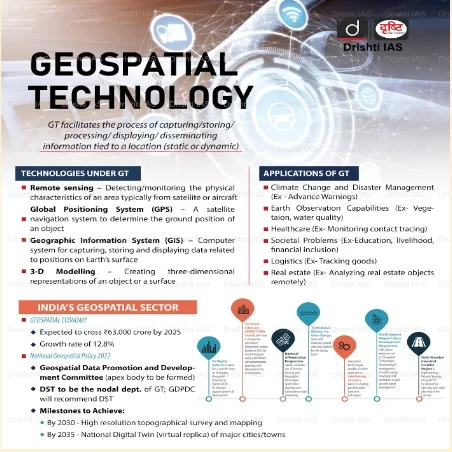
- Expand open-access geospatial data: Fully implement the National Geospatial Policy, 2022 to make high-resolution data affordable and accessible.
- Platforms like PM Gati Shakti and Bhuvan (ISRO) already demonstrate how open geospatial layers can support infrastructure planning, logistics, and regional development.
- Promote all-weather monitoring using SAR: Scale up SAR missions such as RISAT for all-weather, day-night monitoring.
- SAR-based flood mapping during cyclones along India’s east coast has strengthened NDMA-led disaster response and early warning systems.
- Strengthen Capacity Building at Local Levels: Expand ISRO’s capacity-building programmes like IIRS training and outreach to state and district officials.
- This will ensure satellite inputs directly guide agriculture advisories, drought assessment, and disaster management at the grassroots level.
Conclusion
- Remote sensing has become a core pillar of India’s development and data driven governance framework, supporting agriculture, disaster management, urban planning, and climate action. As India advances its National Geospatial Policy, remote sensing will remain critical for strengthening both economic growth and environmental security.
|
Drishti Mains Question: Q. Examine the role of the Indian Remote Sensing (IRS) Programme in supporting sustainable development and governance |
Frequently Asked Questions (FAQs)
- What is remote sensing?
Remote sensing is the science of observing Earth from space or air using sensors that detect reflected or emitted electromagnetic radiation. - Why is remote sensing important for India?
It enables cost-effective monitoring of agriculture, water, forests, minerals, disasters, and development programmes at national scale. - What is the Indian Remote Sensing (IRS) Programme?
IRS is India’s national Earth observation programme, launched in 1988, providing multi-resolution satellite data for resource management and governance. - How does remote sensing help in disaster management?
It supports hazard, vulnerability, and risk assessment, real-time disaster monitoring, damage assessment, and early warning using satellite data.
UPSC Civil Services Examination, Previous Year Question (PYQ)
Prelims
Q.1 In the context of space technology, what is “Bhuvan”, recently in the news? (2010)
(a) A mini satellite launched by ISRO for promoting the distance education in India
(b) The name given to the next Moon Impact Probe, for Chandrayaan-II
(c) A geoportal of ISRO with 3D imaging capabilities of India
(d) A space telescope developed by India
Ans: c
Mains
Q.1 What is India’s plan to have its own space station and how will it benefit our space programme? (2019)
Q.2 Discuss India’s achievements in the field of Space Science and Technology. How the application of this technology helped India in its socio-economic development? (2016)



