




.jpg)

.png)
.jpg)

 PCS Parikshan
National Current Affairs Switch to Hindi
Exercise SURYAKIRAN (2025)
Why in News?
The 19th edition of India–Nepal Joint Military Exercise SURYAKIRAN-XIX began on 25th November 2025 at Pithoragarh, Uttarakhand.
Key Points
- About Exercise SURYAKIRAN:
- Exercise SURYAKIRAN is a bilateral military exercise between the Indian Army and the Nepal Army, held annually, with hosting duties alternating between the two countries.
- It aims to enhance interoperability, strengthen military diplomacy, and deepen India–Nepal defence cooperation.
- The exercise primarily focuses on counter-insurgency, counter-terrorism, and jungle/mountain warfare terrain common to both armies.
- It is conducted under Chapter VII of the UN Charter, which deals with peacekeeping duties related to threats to peace, breaches of peace, and counter-terrorism scenarios.
- About the 2025 Edition:
- The 2025 edition of the exercise is being hosted at Pithoragarh, Uttarakhand, from 25th November to 08th December, 2025.
- The Indian contingent comprises 334 personnel, mainly from the Assam Regiment while the Nepalese contingent also includes 334 personnel, primarily from the Devi Datta Regiment.
- The 2025 edition highlights incorporation of niche and emerging military technologies, such as:
- Unmanned Aerial Systems (UAS)
- Drone-based ISR (Intelligence, Surveillance & Reconnaissance)
- AI-enabled decision-support tools
- Unmanned logistics vehicles
- Armoured protection platforms
Madhya Pradesh Switch to Hindi
Patra River
Why in News?
The Patra River, once a vital freshwater stream known for its association with Raja Bhoj, is undergoing renewed attention as authorities and environmental experts highlight its severe degradation and ongoing revival efforts in Bhopal.
Key Points
- About Patra River:
- The Patra River, also called the Patra Nala, historically flowed through old Bhopal and was known for its therapeutic qualities. It is said that Raja Bhoj was cured of a severe ailment after bathing in its waters, contributing to its cultural significance.
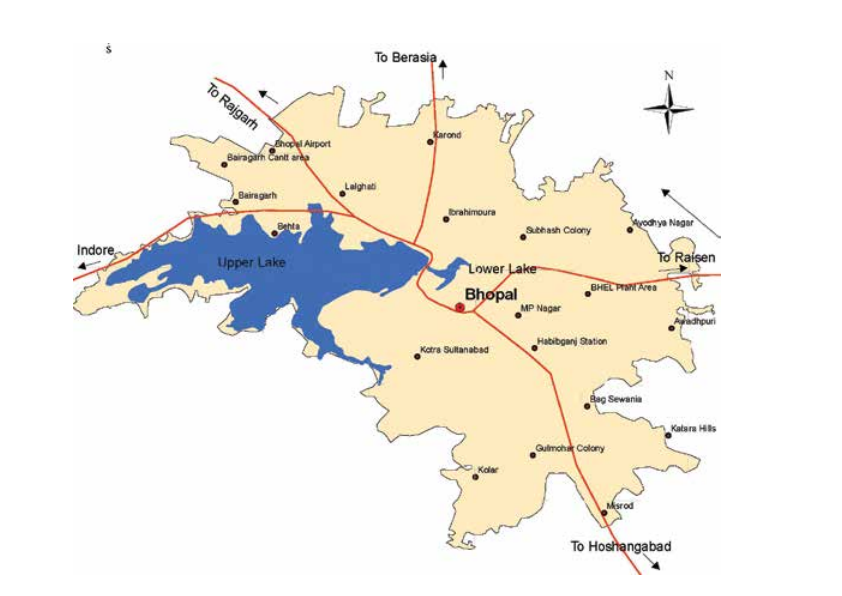
- The river originally served as a natural drainage and freshwater carrier flowing into the Upper Lake (Bada Talab).
- Over the decades, rapid urbanisation, encroachment, and unregulated waste discharge turned the river into a polluted drain, leading to near-total loss of its ecological character.
- About Upper Lake:
- Upper Lake (Bada Talab) is one of India’s oldest man-made lakes, constructed in the 11th century by Raja Bhoj.
- It is part of the Bhoj Wetlands, designated as a Ramsar Site (2002) for its ecological importance.
- Its major inflow sources include Kolans River and seasonal rivulets including the Patra River.
- The lake is crucial because it provides drinking water to over 40% of Bhopal’s population and also serves as an important habitat supporting more than 200 species of birds.
Raja Bhoj
- Raja Bhoj (c. 1010–1055 CE) was one of the most renowned rulers of the Paramara dynasty of Malwa, celebrated for his scholarship, statecraft, and public welfare works.
- He founded the historic city of Bhojpal, which later evolved into modern Bhopal, linked to his large-scale water management initiatives.
- He is credited with constructing the Upper Lake (Bada Talab) by building an embankment across the Kolans River, transforming the region’s hydrology.
- Raja Bhoj authored or patronised several Sanskrit works on Ayurveda, astronomy, architecture, poetics, and grammar, such as the Samarangana Sutradhara (architecture) and Rajamartanda (astrology).
Uttarakhand Switch to Hindi
Dehradun’s First ‘Grey Smart Toilet’
Why in News?
Uttarakhand has inaugurated its first Grey Smart Toilet designed specifically for senior citizens and the people with disabilities, introducing an accessible, tech-enabled sanitation unit in Dehradun.
Key Points
- The Grey Smart Toilet has been installed in Prem Nagar Area, Dehradun, marking the state’s first senior-citizen-centric sanitation facility.
- The toilet equipped with sensor-based automated features, wheelchair-friendly ramps, supportive grab bars, anti-skid flooring, and low-height fixtures to ensure safety and comfort for the elderly.
- It also includes IoT-based monitoring, automatic flushing, water-level sensors, and an app-linked dashboard for maintenance alerts, reducing manual supervision.
- The structure uses pre-fabricated, weather-resistant material, ensuring durability in hilly terrains while maintaining ease of installation and mobility.
- Built under a public-welfare initiative, the project aims to promote dignified and accessible sanitation, aligning with Uttarakhand’s push for people-friendly urban and rural infrastructure.
- The model is expected to be replicated across popular pilgrim and tourist circuits in the state, such as Char Dham routes, where senior citizens form a significant visitor demographic.
Haryana Switch to Hindi
Watchtowers in Aravallis
Why in News?
Two new watchtowers are set to be constructed in the Aravalli region of Gurugram to strengthen surveillance, prevent illegal activities, and improve forest protection efforts.
Key Points
- About the Watchtowers:
- The Forest Department has approved construction of two elevated watchtowers planned in the Mangar Bani and Dhauj belts.
- It will enhance monitoring across vulnerable stretches of the Gurugram–Aravalli landscape, which faces encroachment, mining, tree felling, and illegal dumping, especially in eco-sensitive pockets such as Gairatpur Bas, Gwal Pahari, and Mangar.
- Officials plan to integrate the watchtowers with camera-based monitoring, enabling forest guards to track movement, detect intrusions, and coordinate with beat staff more effectively.
- About Aravalli Range:
- The Aravalli Range is one of the oldest fold mountain systems in the world, stretching across Haryana, Rajasthan, Gujarat, and Delhi.
- It acts as a natural barrier preventing desertification from the Thar Desert toward the Indo-Gangetic plains.
- The range hosts critical ecosystems such as dry deciduous forests, scrublands, and supports species like Indian leopard, striped hyena, sambar, and Indian peafowl.
- Aravallis play a crucial role in groundwater recharge, climate regulation, and reducing urban heat island effects in NCR.
- Major threats include illegal mining, urbanisation, encroachment, pollution, and habitat fragmentation.
Maharashtra Switch to Hindi
BharatGen
Why in News?
BharatGen, India’s first sovereign, multilingual and multimodal AI-driven Large Language Model (LLM), was highlighted by Union Minister of Science and Technology during his visit to IIT Bombay.
Key Points
- About BharatGen:
- BharatGen is India’s first government-supported sovereign AI stack, developed to support over 22 Indian languages across text, speech, and document-vision modalities.
- It has been developed by a consortium led by IIT Bombay, in collaboration with IIT Madras, IIT Kanpur, IIT Hyderabad, IIT Mandi, IIT Kharagpur, IIIT Hyderabad, IIIT Delhi, and IIM Indore.
- The project is funded with ₹235 crore under National Mission on Interdisciplinary Cyber Physical Systems (NM-ICPS), along with an additional ₹1,058 crore from MeitY under the India AI Mission, bringing the total public investment to ₹1,293 crore.
- It is designed to advance India’s digital sovereignty, ensuring that AI development is rooted in Indian languages, cultural contexts, and national priorities.
|
Core AI Models Under BharatGen |
||
|
Model Name |
Modality |
Key Specifications |
|
Param-1 |
Text (LLM) |
Foundational text model trained on 7.5 trillion tokens, with one-third of the dataset comprising Indian linguistic data. |
|
Shrutam |
Speech (ASR) |
Automatic Speech Recognition (ASR) model designed to handle complex Indian linguistic diversity, including multiple dialects. |
|
Sooktam |
Speech (TTS) |
Text-to-Speech (TTS) model providing speech synthesis in nine Indic languages. |
|
Patram |
Document Vision |
India’s first document-vision model trained to interpret complex India-specific document formats such as identity records and legal documents. |
- About Bharat Data Sagar:
- Bharat Data Sagar is one of India’s largest sovereign data initiatives, aimed at ensuring complete national ownership of AI-relevant datasets.
- It focuses on India-centric data curation, covering diverse languages, dialects, cultural nuances, and region-specific contexts.
- It ensures data sovereignty, accuracy, and long-term national regulation over India’s AI ecosystem.
National Current Affairs Switch to Hindi
Nayi Chetna 4.0 Campaign
Why in News?
The Union Minister for Rural Development, alongside the Union Minister for Women and Child Development, launched ‘Nayi Chetna 4.0’, a national campaign under the DAY-NRLM (Deendayal Antyodaya Yojana – National Rural Livelihood Mission).
Key Points
- The fourth edition of Nayi Chetna – Initiative for Change focuses on strengthening women’s safety, mobility, dignity, and socio-economic participation, especially in rural India.
- The campaign will run nationwide from 25th November to 23rd December 2025, led by the extensive network of Self-Help Groups (SHGs) under DAY-NRLM.
- Emphasis given on elimination of substance abuse, which was termed a major cause of domestic violence, and village-level campaigns for violence-free communities.
- The initiative stresses women’s voices in governance, safe public spaces, shared domestic responsibilities, and recognition of women’s economic roles.
DAY-NRLM (Deendayal Antyodaya Yojana – National Rural Livelihood Mission)
- The DAY-NRLM was launched in 2011 and later restructured in 2015 to strengthen its implementation framework and outreach. The mission is implemented by the Ministry of Rural Development.
- The scheme aims to reduce rural poverty by promoting self-employment, skill development, and sustainable livelihoods through Self-Help Groups (SHGs).
- It primarily focuses on mobilizing rural women into SHGs, providing them with credit linkages, capacity-building support, and enhanced access to markets.
- It includes key components such as financial inclusion, digital literacy, and the diversification of livelihood activities to improve and stabilize household incomes in rural areas.


