












.jpg)





.png)


.jpg)

 PCS Parikshan
Bihar Switch to Hindi
Audit of Deo Sun Temple and Umga Temple Complex
Why in News?
The Patna High Court has directed the Bihar Government to conduct a comprehensive health and structural safety audit of the Deo Sun Temple and the Umga Temple Complex in the Aurangabad district to assess their conservation status and prevent further deterioration.
Key Points
- About Deo Sun Temple:
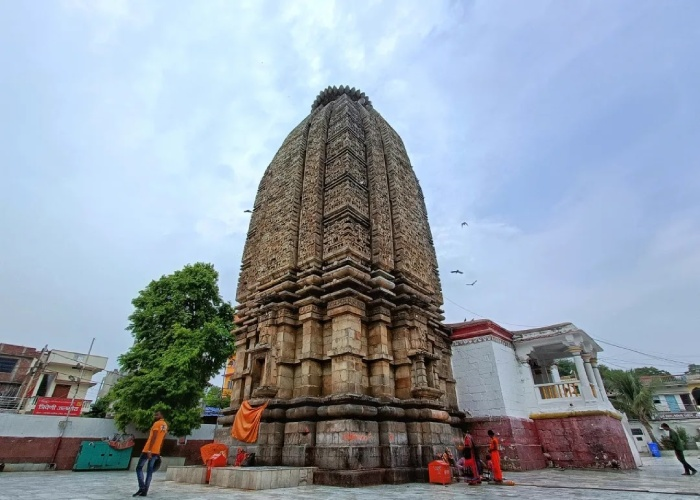
- It is located in Deo town of Aurangabad district, Bihar, and is one of the most prominent temples in India dedicated to Surya (the Sun God).
- This temple dates back to the 8th century and is famous for hosting the Chhath Puja, attracting lakhs of devotees.
- The temple is architecturally unique as its main entrance is oriented towards the West (setting sun), unlike most Hindu temples that face East (rising sun).
- The temple shows signs of structural stress, erosion, and unmanaged visitor load, prompting court-ordered assessment.
- About Umga Temple Complex:
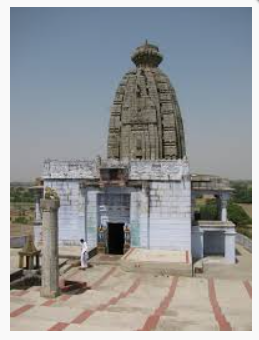
- The Umga Temple Complex, located on the Umga hills in Aurangabad district, is known for its Nagara architecture, with several stone temples carved in a distinctive style.
- Square granite blocks are used to built the magnificent temple, which houses the deities of Lord Ganesha, Sun God and Lord Shiva.
- Many structures face cracks, vegetation growth, and neglect, raising concerns about long-term stability.
Uttarakhand Switch to Hindi
India’s First Digital Twin of the Ganga River Basin
Why in News?
IIT Delhi, in collaboration with the National Mission for Clean Ganga (NMCG), has begun work on developing India’s first Digital Twin of the Ganga River Basin, a high-precision virtual replica.
Key Points
- About the Project:
- IIT Delhi will create a digital twin model—a real-time, data-driven virtual simulation—covering the entire Ganga basin, including major tributaries like Yamuna, Kosi, Ghaghara, Gandak, and Son.
- The model will integrate hydrology, pollution loads, river morphology, land use, groundwater interactions, and climate impacts to provide a continuous 3D digital representation of the basin.
- The system will use remote sensing, GIS, IoT sensors, satellite data, machine learning, and river-flow monitoring to forecast environmental changes and disaster scenarios.
- Benefits:
- Improve flood forecasting, especially for Uttarakhand and the Indo-Gangetic plains, by modelling discharge, rainfall patterns, and glacial melt.
- Enable real-time pollution monitoring to trace point-source discharges, industrial effluents, sewage loads, and seasonal variations.
- Provide scientific support for Namami Gange interventions, including river-cleaning, drain management, wetland conservation, and biodiversity assessment.
- Help identify illegal riverbed activities, sand mining hotspots, and encroachments..
- About Digital Twin:
- A Digital Twin is a virtual, real-time digital replica of a physical system (e.g., a river, city, machine, or ecosystem).
- It continuously updates using live data, enabling simulation, prediction, and decision-making.
- Applications include smart cities, irrigation, transport networks, river management, climate modelling, and infrastructure planning.
National Current Affairs Switch to Hindi
Hayli Gubbi Volcano
Why in News?
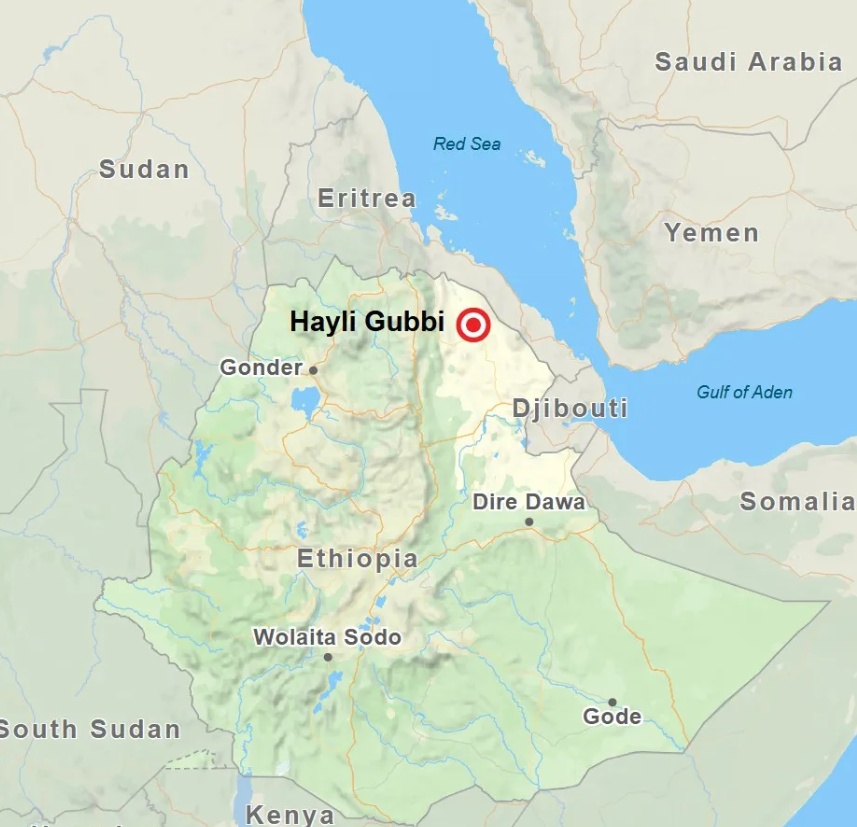
The Hayli Gubbi volcano in Ethiopia has erupted explosively, sending high-altitude ash plumes thousands of metres up, some of which have drifted into Indian airspace, triggering aviation advisories.
Key Points
- Hayli Gubbi volcano is located in Afar, northeastern Ethiopia, within the Danakil Depression - one of the hottest and lowest places on Earth.
- The current eruption is significant because the volcano is believed to have erupted after nearly 12,000 years, based on geological evidence from the Afar Rift.
- The Hayli Gubbi eruption highlights the geological volatility of the East African Rift System (EARS) where active volcanism, fissure eruptions, and spreading ridges are common.
- It is one of the world’s most tectonically active rift systems where the Arabian, Nubian, and Somali plates are diverging.
- The region is characterised by basaltic lava, fissure systems, and frequent seismic activity linked to the continental rifting process.
Volcanic Ash & Aviation Risks
- Volcanic ash is made of tiny, abrasive particles of rock and glass that can melt inside jet engines and cause serious damage.
- Jet engines can stall when ash melts and re-solidifies on turbine blades.
Haryana Switch to Hindi
Digital Geofencing in Sultanpur National Park
Why in News?
Authorities in Haryana are planning to introduce digital geofencing around the Sultanpur National Park buffer zone to monitor land-use changes in real time and curb violations.
Key Points
- About Digital Geofencing:
- The Haryana Forest Department and district administration will create a digital geospatial boundary around the buffer zone of Sultanpur National Park, enabling automatic alerts whenever land-use changes occur in the mapped area.
- The initiative aims to prevent activities such as unauthorized construction, land fragmentation, soil excavation, and commercial land conversion, which have increasingly threatened the ecological sensitivity of the region.
- Satellite imagery, drone surveys, and GIS-based digital mapping will be integrated, allowing real-time tracking of any physical alterations around the sanctuary.
- About Sultanpur National Park:
- Sultanpur National Park, located in Gurugram district, Haryana, is one of India’s prominent bird sanctuaries and an important wintering site for migratory birds from Central Asia, Europe, and Siberia.
- Sultanpur lies along the Central Asian Flyway (CAF), which makes stringent monitoring of land-use change essential to protect migratory species' pathways
- It was declared a Ramsar Site in 2021, highlighting its ecological significance.
- Sultanpur National Park, located in Gurugram district, Haryana, is one of India’s prominent bird sanctuaries and an important wintering site for migratory birds from Central Asia, Europe, and Siberia.
Madhya Pradesh Switch to Hindi
Denwa River in Satpura Tiger Reserve
Why in News?
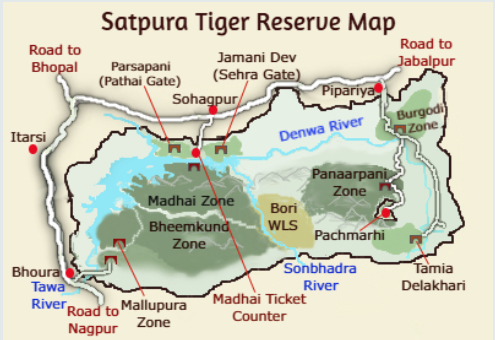
A rare sighting of a tigress swimming across the Denwa River inside the Satpura Tiger Reserve (STR), Madhya Pradesh, was recorded by forest officials, highlighting rising tiger activity and healthy riverine habitats in the reserve.
- Tigress leisurely swimming in the Denwa River is a behaviour seldom captured on camera due to the elusive nature of tigers.
Key Points
- About Denwa River:
- The Denwa River is the lifeline of Satpura Tiger Reserve and originates from the southern slopes of the Mahadeo Hills in the Satpura range.
- It flows northward and joins the Tawa River, forming extensive wetlands inside the reserve, which support rich aquatic and terrestrial biodiversity.
- The river creates natural barriers, riverine islands, and grasslands that act as wildlife corridors for tigers, sloth bears, deer species, and birds.
- About Satpura Tiger Reserve:
- Satpura Tiger Reserve, located in Hoshangabad (Narmadapuram) district, is part of the Satpura–Maikal landscape in Madhya Pradesh.
- Pachmarhi Biosphere Reserve (which includes STR) was the first Biosphere Reserve of Madhya Pradesh (declared in 1999) and was later recognized by UNESCO.
- It comprises Satpura National Park, Pachmarhi Wildlife Sanctuary, and Bori Wildlife Sanctuary, making it one of India’s oldest forest reserves.
- The terrain includes sandstone peaks, deep gorges, ravines, rivers, and dense sal-teak forests, offering ideal tiger habitat.
- It is known for high densities of tigers, leopards, sloth bears, Indian bison (gaur), wild dogs (dhole), and rich bird diversity.
- Satpura Tiger Reserve, located in Hoshangabad (Narmadapuram) district, is part of the Satpura–Maikal landscape in Madhya Pradesh.
Jammu & Kashmir Switch to Hindi
J&K’s First Limestone Block Auction
Why in News?
Jammu & Kashmir hosted its first-ever limestone block auction on 24th November, 2025, marking a major milestone in the Union Territory’s mineral sector reforms under the MMDR Act, 2015.
Key Points
- This is the first mining block auction in Jammu & Kashmir since the introduction of mining reforms under the Mines and Minerals (Development and Regulation) Act, 2015.
- The auction is being conducted under Section 11 of the Act, as amended by the MMDR Amendment Act, 2015, which introduced the auction regime.
- Seven limestone blocks, spread across Anantnag, Rajouri, and Poonch districts, have been identified for auction. The deposits hold high-quality limestone suitable for cement, construction, and allied industries.
- These blocks cover around 314 hectares and fall under UNFC G3 and G4 exploration categories. UNFC – United Nations Framework Classification categorises mineral resources by geological confidence:
- G1 – Detailed Exploration: Highest confidence; drilling and testing clearly establish the size, grade, and exact characteristics of the mineral deposit.
- G2 – General Exploration: Moderate confidence; geological studies and limited drilling indicate the deposit’s continuity and economic potential.
- G3 – Prospecting: Early-stage confidence; preliminary surveys suggest the presence of minerals but without firm data on quantity or quality.
- G4 – Reconnaissance: Lowest confidence; broad regional studies only indicate possible mineralisation, requiring further detailed exploration.\
Limestone
- Limestone is a sedimentary rock rich in calcium carbonate (CaCO₃), widely used in cement, steel, construction, chemicals, and environmental applications.
- India has major reserves in Rajasthan, Andhra Pradesh, Madhya Pradesh, Gujarat, Chhattisgarh, Karnataka, and J&K, making it vital for mineral-based industrial corridors.
- It forms the backbone of the cement industry, where it is processed into clinker, the base material for all major cement types.
- In the steel sector, limestone acts as a flux in blast furnaces, helping remove impurities and improving molten metal quality.


