


Social Justice
World Tuberculosis Day 2026
- 24 Mar 2026
- 13 min read
For Prelims: Tuberculosis (TB), World Health Organization, Pradhan Mantri TB Mukt Bharat Abhiyan, BPaLM Regimen, Ni-kshay Mitras, Ni-Kshay Poshan Yojana (NPY),
For Mains: India’s progress and challenges under the National TB Elimination Programme (NTEP), Drug-resistant TB
Why in News?
Every year, 24th March is observed globally as World Tuberculosis (TB) Day to raise public awareness about the devastating health, social, and economic consequences of TB.
Summary
- World Tuberculosis (TB) Day is observed on 24 March every year to raise awareness about the global impact of tuberculosis and efforts to eliminate it.
- India has made strong progress in TB control with better detection, higher treatment coverage, and reduced deaths, but still carries a very high global burden with many undiagnosed cases.
- TB in India is driven by poverty, malnutrition, drug resistance, and weak detection, so elimination requires better diagnostics, nutrition support, technology use, and community-level interventions.
What is the Significance of World Tuberculosis (TB) Day?
- Historical Context: 24th March commemorates the day in 1882 when Dr. Robert Koch announced his groundbreaking discovery of the Mycobacterium tuberculosis bacterium, the bacillus that causes TB.
- This discovery paved the way for diagnosing and curing the disease.
- Global Theme (2026): The World Health Organization (WHO) have announced the 2026 theme as “Yes! We can End TB!”
- This theme emphasizes a strategic shift from merely stating global ambitions to driving localized action, focusing on strong country-level leadership, rapid innovation uptake, and community mobilization.
- Ending TB is a strategic political and economic choice. Every USD 1 invested in TB can generate up to USD 43 in health and economic returns.
- India’s Initiatives Launched at TB Day 2026:
- TB Mukt Bharat Abhiyaan (100 Days): Mission-mode campaign for rapid TB case detection and improved treatment adherence.
- TB Mukt Bharat App: Digital tool for patient tracking, last-mile service delivery, and treatment compliance.
- TB Mukt Urban Ward Initiative: Micro-level urban strategy targeting high-transmission wards for TB elimination.
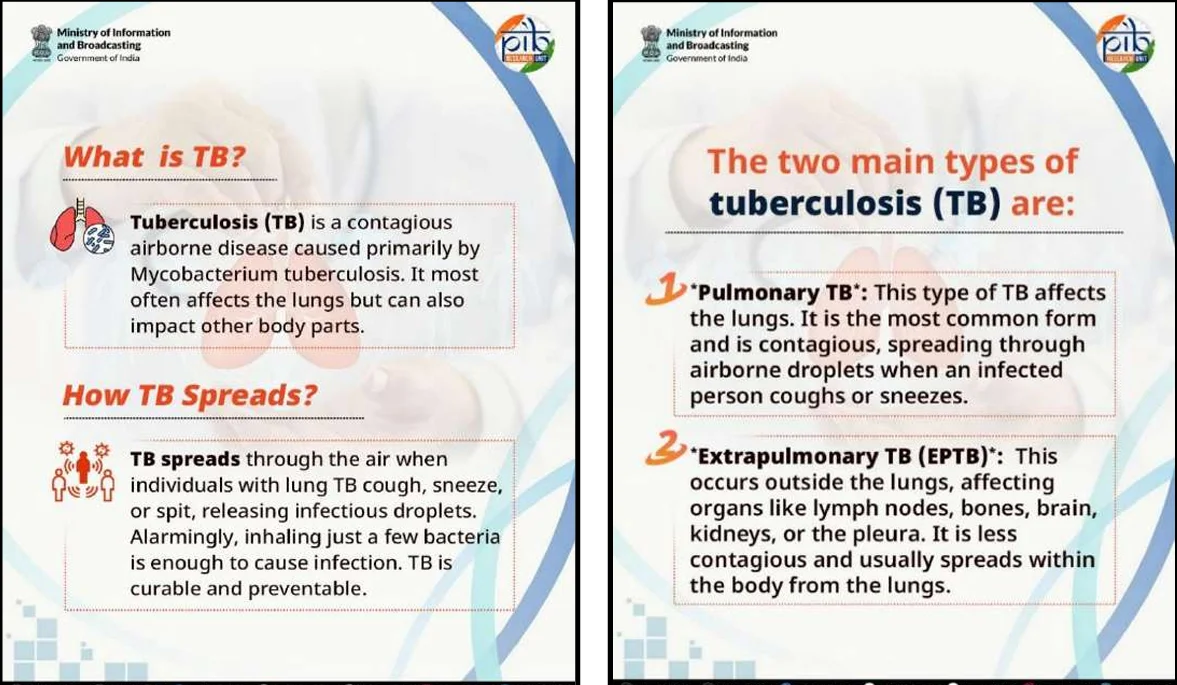
What is the Status of TB in India?
- TB in India: According to the WHO Global Tuberculosis Report 2025, India accounts for around 25% of global TB cases but has achieved a significant decline among high-burden countries, with treatment coverage rising from 53% (2015) to 92% (2024).
- The TB mortality rate reduced from 28 per lakh (2015) to 21 per lakh (2024), while the treatment success rate under the Pradhan Mantri TB Mukt Bharat Abhiyan reached 90% in 2024, exceeding the global average of 88%.
- However, India still accounts for about 28% of global TB deaths, and nearly one lakh cases remain “missing” (undiagnosed), contributing to 8.8% of the global detection gap, second only to Indonesia (10%).
- India’s TB Elimination Target: In 2020, India renamed the Revised National Tuberculosis Control Programme (RNTCP) as the National TB Elimination Programme (NTEP) to align with its ambitious goal of eliminating TB by 2025, five years ahead of the global target of 2030. (India did not achieve this target).
-
TB elimination is defined as less than one notified case per million population per year.
-
The programme is guided by the National Strategic Plan (2017–2025), which follows the Detect–Treat–Prevent–Build (DTPB) approach to comprehensively address TB control.
-
While the WHO End TB Strategy targets an 80% reduction in incidence and 90% reduction in deaths by 2030 (from 2015 levels), India has achieved a 21% decline in new cases and a 28% reduction in deaths between 2015 and 2024, indicating progress but also highlighting the gap to meet elimination targets.
-
- India’s Advancements in TB Elimination:
- Early Detection at Scale: India now has the world’s largest TB lab network, and 92% of patients receive upfront Rifampicin drug-resistance testing. This level of early detection helps cut transmission at the source.
- Shorter Treatment Regimens: Introduction of the BPaLM (bedaquiline, pretomanid, linezolid, moxifloxacin) regimen reduced DR-TB treatment duration from 18–24 months to just 6 months.
- All-oral MDR-TB therapies improved safety, reduced dropouts and increased successful treatment outcomes.
- Decentralised Care: 1.78 lakh Ayushman Arogya Mandirs & Ni-kshay Mitras improved access to testing and treatment.
- Nutrition Support: Under the Ni-Kshay Poshan Yojana (NPY), financial aid increased to Rs 1000/month, providing Rs 3,000 to Rs 6,000 per patient throughout treatment. for better treatment adherence and recovery.
What are the Major Challenges in Meeting the TB Elimination Target?
- Crisis of Drug-Resistant TB (MDR/XDR-TB): India accounts for a staggering 32% of the global multi-drug-resistant (MDR) and rifampicin-resistant TB cases.
-
The treatment for drug-resistant TB is complex, highly toxic, heavily expensive, and significantly longer. While the treatment success rate for new (drug-sensitive) TB cases is around 90%, it drops to roughly 77% for MDR-TB cases.
-
-
Co-morbidities: Medical intervention alone cannot cure TB if the host's immunity is compromised.
-
Malnutrition is the most critical driver of TB in India, linked to roughly 35% of all active cases.
-
High prevalence of anemia and stunting in high-burden states (like Bihar, Jharkhand, and Uttar Pradesh), coupled with rising rates of Diabetes (in 2024 around 3.2 lakh TB cases were linked to diabetes ) and HIV, creates a fertile ground for the TB bacillus to thrive.
-
-
Diagnostic Gaps: Fear of social exclusion, marital rejection (especially for young women), and loss of employment lead to massive under-reporting.
-
Many patients hide their symptoms or abandon treatment prematurely once they start feeling slightly better.
-
Over a lakh TB cases remain "missing" (undiagnosed or untreated in the informal private sector) every year, acting as active transmitters of the disease in communities.
-
While rapid molecular tests (like Truenat and CBNAAT) have expanded, upfront access to these tests in rural and remote areas remains uneven, leading to reliance on outdated, less sensitive sputum microscopy..
-
Supply Chain Disruptions: Frequent stockouts of critical first-line and second-line drugs in several states force patients to skip doses—a direct catalyst for developing deadly drug resistance.
-
-
Socio-Economic Determinants and Migration: TB is profoundly a disease of poverty. Overcrowded living conditions and poor indoor ventilation in urban slums provide ideal environments for airborne transmission.
-
Circular migration of informal labor makes it incredibly difficult for health workers to track patients and ensure uninterrupted Directly Observed Treatment (DOTS).
-
-
Funding and R&D Deficits: R&D funding for developing highly effective adult TB vaccines (the current BCG vaccine is only effective in severe childhood TB) and cheaper point-of-care diagnostics falls drastically short of required targets.
What Measures can Strengthen TB Elimination Efforts in India?
- Targeting Asymptomatic Carriers: The National TB Prevalence Survey revealed that nearly half of all TB cases in India are subclinical (asymptomatic).
- Relying solely on symptom-based screening is no longer viable. There must be a mass rollout of AI-enabled portable Chest X-rays (CXR) and non-invasive tongue/nasal swabs in communities to identify "silent" transmitters.
- Tackling Drug Resistance: Rapid testing reduces diagnostic delays, allowing immediate identification of rifampicin resistance so that patients with Multi-Drug Resistant TB (MDR-TB) are not kept on ineffective first-line drugs.
- Tribal-Focused Financing: TB prevalence among Scheduled Tribes is roughly 50% higher than the national average.
- Utilizing innovative local financing mechanisms such as tapping into District Mineral Foundation (DMF) funds in mining-affected tribal belts can upgrade local diagnostic and nutritional infrastructure.
- Digital Tracking: Upgraded digital tools like the newly launched TB Mukt Bharat App will help trace patients in real-time and prevent deadly treatment dropouts.
- Tackling Undernutrition: Financial aid under the Ni-kshay Poshan Yojana must be seamlessly linked with the Public Distribution System (PDS).
- Furthermore, the Ni-kshay Mitra initiative (where corporates and citizens adopt patients to provide food baskets) needs sustained expansion.
- TB Preventive Treatment (TPT): Proactively administering preventive therapy to the household contacts of active TB patients to break the chain of transmission before the disease develops.
Conclusion
- Achieving a TB-Mukt Bharat requires viewing Tuberculosis not just as a pathogen, but as a symptom of poverty and inequality. Integrating TB care with broader developmental goals such as improving housing ventilation, alleviating poverty, and ensuring universal health coverage through Ayushman Aarogya Mandirs is the ultimate key to sustainable elimination.
|
Drishti Mains Question: Q. Despite aggressive programmatic interventions, India has missed its ambitious target of eliminating Tuberculosis by 2025. Critically analyze the major clinical and socio-economic bottlenecks hindering India's TB elimination efforts. |
Frequently Asked Questions (FAQs)
- What is World Tuberculosis Day and why is it observed on 24 March?
It marks Dr. Robert Koch’s discovery (1882) of the TB-causing bacterium, raising awareness about TB’s global impact. - What is the theme of World TB Day 2026?
The theme is “Yes! We can End TB!”, focusing on localized action and innovation-driven strategies. - What is India’s TB elimination target under NTEP?
India aims to eliminate TB by 2025 (not achieved), ahead of the global target of 2030. - What are the major challenges in TB elimination in India?
Drug-resistant TB, malnutrition, diagnostic gaps, stigma, and migration remain key barriers. - What key initiatives were launched for TB control in 2026?
TB Mukt Bharat Abhiyaan (100 Days), TB Mukt Bharat App, and Urban Ward Initiative aim to improve detection, tracking, and localized intervention.
UPSC Civil Services Examination, Previous Year Questions (PYQs)
Mains
Q. Besides being a moral imperative of a Welfare State, primary health structure is a necessary precondition for sustainable development.” Analyse. (2021)



