


Indian Economy
State Finances: A Study of Budgets of 2025–26
- 30 Jan 2026
- 17 min read
For Prelims: Demographic Transition, Fiscal Deficit, GST, Capital Expenditure, Scheme for Special Assistance to States for Capital Investment (SASCI), Consolidated Sinking Fund, Guarantee Redemption Fund, Total Fertility Rate (TFR), Demographic Winter, Tax Buoyancy, Silver Economy, ,National Pension System (NPS), Public Private Partnership, Green Hydrogen.
For Mains: Key findings of the RBI’s State Finances: A Study of Budgets of 2025–26, fiscal implications of India's demographic transition for state governments and way forward for harnessing the demographic dividend and mitigate the risks of ageing population.
Why in News?
The RBI’s State Finances: A Study of Budgets of 2025–26 report notes that India is at a critical demographic inflection point, with the need to harness the youth bulge while preparing for an ageing population.
- It stresses that tailored state-level fiscal strategies, aligned with different stages of demographic transition, are essential for sustainable economic growth.
Summary
- India’s States face varied demographic stages, demanding differentiated fiscal strategies.
- Youthful States require investment in education, skills, and job creation; Ageing States must prioritise healthcare and pensions.
- Capital expenditure, revenue mobilisation, and fiscal buffers are crucial for sustainable growth and debt management.
What are the Key Findings of the RBI's State Finances Report 2025-26?
- Demographic Diversity Across States: The median age varies from 23 years in Bihar to 37 years in Kerala, while the old-age dependency ratio ranges from 14.0 to 30.1, leading to the classification of states into Youthful, Intermediate, and Ageing categories, each requiring distinct fiscal approaches. It calls for differentiated fiscal strategies.
- Youthful States need higher spending on education, skilling, and job creation; Intermediate States should focus on infrastructure, urban reforms, and female workforce participation; Ageing States must prepare for higher healthcare, pension, and social welfare costs.
- Widened Fiscal Deficit: The states’ Gross Fiscal Deficit (GFD) widened to 3.3% in 2024-25 (from lower levels post-pandemic), primarily due to lower grants from the Centre (decline in GST compensation & revenue deficit grants).
- 16 States have budgeted a GFD exceeding 3% of GSDP for 2025-26, with 13 States surpassing 3.5%.
- State-Level Reforms for Revenue Growth: States' own tax base is highly concentrated, with State GST, sales tax, excise duties, and stamp duties constituting ~90% of collections. States are exploring non-tax revenue sources like mineral taxation and asset monetisation.
- Capital Push and Social Sector Focus: Capital expenditure has firmed up steadily, supported by the Centre's Scheme for Special Assistance to States for Capital Investment (SASCI). It is expected to increase up to 3.2% of GDP in 2025-26. Social sector expenditure is the major driver of revenue expenditure in 2025-26 (8.2% of GDP).
- Debt and Borrowings: Consolidated debt of States declined to 28.1% of GDP by March 2024 from a peak of 31% (March 2021), but is budgeted to rise to 29.2% by March 2026.
- Market borrowings now finance about 76% of the GFD (2025-26), indicating increased reliance.
- Interest payment burden remains manageable (Interest Payments-to-GDP stable at 1.5–1.9%), aided by concessional loans from the Centre.
- The maturity profile of State Government Securities (SGS) is elongating, with an increase in issuances beyond 10–15 years.
- Other Key Observations: Research & Development (R&D) expenditure by States is low (around 0.2–0.3% of GSDP) and dominated by medical and agricultural research.
- States are building fiscal buffers via the Consolidated Sinking Fund (CSF, Rs 2.4 lakh crore) and Guarantee Redemption Fund (GRF, Rs 16,019 crore).
- SASCI has been highly effective, with nearly full disbursement (Rs 1.49 lakh crore in 2024-25) and driving reforms.
Demographic Transition
- About: The demographic transition describes the historical shift from high to low birth and death rates as a country develops. It typically involves several stages.
- Stage 1: High birth and high death rates lead to a stable, low population.
- Stage 2: Death rates fall due to better healthcare and food security, while birth rates remain high, causing rapid population growth.
- Stage 3: Birth rates begin to decline due to urbanization, education, and family planning, slowing population growth.
- Stage 4: Both birth and death rates are low, leading to a stable or aging population.
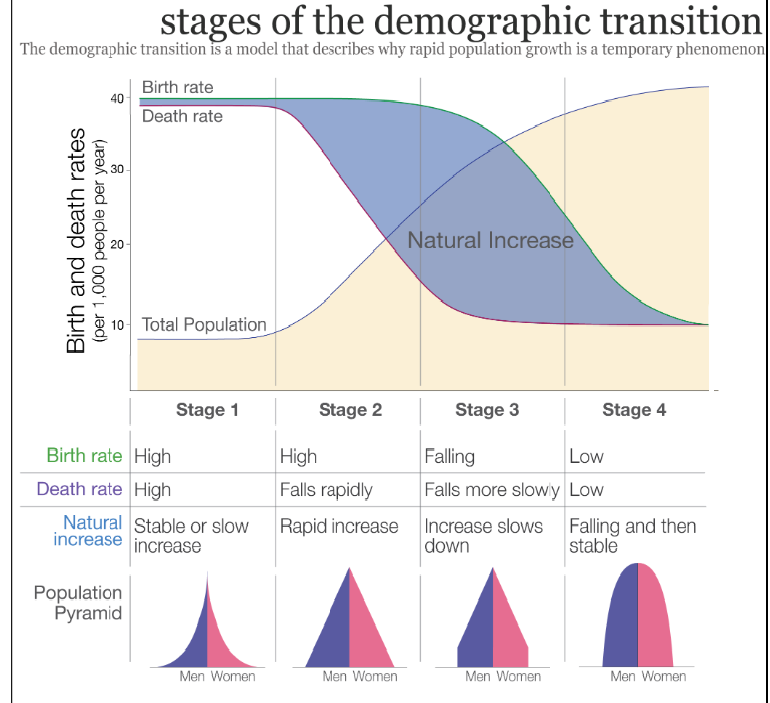
- India's Current Demographic Status: As per the 2011 Census, India is in Stage 3 of the demographic transition model.
- The Total Fertility Rate (TFR) has fallen to 2.0 (as per NFHS-5), which is below the replacement rate of 2.1. This means, on average, women are having fewer children than needed to maintain the current population size without migration.
- Future Projection: According to the UN's World Population Prospects 2024, India's population is expected to peak at around 1.7 billion in the early 2060s and then gradually decline, though it will remain the world's most populous country.
- Demographic Disaster: A demographic disaster occurs when a rapidly growing working-age population (15–64 years) fails to boost growth, creating unemployment, underemployment, social unrest, higher dependency, and long-term economic stagnation.
- Demographic Winter: The Demographic winter refers to a long-term population decline from low birth rates (below ~2.1 children per woman), causing a shrinking workforce, higher elder dependency, and strained social systems. China’s population fell for the fourth consecutive year in 2025, highlighting this trend.
What are the Fiscal Implications of India's Demographic Transition for State Governments?
|
Area |
Youthful States |
Intermediate States |
Ageing States |
|
Revenue Potential |
High potential tax buoyancy due to expanding working-age population, rising incomes, consumption, and labour participation. Requires productivity-enhancing investments to realise demographic dividend (e.g., Bihar, Uttar Pradesh). |
Stable but slowing revenue growth as workforce share peaks. Scope to tap skilled labour, services, and silver economy (senior citizens centered) (e.g., Telangana). |
Shrinking or stagnant tax bases as the working-age population declines. Lower income and consumption growth caps own-source revenues (e.g., Kerala, Punjab). |
|
Expenditure Composition |
High developmental spending needs on education, skilling, healthcare, and job creation to absorb youth bulge; lower old-age welfare burden initially. |
Dual expenditure pressure—continued investment in human capital alongside rising healthcare and social security demands. |
Rising committed expenditure on pensions, geriatric healthcare, and social security, crowding out infrastructure and education spending. |
|
Debt Sustainability & Fiscal Space |
Manageable debt outlook if growth-enhancing spending raises future revenues; risk of stress if youth dividend is missed. |
Tightening fiscal space as welfare obligations rise while revenue growth moderates; careful debt management required. |
High stress on debt sustainability due to rising welfare spending, and high interest payments; fiscal deficits risk exceeding 3% of GSDP. |
|
Fiscal Buffers, Transfers & Productivity |
Need to build early fiscal buffers and invest in productive capex; benefit relatively from current Finance Commission devolution norms based on population size. |
Strategic focus on expenditure quality, R&D, and technology to offset future ageing effects; gradual buffer creation. |
Strong need for fiscal buffers, prudent contingent liability management (pensions), higher R&D spending, and reform of devolution criteria to reflect higher old-age dependency ratios. |
How can States Harness the Demographic Dividend and Mitigate the Risks of Ageing Population?
Harnessing the Demographic Dividend
- Hyper-Local Skill Matching: Use AI-driven platforms to map local industry demand in real-time with the skill profiles of youth, creating dynamic, district-level apprenticeship and job-matching ecosystems.
- Create ‘Opportunity Corridors’ in Emerging Sectors: Identify and develop specialized industrial/technology corridors focused on future sectors (e.g., green hydrogen, semiconductors, space technology) with pre-approved land, plug-and-play infrastructure, and fast-tracked clearances to attract investment and high-quality jobs.
- Implement a ‘Learn-Earn-Pension’ Continuum: Bundle student loans with guaranteed internship stipends and an option to auto-enroll a micro-contribution into the National Pension System (NPS) upon first employment, fostering long-term financial security from the start of a career.
- Foster District as an Export Hub (DEH) Model: Empower districts with high youth populations to specialize in niche products (handicrafts, textiles, food processing). Provide integrated support for branding, e-commerce onboarding, logistics, and meeting global quality standards to turn local talent into global entrepreneurs.
Mitigating Risks of Population Ageing
- Develop Silver Economy Clusters: Incentivize the private sector to develop integrated townships or clusters with age-friendly housing, accessible healthcare facilities, recreation centers, and geriatric care services, creating new economic ecosystems and reducing public infrastructure burden.
- Elderpreneurship Schemes: Partner with industry to design flexible, part-time, and consultancy-based roles for experienced retirees. Provide seed grants and incubation support for seniors to start social enterprises or knowledge-based consultancies.
- Sub-National Longevity Funds: Create dedicated state-level funds, potentially through public-private partnerships, to invest in and subsidize preventive healthcare, telemedicine, assistive technologies, and drug research for age-related diseases.
Conclusion
India’s demographic transition presents both opportunities and challenges for State finances. Harnessing the youth bulge through skill development, employment, and innovation can boost revenue, while ageing populations require fiscal buffers, social security, and healthcare preparedness. Tailored, stage-specific fiscal strategies are essential for sustainable growth and intergenerational equity.
|
Drishti Mains Question: Examine the fiscal implications of India’s demographic transition for State governments and suggest measures for sustainable finances. |
Frequently Asked Questions (FAQs)
1. What is the Gross Fiscal Deficit (GFD) trend for States in 2025-26?
States budgeted a GFD of 3.3% of GDP, with 16 States exceeding 3% and 13 States surpassing 3.5% of GSDP.
2. What is the primary reason for the widening of the Gross Fiscal Deficit (GFD) of states in 2024-25?
It was primarily driven by lower revenue receipts due to a sharp decline in grants from the Centre, including reduced GST compensation and post-devolution revenue deficit grants.
3. Which States are classified as Youthful, Intermediate, and Ageing?
Youthful: Bihar, Uttar Pradesh; Intermediate: Telangana; Ageing: Kerala, Punjab, based on median age and old-age dependency ratios.
UPSC Civil Services Examination, Previous Year Questions (PYQs)
Prelims
Q. To obtain full benefits of demographic dividend, what should India do? (2013)
(a) Promoting skill development
(b) Introducing more social security schemes
(c) Reducing infant mortality rate
(d) Privatization of higher education
Ans: (a)
Q. Consider the following specific stages of demographic transition associated with economic development: (2012)
- Low birthrate with low death rate
- High birthrate with high death rate
- High birthrate with low death rate
Select the correct order of the above stages using the codes given below:
(a) 1, 2, 3
(b) 2, 1, 3
(c) 2, 3, 1
(d) 3, 2, 1
Ans: (c)
Mains
Q. What is the concept of a ‘demographic winter’? Is the world moving towards such a situation? Elaborate. (2024)
Q. Discuss the main objectives of Population Education and point out the measures to achieve them in India in detail. (2021)
Q. ‘’Empowering women is the key to control the population growth.’’ Discuss. (2019)
Q. Critically examine the effect of globalization on the aged population in India. (2013)



