


Important Facts For Prelims
Green Ammonia
- 24 Feb 2026
- 6 min read
Why in News?
The Solar Energy Corporation of India (SECI) succeeded in its green ammonia auction under the SIGHT programme, setting new global price benchmarks and establishing India as a potential leader in the emerging clean ammonia market.
What is Green Ammonia?
- About: Green ammonia refers to ammonia (NH₃) synthesized through a sustainable process that relies entirely on renewable energy sources, resulting in a near-zero carbon footprint, unlike conventional methods.
- Production Process: It utilizes the established Haber-Bosch process but with key modifications:
- Green Hydrogen Production: Renewable energy (solar, wind, hydro) powers electrolysis, splitting water (H₂O) into green hydrogen and oxygen.
- Nitrogen Extraction: Nitrogen (N₂) is separated from atmospheric air.
- Ammonia Synthesis: Hydrogen and nitrogen are combined under high pressure and temperature using a catalyst, powered entirely by renewable electricity.
- Comparison with Other Ammonia Types:
|
Type of Ammonia |
Source/Production Method |
Carbon Emissions Profile |
Key Characteristics |
|
Grey/Brown Ammonia |
Produced from fossil fuels – Natural Gas via Steam Methane Reforming (SMR) or coal gasification |
Highest CO₂ emissions (no carbon capture) |
Conventional method; carbon-intensive; widely used in fertilizer industry |
|
Blue Ammonia |
Produced from fossil fuels (SMR or gasification) with Carbon Capture and Storage (CCS) |
Moderate emissions (partially reduced through CCS) |
Transitional low-carbon option; depends on CCS efficiency |
|
Green Ammonia |
Produced using renewable energy through water electrolysis to generate green hydrogen, combined with nitrogen |
Near-zero emissions |
Fully decarbonized pathway; aligned with climate goals and energy transition |
- Environmental Significance: Conventional ammonia production is one of the world's largest industrial emitters, accounting for nearly 2% of global CO₂ emissions. It emits approximately 2–3 tons of CO₂ per ton of ammonia produced. This carbon emission can be curbed by green ammonia.
- Applications:
- Green Fertilizer: Decarbonizes the global food chain by replacing fossil-fuel-based feedstock for agriculture.
- Carbon-Free Fuel: Can be used in maritime shipping (replacing heavy fuel oil) and power generation (co-firing with coal or in dedicated turbines). While combustion produces NOx, it can be managed with technologies like Selective Catalytic Reduction (SCR).
- Hydrogen Carrier: Addresses hydrogen's storage and transport challenges. Ammonia is easier to liquefy (at -33°C) than hydrogen (below -253°C) and can leverage existing infrastructure. It can be "cracked" back into hydrogen at its destination.
Strategic Interventions for Green Hydrogen Transition (SIGHT) Scheme
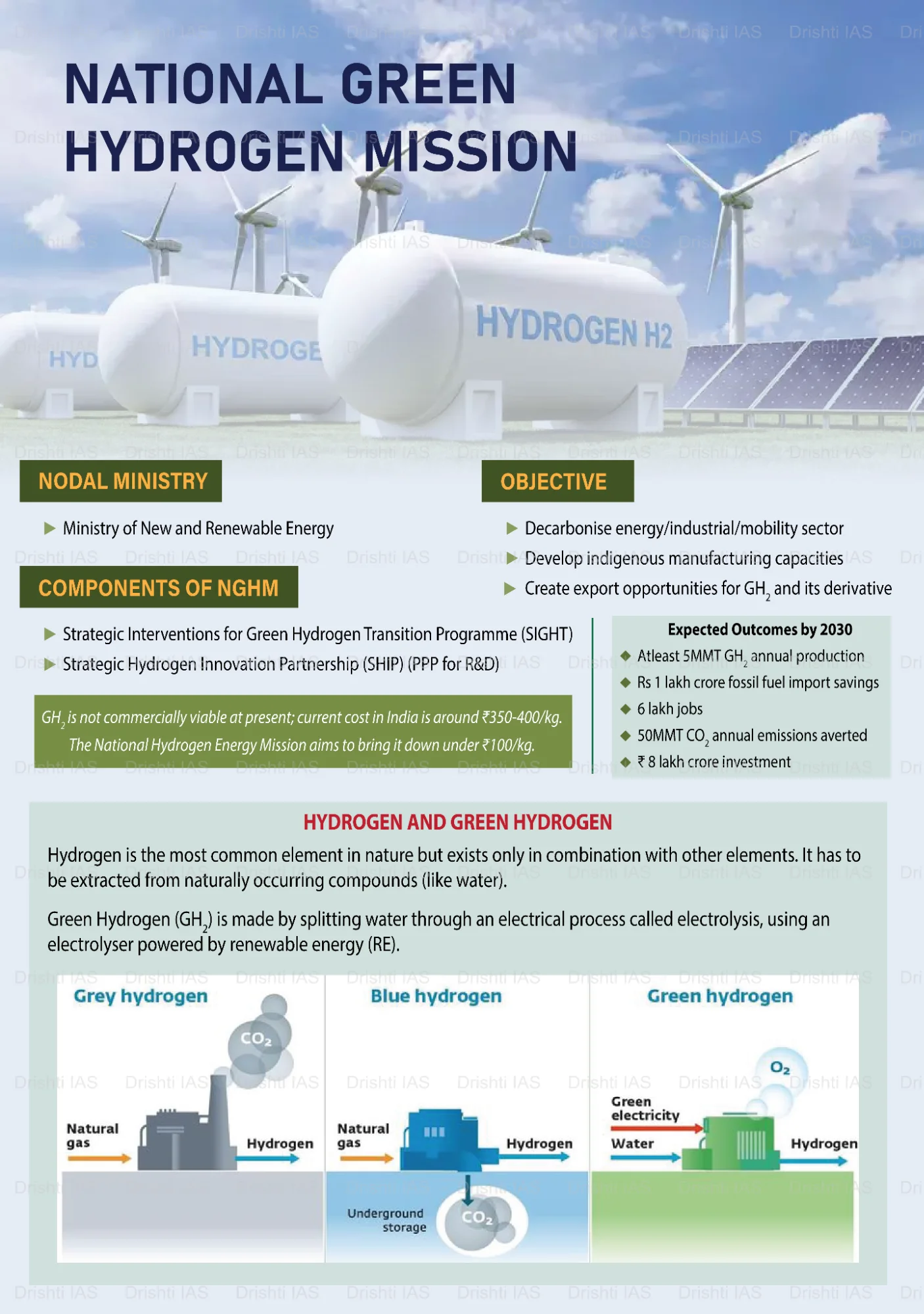
- About: The SIGHT scheme is a financial incentive programme under the National Green Hydrogen Mission. It is implemented by the Ministry of New and Renewable Energy (MNRE) through SECI via competitive bidding.
- Objectives: The scheme aims to stimulate domestic electrolyser manufacturing and boost production of green hydrogen and its derivatives, such as green ammonia.
- Its objectives include achieving cost competitiveness against fossil fuels, ensuring technology advancement, and enabling progressive localization aligned with global standards.
- Two Key Components:
- Component I (Electrolyser Manufacturing): Focuses on indigenous manufacturing of electrolysers. Incentives are performance-linked, based on energy efficiency and localization.
- Component II (Green Hydrogen Production): Targets production of green hydrogen and derivatives (notably green ammonia). Implemented through competitive bidding modes. It offers financial support and long-term offtake agreements (7–10 years) to de-risk investments.
Frequently Asked Questions (FAQs)
1. What is Green Ammonia?
Green ammonia is NH₃ produced using renewable energy-powered electrolysis, resulting in near-zero carbon emissions compared to fossil fuel-based methods.
2. How does Green Ammonia differ from Grey and Blue Ammonia?
Grey ammonia uses fossil fuels without carbon capture; Blue ammonia includes CCS; Green ammonia relies entirely on renewable energy and green hydrogen.
3. What is the objective of the SIGHT Scheme?
The scheme promotes electrolyser manufacturing and green hydrogen production through financial incentives and competitive bidding.
UPSC Civil Services Examination, Previous Year Questions (PYQs)
Q. Consider the following heavy industries: (2023)
- Fertilizer plants
- Oil refineries
- Steel plants
Green hydrogen is expected to play a significant role in decarbonizing how many of the above industries?
(a) Only one
(b) Only two
(c) All three
(d) None
Ans: (c)
Q. With reference to green hydrogen, consider the following statements : (2023)
- It can be used directly as a fuel for internal combustion.
- It can be blended with natural gas and used as fuel for heat or power generation.
- It can be used in the hydrogen fuel cell to run vehicles.
How many of the above statements are correct?
(a) Only one
(b) Only two
(c) All three
(d) None
Ans: (c)
Q. Hydrogen fuel cell vehicles produce one of the following as “exhaust” (2010)
(a) NH3
(b) CH4
(c) H2O
(d) H2O2
Ans: (c)



