


Important Facts For Prelims
Code of Wages, 2019
- 04 Feb 2026
- 7 min read
Why in News?
The Supreme Court (SC) urged States to evolve "suitable mechanisms" and take a "final call" on bringing domestic workers under the legal protection and benefits of the Minimum Wages Act, 1948 and the Code of Wages, 2019.
What is Code of Wages, 2019?
- About: The Code on Wages, 2019 is a landmark labour reform aimed at ensuring fair wages, social justice, ease of compliance, and employment generation, by consolidating multiple wage-related laws into a single, uniform legal framework across India.
- It promotes Single Registration, Single License, and Single Return. It reduces rules from 163 to 58, forms from 20 to 6, and registers from 24 to 2.
- Origin: Enacted based on recommendations of the 2nd National Commission on Labour (2002) to consolidate 29 laws into four functional codes, namely, the Code on Wages, 2019, the Industrial Relations Code, 2020, the Code on Social Security, 2020 and the Occupational Safety, Health and Working Conditions Code, 2020.
- It subsumes four existing laws namely the Payment of Wages Act, 1936; the Minimum Wages Act, 1948; the Payment of Bonus Act, 1965; and the Equal Remuneration Act, 1976.
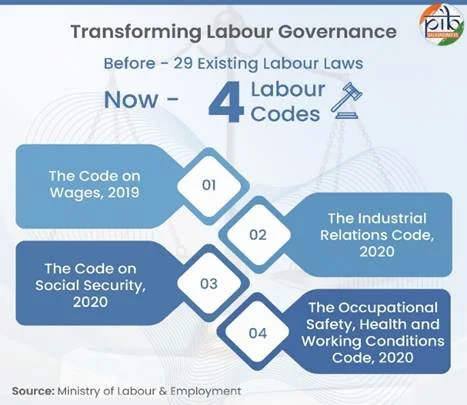
- Objective: Aims to balance worker protection with ease of compliance for employers, driving economic growth through decent employment.
- Key Pro-Worker Reforms & Provisions:
- Universalisation of Minimum Wages (Section 5): Extends statutory right to minimum wages to all employees in both organised and unorganised sectors, moving from ~30% coverage to 100%.
- Introduction of National Floor Wage (Section 9): Empowers the Central Government to set a baseline floor wage based on minimum living standards; states cannot fix minimum wages below this floor.
- Fixing of Minimum Wages: Rates are to be fixed by the appropriate Government based on skill, geographical area, and arduousness of work, and revised ordinarily every 5 years.
- Timely Wage Payments (Section 17): Applies to all employees without any wage ceiling. Strict timelines are set (e.g., monthly wages within 7 days of the next month; termination wages within 2 working days).
- Stipulated Working Hours (Section 13): Limits work to 48 hours a week and a maximum of 12 hours a day (including rest intervals).
- Section 14 mandates overtime wages payment at twice the normal wage rate.
- Proof of Payment (Section 50): Mandates issuance of wage slips to all workers, including in the unorganised sector.
- Pro-Employment and Compliance Reforms:
- Decriminalization & Compounding of Offences (Section 56): Replaces criminal penalties (imprisonment) with civil penalties (fines) for first-time offences punishable by fine only.
- It introduces a compounding provision where such offences can be settled by paying 50% of the maximum fine.
- Inspector-cum-Facilitator (Section 51): Replaces the "Inspector Raj" with a transparent, web-based random inspection system and a facilitative role.
- Protection of Employer's Assets (Section 64): Safeguards employer's deposits/dues with government from court attachment, except for liabilities towards employees.
- Decriminalization & Compounding of Offences (Section 56): Replaces criminal penalties (imprisonment) with civil penalties (fines) for first-time offences punishable by fine only.
- Gender Inclusivity and Social Justice:
- Prohibition of Gender Discrimination (Section 3): Mandates no discrimination in recruitment, wages, or conditions based on gender (including transgender) for the same or similar work.
- Women's Representation in Advisory Boards (Section 42): Ensures at least one-third of Central and State Advisory Board members are women. These boards advise on minimum wage fixation and increasing employment opportunities for women.
Frequently Asked Questions (FAQs)
1. What is the Code of Wages, 2019?
It is a consolidated labour law that merges four wage-related Acts to ensure universal minimum wages, fair pay, and ease of compliance across India.
2. Which laws are subsumed under the Code of Wages, 2019?
The Payment of Wages Act, 1936; Minimum Wages Act, 1948; Payment of Bonus Act, 1965; and Equal Remuneration Act, 1976.
3. What is the National Floor Wage under the Code of Wages?
Under Section 9, the Central Government fixes a baseline wage linked to minimum living standards, below which states cannot set minimum wages.
UPSC Civil Services Examination, Previous Year Questions (PYQs)
Q. In India, which one of the following compiles information on industrial disputes, closures, retrenchments and lay-offs in factories employing workers? (2022)
(a) Central Statistics Office
(b) Department for Promotion of Industry and Internal Trade
(c) Labour Bureau
(d) National Technical Manpower Information System
Ans: (c)



