
-
Q. Discuss the role of Public–Private Partnerships (PPPs) in promoting innovation in emerging technologies in India. (250 words).
11 Feb, 2026 GS Paper 3 Science & TechnologyApproach:
- Introduce your answer by explaining PPPs models.
- In the body explain how this can be leveraged in promoting innovation.
- Mention limitations in this approach.
- Suggest measures to overcome these limitations.
- Conclude accordingly.
Introduction:
In the journey toward Viksit Bharat @2047, Public–Private Partnerships (PPPs) have evolved from mere infrastructure tools into the engine for India's Deep-Tech revolution.
- By 2026, the traditional models of building roads have been adapted to build Sovereign Clouds, AI Supercomputers, and Space Constellations.
Body:
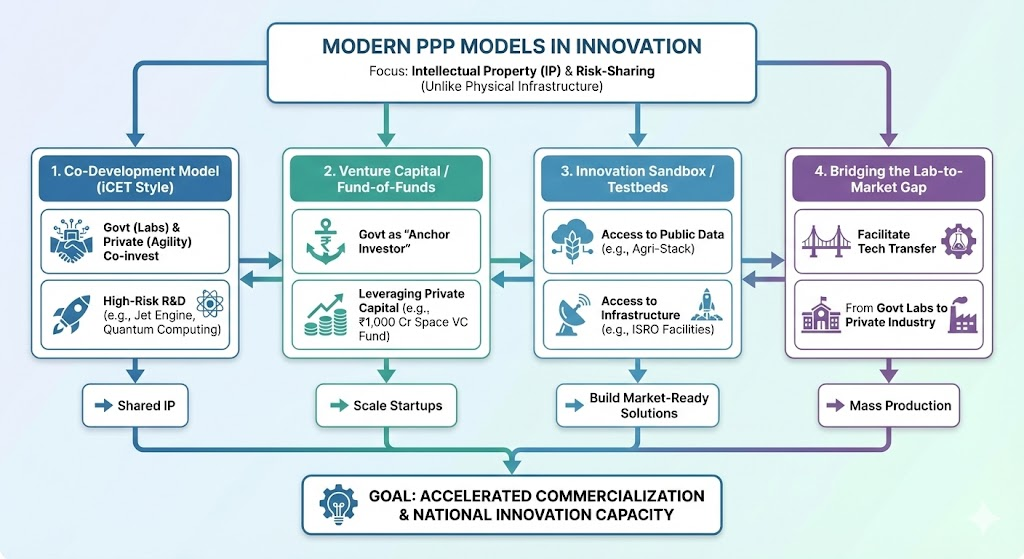
Leveraging PPPs for Emerging Technologies
PPPs act as a bridge across the "Valley of Death" (the gap between lab research and commercial success).
- Artificial Intelligence (IndiaAI Mission): The government provides the GPU-based supercomputing clusters, while private companies (Sarvam) develop the Large Language Models (LLMs).
- Also, PPPs are building Sovereign Cloud platforms to ensure critical data stays within India while using private-sector encryption technologies.
- Semiconductors (ISM 2.0): Through the India Semiconductor Mission (ISM) 2.0, the state provides massive fiscal incentives, while private giants like Tata Electronics manage the high-value fabrication (Fabs) and assembly units.
- The state also offers "Tool Hours" on public Electronic Design Automation platforms, allowing private startups to design chips without massive upfront costs.
- Space: IN-SPACe is acting as a single-window PPP regulator and allows private firms like Skyroot or Agnikul to use ISRO’s launch pads and testing facilities, reducing the "time-to-market" for private satellite launches.
- Also, India is set to deploy a fully indigenous commercial EO satellite constellation under a public-private partnership.
- Digital Public Infrastructure (DPI): India has pioneered a unique PPP model where the government builds the "rails" (open protocols), and the private sector builds the "trains" (consumer apps).
- Example: UPI (Unified Payments Interface) is managed by NPCI (a quasi-public body), but the innovation in fintech (PhonePe, Paytm, Google Pay) is driven by the private sector building upon this public backbone.
Limitations of the PPP Approach in Innovation:
- Low GERD Participation: India's Gross Expenditure on R&D (GERD) remains at ~0.64% of GDP. Critically, the private sector contributes only ~37%, compared to over 70% in the US and South Korea.
- Risk Aversion: High-risk, long-gestation projects (like Quantum or Biotech) often struggle to attract private capital looking for quick returns.
- IP Ownership Disputes: Conflicts over who owns the Intellectual Property generated through public funding often stall collaboration.
- Bureaucratic Rigidities: Complex procurement rules and "L1" (lowest bidder) mentalities in government contracts are incompatible with the "fail-fast" nature of emerging tech.
Measures to Strengthen the Partnership:
- Outcome-Based Funding: Shift from "input-based" funding to rewarding milestones (e.g., successful prototype/patent filing).
- Clear IP Framework: Standardize IP sharing agreements to ensure private firms can commercialize innovations while the State retains "license-free use" for public good.
- Regulatory Sandboxes: Expand sandboxes in Fintech, Drone Tech, and AI to allow private innovation to thrive under "light-touch" regulation before full-scale rollout.
- Deep-Tech Procurement: Reform government procurement to prioritize "innovation" and "strategic value" over the lowest price, essentially acting as a First Buyer for indigenous tech.
Conclusion:
The shift from a State-led R&D model to a Private-led Innovation Cycle is the defining feature of India’s current economic strategy. By leveraging PPPs, India is moving away from "Labor Arbitrage" (IT Services) toward "IP-led Leadership."
To get PDF version, Please click on "Print PDF" button.
Print PDF



