
-
Q. “Indian agriculture remains heavily input-intensive and ecologically stressed.” Examine the challenges in shifting towards climate-resilient and sustainable farming systems. ( 250 words).
11 Feb, 2026 GS Paper 3 EconomyApproach:
- Introduce your answer by highlighting unsustainable practices in Indian agriculture.
- In body, Mention challenges that hamper the shift towards climate resilient and sustainable farming.
- Suggest measures to make this transition smooth.
- Conclude accordingly.
Introduction:
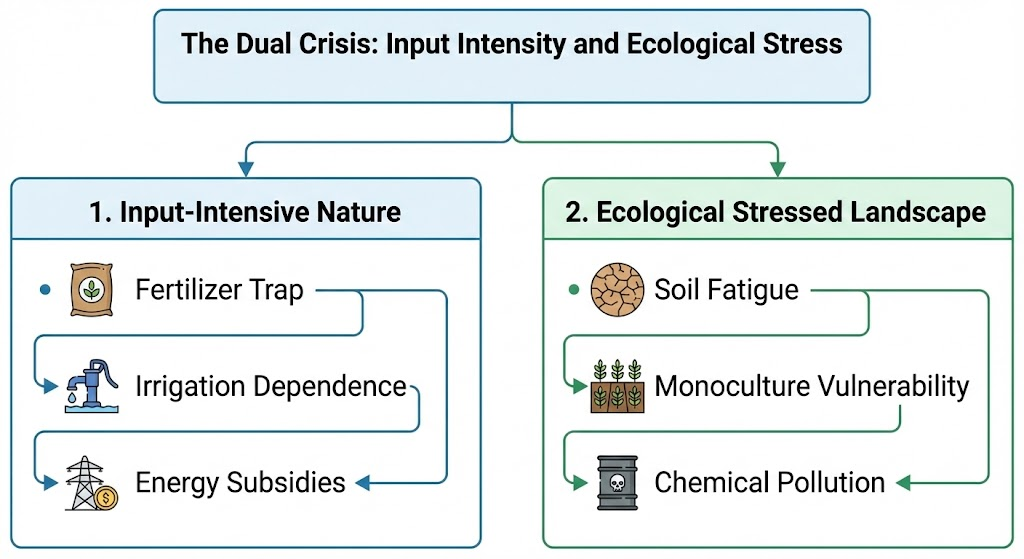
Indian agriculture is currently at a crossroads. While the Green Revolution transformed India from a "begging bowl" to a "breadbasket," but it is characterized by high-yielding varieties (HYVs) that demand intensive irrigation, chemical fertilizers, and pesticides has pushed Indian agriculture into an ecological crisis.
- While the need to shift to Climate-Resilient and Sustainable Farming is urgent, the transition is hindered by deep-rooted structural and policy barriers.
Body:
Challenges in Shifting to Climate-Resilient Farming
Transitioning to sustainable systems like Natural Farming or Climate-Smart Agriculture (CSA) is hindered by deep-seated structural and behavioral barriers.
- The "Subsidy Lockdown": Current policy heavily subsidizes chemical inputs (Urea) and water. Farmers find it economically irrational to switch to organic methods where subsidies are minimal or non-existent.
- Yield Anxiety: Small and marginal farmers (86% of total) fear that the "transition period" (3–5 years) to sustainable farming will lead to initial yield drops, which they cannot afford without a safety net.
- Information Asymmetry: The traditional Extension Services (Krishi Vigyan Kendras) are often understaffed or still oriented toward the old Green Revolution toolkit rather than regenerative techniques.
- Fragmented Supply Chains: While "Ganga-branded" organic belts are emerging, the lack of localized Bio-Input Resource Centres (BRCs) makes it difficult for farmers to procure standardized organic inputs at scale.
- Market Price Gap: Sustainable produce often lacks a "premium" price at local Mandis, and the lack of certification makes it hard for small farmers to access high-value export markets.
Measures to Enable a Smooth Transition
A "Viksit Bharat" by 2047 requires an agricultural system that is as green as it is productive.
- Rationalize Subsidies (PM-PRANAM): Scale up the PM-PRANAM scheme to reward states that reduce chemical fertilizer use, diverting the "subsidy savings" directly to farmers as Direct Benefit Transfers (DBT) for adopting natural farming.
- Scale Up "iCET" for Agriculture: Enhance the usage of Digital Public Infrastructure for Agriculture (DPI) to provide precision advisories.
- Promote Regenerative Hubs: Establish village-level micro-enterprises (BRCs) to supply ready-to-use bio-inputs (like Jeevamrut), reducing the labor burden on individual farmers.
- Focus on "Nutri-Cereals" (Millets): Build on the momentum of the International Year of Millets to shift the Minimum Support Price (MSP) and procurement focus toward climate-hardy crops that require 70% less water than rice.
- Climate-Resilient Seeds: Accelerate the rollout of genome-edited and heat-tolerant varieties (like DBW 187 wheat) through the National Innovations in Climate Resilient Agriculture project.
Conclusion
The shift from "Input Intensity" to "Ecological Intelligence" is no longer an option but a survival imperative. India must adopt the 5 'Rs': Resistance, Recovery, Rebounding, Regeneration, and Robustness. By aligning fiscal incentives with ecological health, India can ensure that its "Annadata" (farmers) remain resilient in the face of a warming planet.
To get PDF version, Please click on "Print PDF" button.
Print PDF



