


Economy
Washington Consensus
- 17 Mar 2026
- 13 min read
For Prelims: International Monetary Fund (IMF), World Bank, Liberalisation, Privatisation, Globalisation, Deregulation, Washington Consensus, Asian Development Bank,
For Mains: Washington Consensus and its impact on global economic policy, Beijing Consensus and Cornwall Consensus, Economic nationalism in the contemporary global order.
Why in News?
The Washington Consensus (WC), once considered a “talisman” of economic policy, is increasingly viewed as outdated in today’s multipolar, digital, and geopolitically fragmented world.
- Recent global developments, such as protectionism, industrial policy revival, supply chain restructuring, and economic nationalism, have revived debates about the relevance of the WC model.
Summary
- The Washington Consensus, once promoted as a universal model of liberalisation, privatisation, and deregulation, is increasingly being questioned as global economies shift toward industrial policy, economic nationalism, and strategic supply chains.
- In the emerging post-Washington Consensus era, countries like India must balance market reforms with strategic state intervention, strengthen domestic industries, and push for more inclusive global economic governance.
What is Washington Consensus (WC)?
- About: The Washington Consensus (WC) refers to a set of economic policy prescriptions aimed at promoting macroeconomic stability and market-oriented reforms in developing countries.
- The term was coined by economist John Williamson in 1989 to describe the policy approach advocated by Washington-based institutions such as the International Monetary Fund (IMF), the World Bank, and the US Treasury.
- Core Principles: The Consensus essentially promoted a neoliberal ideology of Liberalisation, Privatisation, Globalisation, and Deregulation to encourage market-led economic growth.
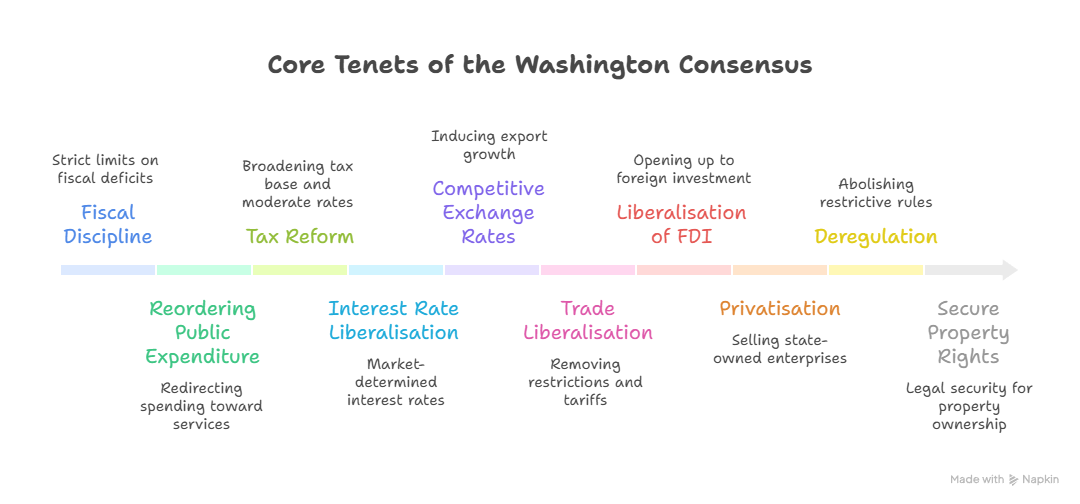
- WC as a “Talisman” of Economic Policy: For decades, the Washington Consensus was viewed as a "talisman" or a magic formula for economic prosperity.
- Perceived Universal Solution: In the 1980s–90s, when many developing countries faced debt crises, hyperinflation, and slow growth, the WC was promoted as a standard policy formula of liberalisation, privatisation, and globalisation, seen as the undisputed path to macroeconomic stability and economic growth.
- India’s 1991 Reforms: India’s historic 1991 LPG (Liberalisation, Privatisation, Globalisation) reforms were heavily influenced by these principles, which helped pull the country out of a severe Balance of Payments (BoP) crisis and ushered in an era of high growth.
- Trickle-Down Growth Belief: WC was based on the idea that free markets and reduced government intervention would generate growth, which would eventually reduce poverty through “trickle-down” effects.
- Global Integration: It successfully drove the era of hyper-globalisation, leading to the rapid expansion of global supply chains and massive wealth creation in emerging markets like East Asia.
- Institutional Support: It was strongly promoted by regional bodies like the Asian Development Bank (ADB) and Bretton Woods institutions such as the IMF and World Bank, giving it the status of a dominant global economic policy framework.
What are the Criticisms Regarding the Relevance of the Washington Consensus (WC)?
- “One-Size-Fits-All” Approach: The WC applied uniform economic reforms to diverse developing countries, ignoring their local political, cultural, and institutional contexts.
- The WC was largely formulated in Western capitals without meaningful participation from developing countries, creating a policy mismatch with local realities.
- While some countries like East Asian economies and Chile combined market reforms with strong state intervention, others particularly in Latin America and post-Soviet states experienced debt crises, rising inequality, and social unrest.
- Severe Social Costs and Rising Inequality: Policies of fiscal austerity and structural adjustment forced cuts in food subsidies, healthcare, and education, often increasing poverty, unemployment, and wealth inequality.
- The assumption that market-led growth would automatically reduce poverty often failed, leading to persistent inequality and social unrest.
- Financial Instability: Rapid capital account liberalisation exposed economies to volatile “hot money” flows, contributing to crises such as the Asian Financial Crisis (1997) and the Argentine economic crisis (2001).
- Rejection of Industrial Policy: The Consensus discouraged state-led industrial strategies, while WTO rules such as TRIMs, TRIPS, and subsidy regulations restricted developing countries’ ability to support domestic industries.
- Many successful economies like the US, Japan, and South Korea historically used protectionism and subsidies to build domestic industries.
- Excessive Faith in Deregulation: The model promoted free markets and deregulation, even in countries with weak institutions and underdeveloped market systems, particularly in Africa and least developed economies.
- Critics argue developed countries used protectionist policies during their development, but later promoted free-market rules for developing nations, limiting their policy space.
- Loss of Economic Sovereignty: WC reforms were often imposed as conditionalities for IMF and World Bank loans, reducing policy autonomy of developing countries and creating a democratic deficit.
- Backlash and Rise of Economic Nationalism: Growing dissatisfaction with globalization has contributed to protectionist policies, tariffs, and industrial subsidies, even in countries that once championed free markets.
Alternative Models
- The Beijing Consensus: A model characterized by heavy state capitalism, political authoritarianism, and aggressive state-led investments (like the Belt and Road Initiative), which has appealed to many developing nations.
- The Cornwall Consensus (2021): Proposed during the G7 summit, this framework advocates for state intervention to achieve broader societal goals such as environmental sustainability, social equity, and economic resilience rather than just market efficiency.
What Measures can India Take in the Post-Washington Consensus Global Economic Order?
- Calibrated Industrial Policy: India must continue to champion active state support for strategic sectors.
- Initiatives like the Production-Linked Incentive (PLI) schemes for semiconductors, green energy, and pharmaceuticals are crucial steps to build domestic manufacturing capacities.
- Building Supply Chain Resilience: The focus must shift from pure cost-efficiency to economic security.
- India should actively participate in "friend-shoring" initiatives and regional frameworks (like the Indo-Pacific Economic Framework) to de-risk its supply chains and reduce over-reliance on single, hostile geographies for critical raw materials.
- Prioritizing Targeted Public Investment: While macroeconomic stability and fiscal prudence remain important, they should not trigger austerity measures that choke growth.
- The state must lead capital expenditure in physical infrastructure (via PM Gati Shakti), digital public infrastructure (DPI), education, and healthcare.
- Balancing Protectionism with Global Integration: India must walk a tightrope using calibrated tariffs to protect its vulnerable Micro, Small, and Medium Enterprises (MSMEs) and infant industries, while simultaneously negotiating equitable, new-age Free Trade Agreements (FTAs) with developed economies.
- Spearheading the Global South’s Agenda: India must leverage multilateral platforms like the G20, BRICS, and the Shanghai Cooperation Organisation (SCO) to push for the democratization of Bretton Woods institutions and the WTO.
- The goal is to ensure that future global economic frameworks are collaborative and reflect the realities of developing nations, rather than being coercive.
- Investing in the Green Transition: As the Cornwall Consensus highlights the need for sustainable growth, India must accelerate its National Green Hydrogen Mission and investments in indigenous renewable technologies.
- This ensures economic growth aligns with climate resilience without compromising developmental goals.
Conclusion
The demise of the WC marks the end of an era where free markets were viewed as a universal panacea. For India, the current multipolar world offers a unique window of opportunity. By blending the dynamism of market economics with strategic, targeted state intervention, India can safeguard its economic sovereignty and emerge as a resilient pillar of the new global economic architecture.
|
Drishti Mains Question: "The Washington Consensus, once considered the talisman for economic development, has lost its relevance in the contemporary geopolitical and economic landscape." Discuss. |
Frequently Asked Questions (FAQs)
1. What is the Washington Consensus?
TheWashington Consensus refers to a set of 10 economic policy prescriptions promoting liberalisation, privatisation, and deregulation, formulated by John Williamson in 1989 and promoted by IMF, World Bank, and the U.S. Treasury.
2. Why was the Washington Consensus considered a “talisman” of economic policy?
It was widely believed to be auniversal formula for economic stability and growth, especially during the 1980s–90s debt crises in developing countries.
3. How did the Washington Consensus influence India’s economic reforms?
India’s1991 LPG reforms (Liberalisation, Privatisation, Globalisation) were influenced by WC principles and helped resolve the Balance of Payments crisis, initiating decades of economic growth.
4. What are the major criticisms of the Washington Consensus?
Critics highlight itsone-size-fits-all approach, rising inequality, financial instability, and restrictions on industrial policy imposed through WTO rules such as TRIMs and TRIPS.
5. What alternative development models have emerged to challenge the Washington Consensus?
Models such as theBeijing Consensus (state-led development) and the Cornwall Consensus (state intervention for sustainability and equity) offer alternative frameworks for economic development.



