


Important Facts For Prelims
Vice President of India's Visit to Sri Lanka
- 20 Apr 2026
- 9 min read
Why in News?
The Vice President of India, Shri C.P. Radhakrishnan, embarked on a two-day visit to Sri Lanka, marking the first-ever visit by an Indian Vice President to the island nation.
- India announced the extension of Overseas Citizen of India (OCI) eligibility, along with discussions on key bilateral issues such as energy cooperation, trade, and fishermen's concerns.
What are the Key Highlights of the Vice President of India's Visit to Sri Lanka?
- Expansion of OCI Card Eligibility: India has extended the OCI scheme to the fifth and sixth generations of the Indian diaspora in Sri Lanka.
- Previously limited to the fourth generation, this move will specifically benefit the Indian Origin Tamil (Malaiyaha Tamil) community.
- To ease administrative hurdles, the application process will be simplified. OCI cards will now be issued based on documents and certificates provided directly by the Sri Lankan government.
- Developmental Assistance & Housing: Discussions highlighted the handover of the final tranche of houses under Phase III of the Indian Housing Project, which is part of India’s commitment announced in 2010 to construct 50,000 houses in Sri Lanka.
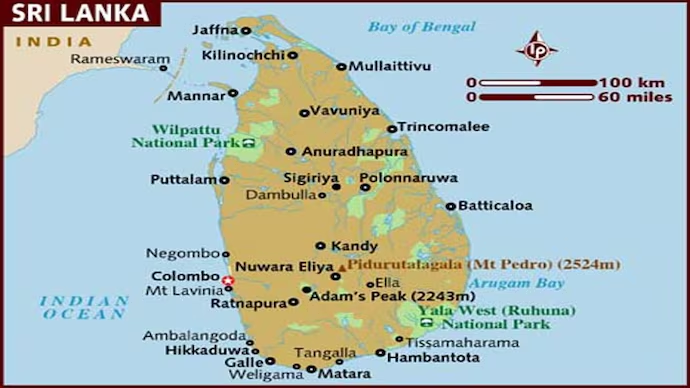
- Trincomalee Energy Hub: Both nations stressed the urgency of developing the 'energy hub' in the Trincomalee district, which includes a proposed fuel pipeline linking South India and Sri Lanka alongside the development of World War II-era oil tank farms.
- The push follows an April 2025 tripartite Memorandum of Understanding (MoU) signed between India, Sri Lanka, and the UAE to develop Trincomalee.
- Fishermen Dispute: The leaders agreed to address the contentious fishermen issue through a humanitarian approach, balancing the livelihoods of fishing communities across the Palk Strait.
- Cyclone Ditwah Relief: Sri Lanka expressed deep gratitude for India’s prompt assistance, particularly the USD 450 million rehabilitation and relief package provided after Cyclone Ditwah, and praised India’s emergence as a reliable “first responder” during regional crises.
What is the Overseas Citizen of India (OCI) Scheme?
- Background: India based on the recommendations of the High-Level Committee on the Indian Diaspora, launched the Overseas Citizenship of India (OCI) Scheme in December 2005 through an amendment to the Citizenship Act, 1955, and it was formally inaugurated at the Pravasi Bharatiya Divas convention in 2006.
- The scheme grants long-term residency and travel privileges to Persons of Indian Origin (PIO) holding foreign citizenship.
- Subsequently, the PIO scheme was merged with OCI in 2015 to streamline diaspora engagement.
- Eligibility: The Government of India may register a person as an Overseas Citizen of India (OCI) if they are a foreign citizen who was an Indian citizen on or after 26th January 1950, or belonged to a territory that became part of India after 15th August 1947, or was eligible for Indian citizenship at that time.
- Eligibility also extends to their children, grandchildren, and great-grandchildren, as well as minor children with at least one Indian parent, and spouses of Indian citizens or OCI holders (subject to a minimum two-year registered marriage).
- Crucial Exception: A person, who or either of whose parents or grandparents or great grandparents is or has been a citizen of Pakistan or Bangladesh, is strictly ineligible for OCI registration.
- Key Benefits: OCI cardholders receive a multiple-entry, multi-purpose, lifelong visa to visit India.
- They are legally exempt from registering with the Foreign Regional Registration Officer (FRRO) regardless of their length of stay.
- Parity with NRIs: They enjoy parity with Non-Resident Indians (NRIs) in economic, financial, and educational fields.
- However, they cannot acquire agricultural land, farmhouses, or plantation properties.
- Limitations of OCI:
- No Dual Citizenship: OCI must not be misconstrued as dual citizenship; it does not confer any political rights.
- Public Employment: They are denied equality of opportunity in matters of public employment (Article 16).
- Electoral Politics: OCIs cannot register as voters under the Representation of the People Act, 1950, and are ineligible to contest elections for the Parliament or State Legislatures.
- Constitutional Offices: They are ineligible for election as President or Vice-President, and cannot be appointed as a Judge of the Supreme Court or High Court.
- OCI Cancellation: An OCI registration can be cancelled if it was obtained through fraud, false representation, or concealment of facts, or if the individual shows disaffection towards the Constitution of India.
- It may also be revoked in cases of unlawful communication or trade with an enemy during war, or if the person is convicted and sentenced to two or more years of imprisonment within five years of registration.
- Additionally, cancellation can occur in the interest of India’s sovereignty, integrity, security, or friendly relations with foreign countries.
Frequently Asked Questions (FAQs)
1. What is the OCI Scheme?
It is a scheme providing lifelong visa and residency benefits to Persons of Indian Origin under the Citizenship Act, 1955.
2. Is OCI equivalent to dual citizenship?
No, OCI does not grant political rights or full citizenship, only limited economic and travel privileges.
3. Who is not eligible for OCI?
Individuals with links to Pakistan or Bangladesh are ineligible for OCI registration.
4. What are the key benefits of OCI?
Lifelong visa, no FRRO registration, and parity with NRIs in economic and educational fields.
5. On what grounds can OCI be cancelled?
It can be revoked for fraud, anti-national activities, criminal conviction, or threats to national security.
UPSC Civil Services Examination, Previous Year Question (PYQ)
Prelims
Q. With reference to India, consider the following statements: (2021)
- There is only one citizenship and one domicile.
- A citizen by birth only can become the Head of State.
- A foreigner once granted citizenship cannot be deprived of it under any circumstances.
Which of the statements given above is/are correct?
(a) 1 only
(b) 2 only
(c) 1 and 3
(d) 2 and 3
Ans: (a)



