


Governance
Punjab-Rajasthan Water Dispute
- 26 Mar 2026
- 15 min read
For Prelims: Inter-state Water Dispute, Irrigation, Hydropower, Sutlej River, Indus Waters Treaty 1960, Supreme Court, Paddy, Sugarcane, Inter-State River Water Disputes Act, 1956, Article 262, Article 21, Tribunals, Drip Irrigation, Mulching
For Mains: Key facts regarding the Punjab-Rajasthan water sharing dispute, Reasons for rising inter-state water disputes, Disputes resolution provisions regarding inter state water disputes and way forward.
Why in News?
Punjab Chief Minister has reignited a long-standing inter-state water dispute by demanding Rs 1.44 lakh crore from Rajasthan for drawing 18,000 cusecs of water since 1960, citing a colonial-era royalty agreement and the state's worsening groundwater crisis.
Summary
- The Punjab-Rajasthan dispute highlights the friction between the Riparian Principle and historical tripartite agreements amidst India’s worsening water stress.
- While constitutional provisions like Article 262 seek adjudication via tribunals, political and agricultural demands often lead to "conflictual federalism."
- Future resolution lies in Digital Twins technology and a shift toward benefit-sharing models.
What are the Key Facts Regarding the Punjab-Rajasthan Water Sharing Dispute?
- Historical Basis (1920s Agreement): The dispute references a commercial arrangement between Maharaja Ganga Singh of Bikaner and undivided Punjab under British rule for water from the Sutlej River via the Gang (Bikaner) Canals. Royalty payments continued until around 1960.
- Indus Waters Treaty (IWT 1960) Shift: The IWT 1960 granted India control over the eastern rivers (Sutlej, Beas, Ravi) for “unrestricted use”, enabling internal reallocation.
- Post-1960, water sharing was treated as an inter-state allocation rather than a paid commercial arrangement, and Rajasthan stopped making payments.
- Tripartite Agreement (1981): It was signed between Punjab, Haryana, and Rajasthan, with the backing of then Prime Minister Indira Gandhi.
- It allocated 8.6 million acre feet (out of 17.17 MAF) to Rajasthan—the largest share—despite it being a non-riparian state, supporting the expansion of the Indira Gandhi Canal.
- Punjab Termination of Agreements Act, 2004: Punjab enacted the Punjab Termination of Agreements Act, 2004, seeking to scrap water-sharing agreements, but it protected existing utilisation, ensuring ongoing supplies to Rajasthan were not disrupted.
- In 2016, the Supreme Court held that a state cannot unilaterally terminate inter-state agreements, effectively restoring the earlier legal framework.
- Punjab's Latest Riparian Claim: The state invokes the riparian principle—states through which rivers flow have primary rights. Rajasthan, being a non-riparian state (not in the basin of Ravi, Beas, or Sutlej), receiving the largest share is deemed inequitable, especially given current water stress.
Provisions Related to Inter-State Water Sharing
- Constitutional Provisions:
- State List (Entry 17): Water is primarily a State subject. This includes water supplies, irrigation, canals, drainage, embankments, water storage, and water power.
- Union List (Entry 56): The Central Government has the power to regulate and develop inter-state rivers and river valleys to the extent declared by Parliament to be expedient in the public interest.
- Entry 32 of the Concurrent List: It is related to shipping and navigation on inland waterways as regards mechanically propelled vessels, and the rule of the road on such waterways.
- Article 262: It empowers Parliament to adjudicate disputes relating to inter-state rivers. Crucially, it allows Parliament to exclude the jurisdiction of the Supreme Court and other courts in such disputes.
- Statutory Frameworks: Under the authority of Article 262, Parliament enacted the Inter-State River Water Disputes (ISWD) Act, 1956.
- If a State Government believes a water dispute has arisen and cannot be settled by negotiations, it can request the Central Government to refer the matter to a Tribunal (to be formed within one year of the request, as per the 2002 amendment).
- The decision (Award) of the Tribunal, once published in the Official Gazette, has the same force as an order or decree of the Supreme Court.
- Supreme Court Judgements:
- State of Karnataka v. State of Tamil Nadu (2018): The SC reduced Karnataka's water release burden, recognising drinking water needs of Bengaluru and declaring the river a "National Asset."
- The Punjab Termination of Agreement Act, 2004 (2016): A Presidential Reference where the SC declared Punjab's law—which unilaterally cancelled all water-sharing agreements—as unconstitutional.
- State of Tamil Nadu v. State of Kerala (2014): The SC struck down the Kerala Irrigation and Water Conservation (Amendment) Act, 2006, which had tried to restrict the water level. The Court ruled that Kerala could not interfere with a judicial order under the guise of "safety legislation."
- Narmada Bachao Andolan v. Union of India (2000): While primarily about the Sardar Sarovar Dam construction and R&R (Resettlement and Rehabilitation), the SC affirmed that the Narmada Water Disputes Tribunal (NWDT) award was final and binding, and that water is a part of the Right to Life (Article 21).
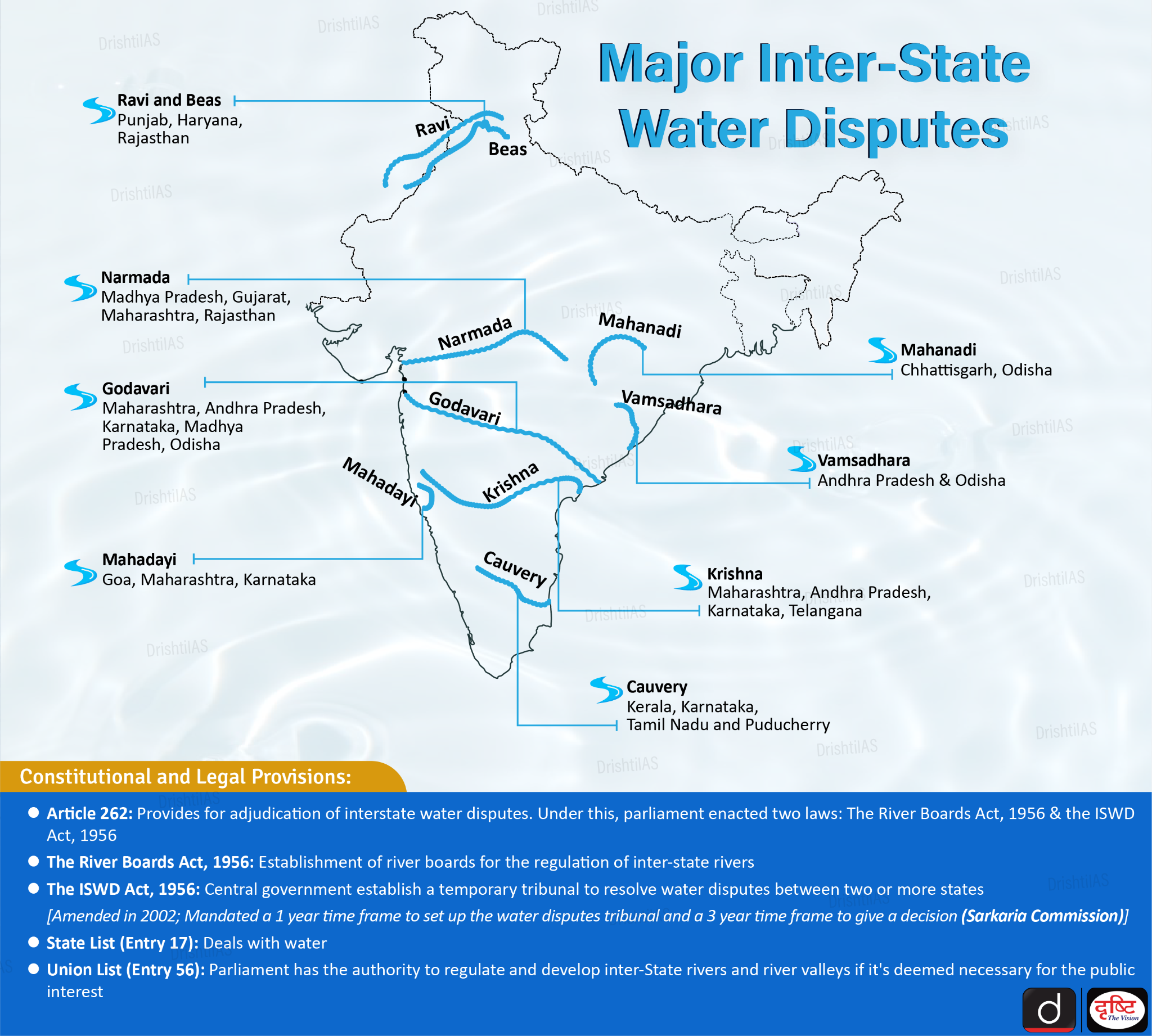
What are the Reasons for Rising Inter-state Water Disputes?
- Increasing Water Scarcity: Rapid population growth and urbanization have heightened the demand for water. As the per capita availability of water declines, states become more protective of their existing shares, leading to a zero-sum game mentality.
- E.g., India’s per capita water availability plummeted from a water-abundant 5,200 cubic meters in 1950 to a water-stressed 1,400–1,500 cubic meters in 2024, with projections for 2050 (1,191 cubic meters) dangerously approaching the 1,000 cubic meters water scarcity threshold.
- Agricultural Intensification: The transition to water-intensive crops (like paddy in Punjab or sugarcane in Maharashtra) has led to massive groundwater depletion. Punjab’s demand is fueled by extreme water stress; the state has the highest groundwater extraction rate in India (156.36%), significantly exceeding the national average of 60.63%.
- Jurisdictional Conflicts: Water is largely a state subject (Entry 17, State List), while inter-state rivers fall under central purview (Entry 56, Union List). This division, coupled with states asserting greater autonomy, often leads to "conflictual federalism," where states prioritize their own interests over cooperative basin-wide management.
- Politicization and Hydro-Politics: Water issues are frequently entangled with electoral politics, regional identities, and vote-bank considerations. States may adopt rigid positions or unilateral actions to appeal to domestic constituencies, delaying negotiated settlements.
- Riparian vs. Non-Riparian Debate: Upper riparian states (where the river originates) often claim primary rights to use the water for their own development, while lower riparian states claim rights based on historical usage and downstream necessity, e.g., the Punjab-Rajasthan inter-state water dispute.
- Inefficiency of Tribunals: Under the Inter-State River Water Disputes Act, 1956, tribunals are often criticised for extreme delays. Some disputes, like the Cauvery dispute, have lasted over 30 years, during which time political and environmental conditions shift, making the final "award" difficult to implement.
What Measures can be Taken to Resolve Interstate River Water Disputes?
- Shift to Benefit-Sharing over Water-Sharing: Traditional disputes focus on volumetric allocation (how many cusecs of water). A more innovative approach focuses on the collective benefits derived from the river.
- E.g., States can cooperate by specializing in crops that suit their agro-climatic zones. A water-surplus state could grow water-intensive crops for a water-deficit state, which in turn provides industrial or energy benefits.
- Digital Twins of River Basins: Create a high-resolution 3D digital model of the entire basin using satellite imagery (like RISAT) and AI. This allows for "What-If" simulations to predict how a new dam or a drought year will affect all riparian parties objectively.
- Institutional & Legal Innovations: Move away from ad hoc tribunals to a Single Permanent Inter-State River Water Disputes Tribunal with specialised benches (as proposed in the ISWD (Amendment) Bill, 2019) to ensure institutional memory and speed.
- Mandate a "Mediation-First" approach through a DRC composed of neutral experts before any legal adjudication. This reduces the adversarial nature of the conflict.
- Demand-Side Management & Ecological Integrity: Implement a "Water Budget" for each state where they must prove they are using efficient techniques (like Drip Irrigation or Mulching) before asking for a larger share of the river.
- A mandatory percentage of water must remain in the river to maintain its health, which prevents "Basin Closure" where no water reaches the sea.
- Cooperative Federalism: Encourage bilateral or multi-state agreements on joint projects, such as linking canals or shared storage, to convert potential conflicts into collaborative opportunities. High-performing states could receive "Blue Grants" or extra central funding.
Conclusion
The Punjab-Rajasthan dispute underscores the shift from "water-sharing" to "survival-sharing" in a water-stressed India. Resolving such conflicts requires moving beyond historical riparian claims toward a Basin-Scale Management approach, leveraging Cooperative Federalism and technology like Digital Twins to ensure ecological integrity and national water security.
|
Drishti Mains Question: Discuss the constitutional and legal mechanisms available for resolving inter-state water disputes. Evaluate their effectiveness. |
Frequently Asked Questions (FAQs)
1. What is the core legal basis of Punjab’s claim against Rajasthan in the water dispute?
Punjab invokes the riparian principle and a colonial-era commercial agreement, arguing that Rajasthan, as a non-riparian state, has no inherent right to the largest allocation from the Sutleut waters.
2. Which constitutional provision deals with water disputes?
Article 262 empowers Parliament to adjudicate disputes and exclude Supreme Court jurisdiction.
3. What is the riparian principle?
It grants primary rights over river water to states through which the river naturally flows.
4. What is the role of the ISWD Act, 1956?
It provides for Tribunal-based adjudication of disputes, whose awards have binding legal force.
UPSC Civil Services Examination, Previous Year Question (PYQ)
Mains
Q. Constitutional mechanisms to resolve the inter-state water disputes have failed to address and solve the problems. Is the failure due to structural or process inadequacy or both? Discuss. (2013)



