


Important Facts For Prelims
National Vaccination Day and Universal Immunisation Programme
- 18 Mar 2026
- 13 min read
Why in News?
India celebrated National Vaccination Day (16th March) while highlighting major achievements of the Universal Immunisation Programme (UIP), including 98.4% full immunisation coverage by January 2026 and the launch of nationwide HPV vaccination and an indigenous Td vaccine in 2026.
National Vaccination Day
- National Vaccination Day is celebrated every year on 16th March to commemorate the first dose of Oral Polio Vaccine administered in India in 1995 under the Pulse Polio Programme.
- The programme led to the elimination of polio in India, with the last reported case in 2011 in Howrah, West Bengal.
What is the Universal Immunisation Programme (UIP)?
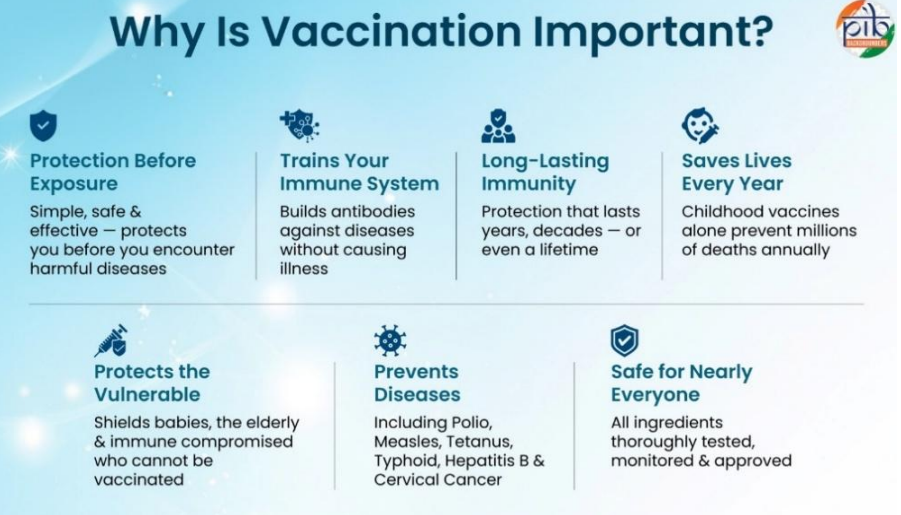
- About: The Universal Immunisation Programme (UIP) is a flagship public health programme of the Ministry of Health and Family Welfare aimed at providing free vaccination to children and pregnant women against vaccine-preventable diseases.
- It was originally launched as the Expanded Programme on Immunization (EPI) in 1978 and later expanded and renamed UIP in 1985.
- The UIP aims to increase immunisation coverage, improve the quality of vaccination services, establish a reliable cold-chain system up to health facilities, monitor programme performance, and achieve self-sufficiency in vaccine production.
- Integration with National Health Programmes: Over time, UIP has been integrated into several national health initiatives.
- It became part of the Child Survival and Safe Motherhood Programme in 1992, was included under the Reproductive and Child Health Programme in 1997, and since 2005 has been an integral component of the National Rural Health Mission (NRHM).
- Coverage and Scale: The UIP is one of the world's largest immunisation programmes, reaching 2.9 crore pregnant women and 2.54 crore newborns every year, free of cost.
- Diseases Covered: Under UIP, free vaccines are provided to newborns, children, adolescents, and pregnant women against 12 vaccine-preventable diseases.
- While most vaccines are administered nationwide, the Japanese Encephalitis (JE) vaccine is provided only in endemic districts.
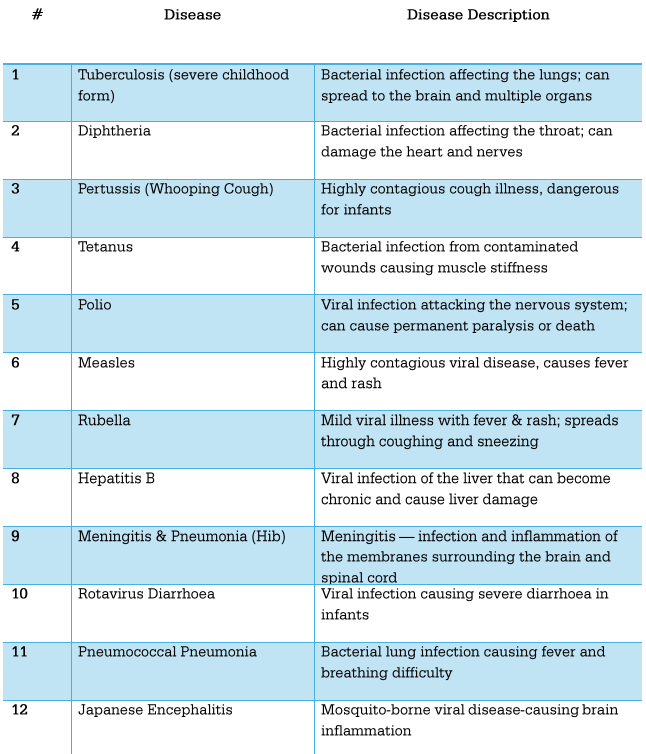
- Vaccines Introduced Under UIP:
- Inactivated Polio Vaccine (IPV) – 2015: Introduced as part of the Global Polio Endgame Strategy.
- Rotavirus Vaccine (RVV) – 2016: Introduced to reduce mortality from severe diarrhoea in children.
- Measles-Rubella (MR) Vaccine – 2017: Introduced through a nationwide campaign targeting about 41 crore children aged 9 months to 15 years.
- Pneumococcal Conjugate Vaccine (PCV) – 2017: Introduced to reduce infant mortality caused by pneumonia.
- Tetanus and Adult Diphtheria (Td) Vaccine: Replaced the TT vaccine to address waning immunity against diphtheria in adolescents and adults.
- Mission Indradhanush: Launched in December 2014, Mission Indradhanush aims to strengthen the UIP by increasing full immunisation coverage to over 90%, targeting unvaccinated and partially vaccinated children and pregnant women, especially in hard-to-reach areas.
- Launched in 2017, Intensified Mission Indradhanush (IMI) aims to vaccinate all children below two years and pregnant women left out of routine immunisation under the UIP, with a special focus on urban areas and low-coverage regions.
- Full immunisation coverage has risen from 62% in 2015 to 98.4% in January 2026.
- Infrastructure Supporting UIP Implementation:
- Vaccination Delivery Network: Under the UIP, vaccines are provided at Primary Health Centres (PHCs), Community Health Centres (CHCs), government hospitals, sub-centres, and outreach sessions at Anganwadi centres and village locations.
- Since 2005, UIP has been implemented under the National Rural Health Mission, including coverage in urban slums.
- Frontline health workers such as ASHAs (Accredited Social Health Activists), Anganwadi Workers (AWWs), and link workers play a crucial role in mobilising beneficiaries and ensuring that no child or pregnant woman is left unvaccinated.
- Model Immunisation Centres strengthen vaccination services. Such centres are already operational in Uttar Pradesh, Bihar, Chandigarh, and Ladakh.
- Cold Chain Infrastructure: Vaccines must be stored within a strict temperature range to maintain potency, which requires a robust cold chain system.
- India operates one of the largest vaccine cold-chain networks in the world, with over 1.06 lakh ice-lined refrigerators and deep freezers.
- This system supports over 1.3 crore immunisation sessions annually across the country.
- Digital Monitoring Systems: To strengthen vaccine logistics, the Electronic Vaccine Intelligence Network (eVIN) tracks vaccine stocks and storage temperatures in real time across the country, ensuring efficient supply chain management.
- U-WIN (2024) digital platform helps citizens locate vaccination centres, book appointments, and maintain vaccination records.
- CoWIN (2021), the digital platform used for Covid-19 vaccination registration and tracking, through which over 220 crore vaccine doses have been administered.
- Vaccination Delivery Network: Under the UIP, vaccines are provided at Primary Health Centres (PHCs), Community Health Centres (CHCs), government hospitals, sub-centres, and outreach sessions at Anganwadi centres and village locations.
What are the Milestones in India’s Vaccination Journey?
- Disease Eradication: India has successfully eradicated smallpox and eliminated polio (last case reported in 2011), yaws, and maternal and neonatal tetanus.
- Reaching the Unreached: The percentage of "zero-dose" children (infants who have not received any routine vaccinations) has been slashed by nearly half, dropping from 0.11% in 2023 to just 0.06% in 2024.
- Global Recognition: India's success in reducing child mortality and targeting leading infectious diseases has been explicitly recognized by the UN Inter-Agency Group for Child Mortality Estimation (2024), positioning the country as a global exemplar in child health.
- India’s Global Leadership in Vaccines and Pharmaceuticals: India ranks 3rd globally in pharmaceutical production by volume and exports medicines to around 200 countries, with the USA, Belgium, South Africa, the UK, and Brazil as major destinations.
- India produces about 60% of the world’s vaccines, making it the largest vaccine manufacturer globally, and supplies low-cost vaccines worldwide.
- The country is also the largest provider of generic medicines, accounting for around 20% of global supply by volume.
- During the Covid-19 pandemic, India supplied over 298 million vaccine doses to nearly 100 countries under the Vaccine Maitri initiative.
- To strengthen domestic pharmaceutical manufacturing and achieve self-reliance, the Government launched Production Linked Incentive (PLI) schemes for Bulk Drugs (2020), Medical Devices (2020), and Pharmaceuticals (2021) to boost investment and enhance global competitiveness.
Frequently Asked Questions (FAQs)
1. What is the Universal Immunisation Programme (UIP)?
UIP is aflagship vaccination programme launched in 1985 by the Ministry of Health and Family Welfare to provide free vaccines to children and pregnant women against 12 vaccine-preventable diseases.
2. What is National Vaccination Day and why is it celebrated?
National Vaccination Day is observed on 16 Marchto commemorate the first dose of Oral Polio Vaccine administered in 1995 under the Pulse Polio Programme, which helped eliminate polio in India.
3. What is Mission Indradhanush?
Launched in2014, Mission Indradhanush aims to increase full immunisation coverage to over 90% by targeting unvaccinated and partially vaccinated children and pregnant women, especially in hard-to-reach areas.
4. What is the role of eVIN in India’s immunisation system?
TheElectronic Vaccine Intelligence Network (eVIN) digitally tracks vaccine stock levels and cold-chain temperatures in real time, ensuring efficient vaccine logistics and supply management.
5. Why is India called the “Pharmacy of the World”?
India producesabout 60% of global vaccines and supplies around 20% of the world’s generic medicines, exporting pharmaceutical products to nearly 200 countries.
UPSC Previous Year Question (PYQ)
Prelims
Q. In the context of vaccines manufactured to prevent COVID-19 pandemic, consider the following statements: (2022)
- The Serum Institute of India produced COVID-19 vaccine named Covishield using mRNA platform.
- Sputnik V vaccine is manufactured using a vector-based platform.
- COVAXIN is an inactivated pathogen-based vaccine.
Which of the statements given above are correct?
(a) 1 and 2 only
(b) 2 and 3 only
(c) 1 and 3 only
(d) 1, 2 and 3
Ans: (b)
Q. With reference to recent developments regarding ‘Recombinant Vector Vaccines’, consider the following statements: (2021)
- Genetic engineering is applied in the development of these vaccines.
- Bacteria and viruses are used as vectors.
Which of the statements given above is/are correct?
(a) 1 only
(b) 2 only
(c) Both 1 and 2
(d) Neither 1 nor 2
Ans: (c)
Q. What is the importance of using Pneumococcal Conjugate Vaccines in India? (2020)
- These vaccines are effective against pneumonia as well as meningitis and sepsis.
- Dependence on antibiotics that are not effective against drug-resistant bacteria can be reduced.
- These vaccines have no side effects and cause no allergic reactions.
Select the correct answer using the code given below:
(a) 1 only
(b) 1 and 2 only
(c) 3 only
(d) 1, 2 and 3
Ans: (b)
Q. Which one of the following statements is not correct?(2019)
(a) Hepatitis B virus is transmitted much like HIV.
(b) Hepatitis B unlike Hepatitis C, does not have a vaccine.
(c) Globally, the number of people infected with Hepatitis B and C viruses arc several times more than those infected with HIV.
(d) Some of those infected with Hepatitis B and C viruses do not show the symptoms for many years.
Ans: (b)
Q. 'Mission Indradhanush' launched by the Government of India pertains to: (2016)
(a) Immunization of children and pregnant women
(b) Construction of smart cities across the country
(c) India's own search for Earth-like planets in outer space
(d) New Educational Policy
Ans: (a)



