


Important Facts For Prelims
Concerns Over Great Nicobar Island Project
- 04 Feb 2026
- 6 min read
Why in News?
With parts of the ₹92,000 crore Great Nicobar Island mega-infrastructure project nearing approval, the Nicobar Tribal Council has alleged pressure from the district administration to surrender ancestral tribal land.
- The Council disputes the administration’s claim that forest rights were settled under the Forest Rights Act, 2006 asserting that FRA processes were never initiated.
What is the Great Nicobar Island Project?
- About: Launched in 2021, GNIP is a mega infrastructure initiative to be implemented on Great Nicobar Island (GNI), located at the southern end of the Andaman and Nicobar Islands.
- The project requires diversion of forest land in Galathea Bay, Pemmaya Bay, and Nanjappa Bay, areas traditionally inhabited by the Nicobarese community before the 2004 tsunami.
- Features: Spearheaded by NITI Aayog, it includes a transshipment terminal at Galathea Bay, a greenfield airport, a greenfield township, and a tourism project with a gas-powered plant.
- It is being executed by the Andaman and Nicobar Islands Integrated Development Corporation (ANIIDCO) and is strategically located near the Malacca Strait, a key maritime route linking the Indian Ocean to the Pacific Ocean.
- Strategic Importance: Nicobar’s strategic location near the Malacca, Sunda, and Lombok Straits enables India to monitor crucial sea routes vital for global trade and energy supply, aligning with the Act East Policy (2014) and the QUAD’s Indo-Pacific strategy.
- The planned greenfield airport will enhance defense deployment, boosting India’s capacity to track Chinese naval movements and reinforce regional security.
- Economic Significance: The International Container Transshipment Terminal (ICTT) aims to reduce India’s dependence on foreign ports like Singapore and Colombo.
- It forms a key part of the Maritime India Vision 2030 and Amrit Kaal Vision 2047, aligning with India’s long-term economic strategy.
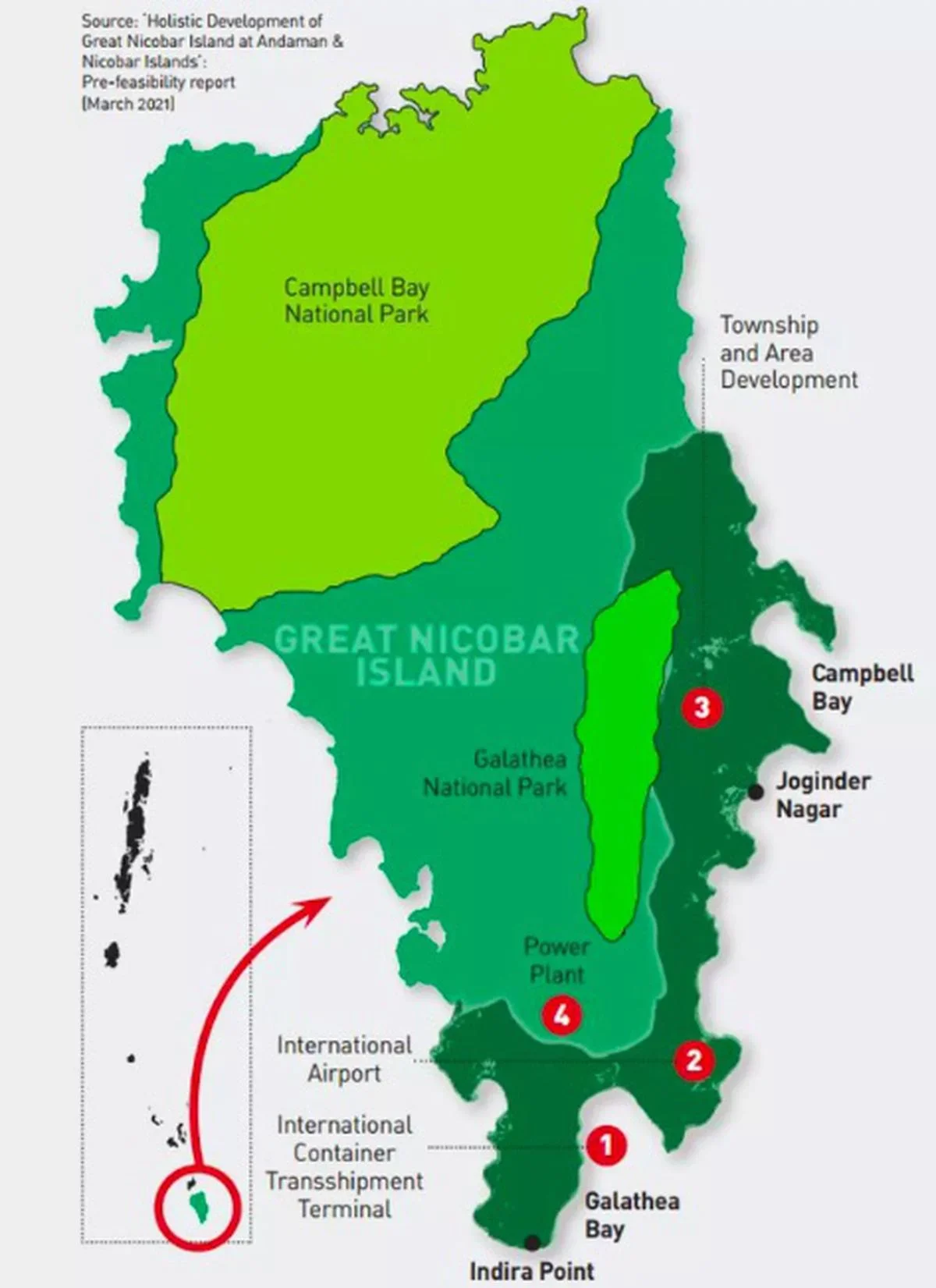
Great Nicobar Island
- About: Great Nicobar is the southernmost and largest island of the Nicobar group in the southeastern Bay of Bengal, and is mostly covered in tropical rainforest.
- Indira Point, situated on Great Nicobar Island, is the southernmost point of India.
- Geographical Division: The Andaman and Nicobar Islands comprise 836 islands, divided into Andaman (north) and Nicobar (south), separated by the 150-km-wide 10° Channel.
- Ecological Importance: Great Nicobar island is home to two national parks— Campbell Bay National Park and Galathea National Park and a biosphere reserve, the Great Nicobar Biosphere Reserve.
- Tribes: It is inhabited by small populations of indigenous tribes, including the Shompen, Onge, Andamanese, and Nicobarese.
Frequently Asked Questions (FAQs)
1. Where is Great Nicobar Island located?
Great Nicobar Island is located in the southernmost part of the Andaman and Nicobar Islands in the Bay of Bengal.
2. Why is Great Nicobar Island ecologically important?
It hosts tropical rainforests, endemic species, two national parks, and the Great Nicobar Biosphere Reserve.
3. Which tribes live on Great Nicobar Island?
Indigenous tribes include the Nicobarese and Shompen communities.
4. Why is Great Nicobar Island strategically significant for India?
Its proximity to major sea lanes near the Malacca Strait enhances India’s maritime security and Indo-Pacific presence.
UPSC Civil Services Examination, Previous Year Question (PYQ)
Prelims
Q. Consider the following statements: (2018)
- The Barren Island volcano is an active volcano located in the Indian territory.
- Barren Island lies about 140 km east of Great Nicobar.
- The last time the Barren Island volcano erupted was in 1991 and it has remained inactive since then.
Which of the statements given above is/are correct?
(a) 1 only
(b) 2 and 3
(c) 3 only
(d) 1 and 3
Ans: (a)
Q. Which one of the following pairs of islands is separated from each other by the ‘Ten Degree Channel’? (2014)
(a) Andaman and Nicobar
(b) Nicobar and Sumatra
(c) Maldives and Lakshadweep
(d) Sumatra and Java
Ans: (a)



