


Governance
23rd Law Commission and One Nation One Election
- 01 Dec 2025
- 13 min read
For Prelims: 23rd Law Commission , Joint Parliamentary Committee, Model Code of Conduct, One Nation One Election, Basic Structure of the Indian Constitution
For Mains: Basic Structure Doctrine and judicial review, Electoral Reforms in India.
Why in News?
The 23rd Law Commission has shared its initial views with the Joint Parliamentary Committee examining the Constitution (129th Amendment) Bill, 2024, and the Union Territories Laws (Amendment) Bill, 2024, both aimed at enabling One Nation One Election.
- The Commission has said that the proposals do not violate the Constitution’s basic structure and that the Model Code of Conduct (MCC) does not need statutory backing.
What are the Key Highlights of 23rd Law Commission?
- 23rd Law Commission of India: Law reform in India has been ongoing since independence, with the first Law Commission set up in 1955.
- The Union government has constituted the 23rd Law Commission for a three-year term from September 1, 2024, to August 31, 2027, with Justice (Retd.) Dinesh Maheshwari as Chairperson.
- The Commission includes a full-time chairperson, four full-time members, the Secretaries of Legal Affairs and Legislative Departments as ex-officio members, and up to five part-time members.
- Its mandate covers reviewing and repealing obsolete laws, simplifying legal language and procedures, and aligning legislation with current economic needs.
- The Commission also advises the government on legal issues, and studies the impact of globalisation on vulnerable groups.
- 23rd Law Commission’s Views Regarding One Nation One Election Bills: The Commission stated that the One Nation One Election Bills do not violate the Constitution’s basic structure, noting that federalism and the voter’s rights remain fully protected.
- It clarified that synchronising elections alters only the frequency and timing of polls and does not in any way dilute the democratic right to vote.
- It is the Commission's view that the Bills do not require ratification by states, as they do not propose amendments to subjects under Article 368(2), clauses (a) to (e), which mandate state ratification.
- Simultaneous elections are viewed positively as they would lead to saving of time and money.
- Model Code of Conduct (MCC): The Law Commission advised against giving statutory status to the MCC, arguing that codifying it would slow down decision-making during elections.
- It stressed that the current flexible, consensus-based MCC works better, as it allows the Election Commission to act quickly when needed.
What is the Basic Structure Doctrine of the Indian Constitution?
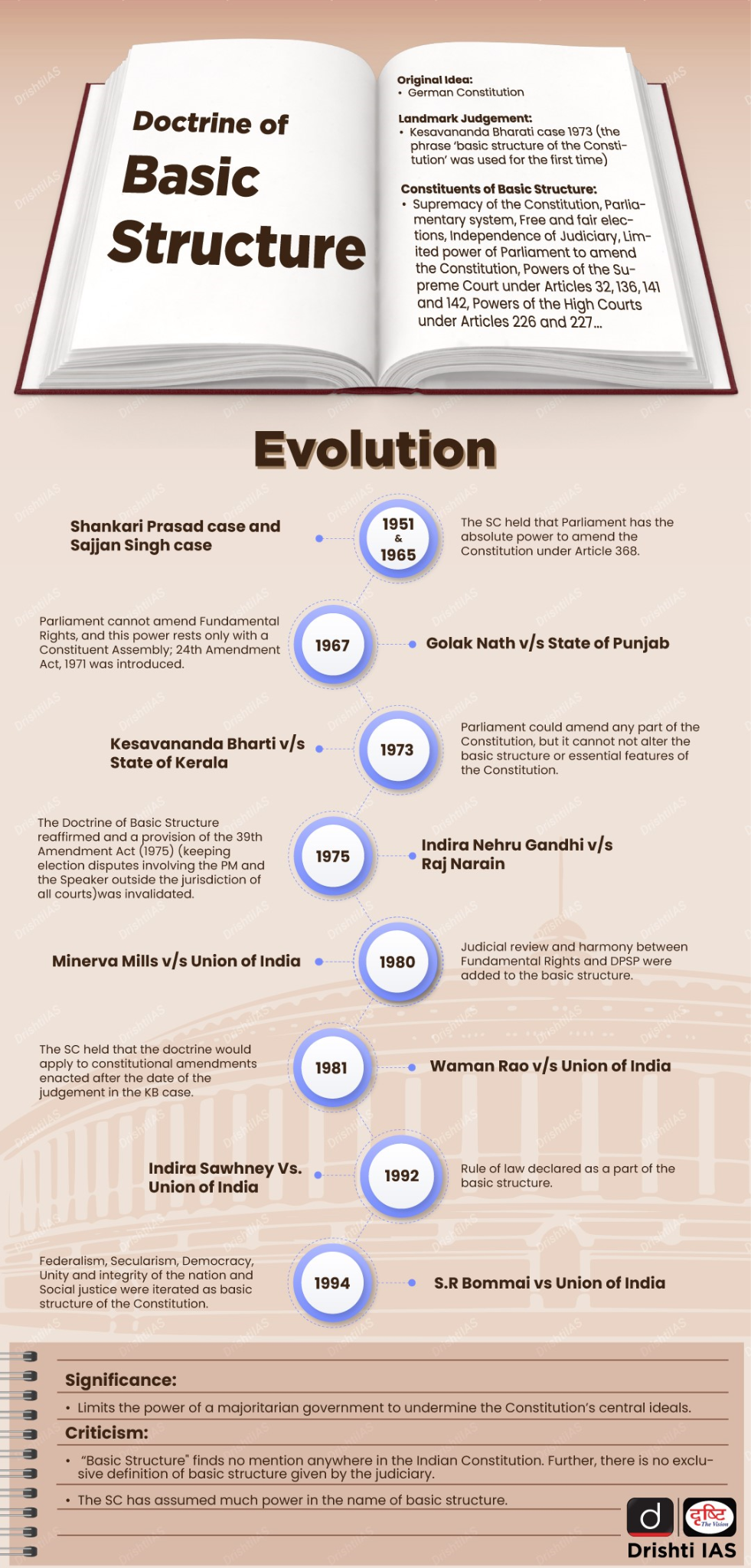
- About: Basic structure doctrine of the Indian Constitution, is a judicial review principle established by the Supreme Court of India in the landmark case of Kesavananda Bharati v. State of Kerala in 1973.
- It protects core constitutional values such as constitutional supremacy, the rule of law, separation of powers, and federalism. It also holds that Parliament, even under Article 368, cannot amend or destroy these essential features of the Constitution.
- Its origins trace back to the post-war German Constitution, 1949, which protected essential principles after the Nazi era.
- Elements of Basic structure doctrine: The Supreme Court has made it clear that the list of basic features is not exhaustive, the Court identifies them case by case.
- It includes several core elements such as the supremacy of the Constitution, a sovereign, democratic, and republican form of government, secularism, federalism, the rule of law, and the separation of powers.
- It also comprises judicial review, independence of the judiciary, free and fair elections, the parliamentary system of government, and the unity and integrity of the nation.
- Other essential features include the primacy of Fundamental Rights, harmony between Fundamental Rights and the Directive Principles of State Policy (DPSPs), and the powers of the Supreme Court under Articles 32, 136, 141, and 142, as well as those of the High Courts under Articles 226 and 227.
- Significance of the Basic Structure Doctrine:
- Safeguards Constitutional Identity: Prevents Parliament from altering or destroying the core features of the Constitution, ensuring continuity and stability.
- Checks Majoritarian Power: Places substantive limits on the amending power under Article 368, acting as a restraint on temporary political majorities.
- Protects Fundamental Rights: Ensures that essential rights like equality, liberty, and rule of law cannot be diluted through amendments.
- Strengthens Judicial Review: Empowers courts to invalidate amendments that damage constitutional essentials, reinforcing accountability.
- Ensures Free and Fair Elections: Prevents amendments that could distort democratic processes or weaken electoral integrity.
- Keeps Constitution a ‘Living Document’: Allows progressive changes while preventing destruction of the Constitution’s foundational philosophy.
What is One Nation, One Election?
- About: Simultaneous elections, or “One Nation, One Election”, refer to holding Lok Sabha, State Assembly, and local body elections at the same time.
- A high-level committee headed by former President Ram Nath Kovind has recommended enabling One Nation, One Election through two constitutional amendment bills the Constitution (129th Amendment) Bill, 2024, and the Union Territories Laws (Amendment) Bill, 2024.
- Historical Context: India experienced synchronized elections from 1951 to 1967, during which elections for the Lok Sabha and most State Assemblies were held simultaneously.
- However, this practice eroded due to political factors and premature dissolutions of assemblies. The election cycles diverged further due to political instability and defections in the 1960s.
- Rationale for Simultaneous Elections:
- Promotes consistent governance by reducing the continuous election cycle that distracts governments and leaders from development and welfare work.
- Prevents policy paralysis, as the Model Code of Conduct would be imposed less frequently, allowing uninterrupted implementation of schemes and decisions.
- Reduces diversion of administrative resources, since simultaneous polls limit the repeated deployment of personnel for election duties.
- Preserves the relevance of regional parties by ensuring that state-level issues receive focused attention without being overshadowed by national campaigns.
- Improves focus on governance, as fewer elections mean fewer political disruptions, less aggressive campaigning, and more attention to public needs.
- Cuts financial burden, lowering repeated expenditure on manpower, security, logistics, and equipment required for separate election cycles.
Conclusion
Simultaneous elections aim to streamline India’s electoral cycle, strengthen governance, and reduce administrative and financial burdens. With the 23rd Law Commission affirming their constitutional validity, the debate now centres on practical feasibility and political consensus.
Frequently Asked Questions (FAQs)
Q. Which committee recommended constitutional amendments to enable One Nation, One Election?
The High-Level Committee chaired by former President Ram Nath Kovind recommended the changes.
Q. What is the 23rd Law Commission’s view on the constitutionality of the One Nation, One Election Bills?
The 23rd Law Commission held that the Bills do not violate the Constitution’s basic structure.
Q. Does synchronising elections require state ratification under Article 368?
No. The Commission stated that the Bills do not amend provisions requiring state ratification under Article 368(2)(a)–(e).
Q. What is the Law Commission’s stance on giving statutory status to the MCC?
It advised against codifying the MCC, stating it would slow down administrative decision-making during elections.
Q. Which Supreme Court case established the Basic Structure Doctrine?
Kesavananda Bharati v. State of Kerala (1973).
UPSC Civil Services Examination, Previous Year Questions (PYQs)
Prelims
Q. Consider the following statements: (2017)
- The Election Commission of India is a five-member body.
- The Union Ministry of Home Affairs decides the election schedule for the conduct of both general elections and bye-elections.
- Election Commission resolves the disputes relating to splits/mergers of recognised political parties.
Which of the statements given above is/are correct?
(a) 1 and 2 only
(b) 2 only
(c) 2 and 3 only
(d) 3 only
Ans: (d)
Q. With reference to the Constitution of India, consider the following statements: (2019)
- No High Court shall have the jurisdiction to declare any central law to be constitutionally invalid.
- An amendment to the Constitution of India cannot be called into question by the Supreme Court of India.
Which of the statements given above is/are correct?
(a) 1 only
(b) 2 only
(c) Both 1 and 2
(d) Neither 1 nor 2
Ans: (d)
Mains
Q. Discuss the role of the Election Commission of India in the light of the evolution of the Model Code of Conduct. (2022)
Q. “Parliament’s power to amend the Constitution is limited power and it cannot be enlarged into absolute power.” In light of this statement explain whether Parliament under Article 368 of the Constitution can destroy the Basic Structure of the Constitution by expanding its amending power? (2019)



