
Economy
Tourism Sector as a Growth Engine for India
This editorial is based on “Why India’s tourism sector needs a regulatory rethink” which was published in The Hindustan Times on 18/12/2025. The article brings into picture the the gap between India’s strong tourism potential and the regulatory bottlenecks limiting investment and competitiveness, arguing that streamlined regulation is essential to unlock the sector’s full economic and developmental impact.
For Prelims :Prashad Scheme, Heritage 2.0, Pradhan Mantri MUDRA Yojana (PMMY), Sustainable Tourism in India
For Mains: Tourism sector in India, Potential and regulatory challenges,measures that needs to be taken
Tourism is a high-employment, service-led growth sector for India. As per the Economic Survey, tourism contributes around 5% to GDP and supports nearly 7.6 crore jobs, making it a key driver of inclusive and regional development. India accounts for 1.5% of international tourist arrivals. According to the World Travel and Tourism Council (WTTC) 2024-25 report, India is the 8th largest tourism economy, contributing USD 231.6 billion. The Union Budget has also emphasised destination development and infrastructure support to boost the sector. However, despite strong demand and policy intent, India’s tourism potential remains under-realised due to fragmented, overlapping and time-consuming regulatory frameworks.This calls for a regulatory rethink to improve ease of doing business, attract investment and make India globally competitive in tourism.
How is India Reforming and Regulating Its Tourism Sector?
- Visa Reforms: In the Union Budget 2025–26, the government has proposed a streamlined e-Visa system along with visa-fee waivers for select categories of foreign tourists to enhance India’s global tourism competitiveness.
- The reform aims to simplify procedures, reduce documentation requirements, and ensure faster processing of visa applications.
- By lowering entry barriers for international visitors, especially for leisure, medical, and cultural tourism, these measures seek to improve ease of travel to India.
- Such visa liberalisation is significant as procedural delays and costs have historically discouraged potential tourists, despite India’s strong cultural and natural appeal.
- The reform aims to simplify procedures, reduce documentation requirements, and ensure faster processing of visa applications.
- Homestay and MSME Support: To strengthen grassroots tourism and promote inclusive growth, financial support mechanisms such as MUDRA loans are being extended to homestay operators and small tourism enterprises.
- This initiative aims to improve formalisation, credit access, and business sustainability for MSMEs that form the backbone of India’s tourism ecosystem.
- By enabling local entrepreneurs, women-led enterprises, and rural households to participate in tourism, the reform helps distribute tourism income more evenly while preserving local culture and traditions. Increased formalisation also improves compliance with safety, quality, and service standards.
- Travel for LiFE" and Sustainable Certification: Under the Travel for LiFE initiative, India is regulating the environmental impact of tourism by introducing "Green Rankings" and certifications for hospitality units.
- Hotels and resorts are now being incentivized to adopt sustainable practices like zero-waste management, rainwater harvesting, and renewable energy usage.
- This regulatory shift aligns the Indian tourism industry with global climate goals and caters to the rising international demand for responsible travel.
- Hotels and resorts are now being incentivized to adopt sustainable practices like zero-waste management, rainwater harvesting, and renewable energy usage.
- Specialized Tourist Police and Safety Standards: To address safety concerns, the Ministry of Tourism is working with State Governments to deploy dedicated Tourist Police units in major hotspots. This reform is supported by a 24/7 multi-lingual toll-free helpline available in 12 languages, including 10 international ones.
- These measures aim to standardize safety protocols across states, providing a more secure environment that is critical for attracting solo and female international travelers.
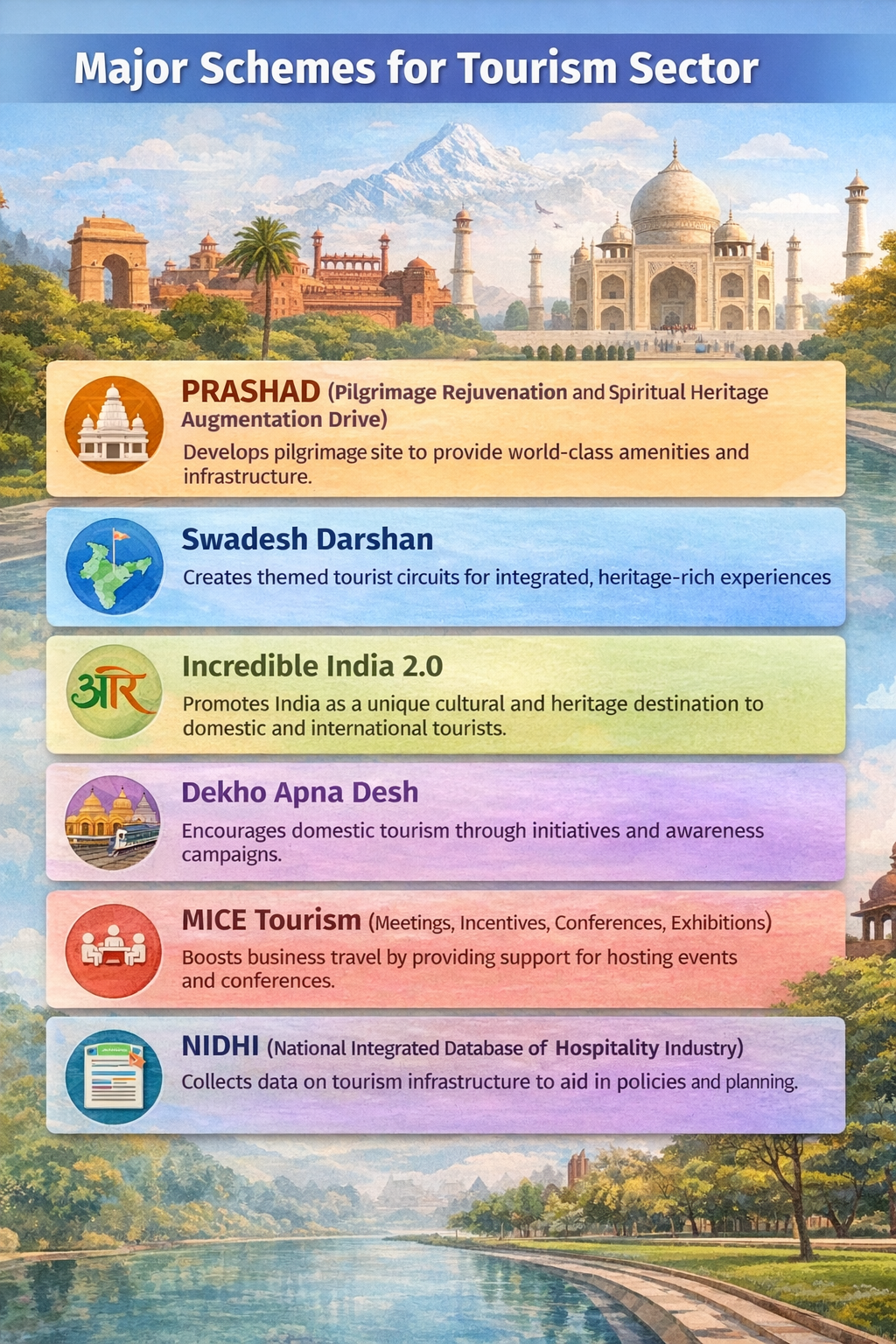
- Swadesh Darshan 2.0 and Theme-Based Circuits:The government has revamped its flagship scheme into Swadesh Darshan 2.0, moving away from scattered projects to a "destination-centric" approach for 50 selected sites.
- This reform focuses on developing integrated thematic circuits—such as spiritual, domestic, and eco-tourism, ensuring that entire regions, rather than just isolated monuments, are equipped with world-class facilities.
- This data-driven selection process prioritizes sustainability and local community involvement to ensure long-term site viability.
- This reform focuses on developing integrated thematic circuits—such as spiritual, domestic, and eco-tourism, ensuring that entire regions, rather than just isolated monuments, are equipped with world-class facilities.
What are the Major Challenges Facing India’s Tourism Sector?
- Fragmented and Overlapping Regulatory Framework:Tourism businesses are governed by multiple central, state and local laws- covering land use, environment, fire safety, labour, liquor, food safety and municipal permissions.
- A single hotel or restaurant often requires 15–20 separate licences, many of which duplicate each other, increasing compliance costs and discouraging formalisation.
- For instance, Coastal Regulation Zone (CRZ) Notification, 2019 requires Eco-friendly resorts to face restrictions similar to ports.
- Delays in Project Approvals and Clearances: Tourism infrastructure projects face lengthy approval timelines, particularly for environmental, coastal and heritage-related clearances.
- For example ,tourism projects are subject to Environment Impact Assessment (EIA) procedures meant for large industrial projects, however, even medium-sized hotels, resorts and tourism infrastructure may require screening, public hearing etc.
- Weak Ease of Doing Business for Small Operators: Small hotels, homestays and tour operators struggle with compliance, inspections and renewals, pushing many into informality.
- Restrictive homestay norms, such as low room caps and compulsory owner residence, which limit scale and income generation.Compliance costs are fixed, irrespective of size, making small units economically unviable.
- For example,a 5–10 room guesthouse must obtain FSSAI licence, fire NOC, municipal trade licence etc.
- Restrictive homestay norms, such as low room caps and compulsory owner residence, which limit scale and income generation.Compliance costs are fixed, irrespective of size, making small units economically unviable.
- Rapid and Unregulated Tourism Growth: Unregulated tourism growth in ecologically sensitive zones like the Himalayas and coastal belts is causing irreversible environmental degradation and resource depletion.
- The lack of "carrying capacity" assessments leads to over-tourism, which strains local water supplies and waste management systems, ultimately destroying the very natural beauty that attracts visitors.
- For instance, in 2024–25, hill stations in Himachal Pradesh and Uttarakhand faced acute water shortages; additionally, over-tourism in reserves like Ranthambore has led to an increase in human-wildlife conflict incidents.
- The lack of "carrying capacity" assessments leads to over-tourism, which strains local water supplies and waste management systems, ultimately destroying the very natural beauty that attracts visitors.
- Last-Mile Connectivity and Infrastructure Gaps: While major "Incredible India" hubs are well-connected, many high-potential spiritual, rural, and eco-tourism sites remain inaccessible due to poor road quality and lack of reliable "last-mile" transport.
- Fragmented infrastructure—such as inadequate sanitation and intermittent electricity in remote circuits—significantly dampens the visitor experience for international tourists accustomed to seamless travel.
- Ministry of Tourism estimates suggest that less than 30% of domestic tourist circuits currently possess adequate integrated road connectivity and world-class sanitation facilities as of 2023.
- Centre–State–Local Coordination Gaps: Tourism is a state subject, but it depends heavily on central ministries (MoEF&CC,Ministry of Culture, Civil aviation) and urban local bodies, leading to coordination failures.
- This fragmentation by showing how multiple authorities regulate the same activity, slowing implementation and accountability.
- For instance, a fire incident at a cliff-top resort in Varkala, Kerala, where poor safety infrastructure and unclear responsibility between municipal authorities, forest/environment regulators, and emergency services severely hampered the response.
- States promote tourism, but cannot control critical approvals, causing coordination delays.
- This fragmentation by showing how multiple authorities regulate the same activity, slowing implementation and accountability.
- Underutilisation of Tourism’s Employment Potential: Despite being labour-intensive, tourism has not reached its full job-creation potential due to regulatory bottlenecks and investment uncertainty.
- Regulatory rigidities prevent tourism from becoming a mass employment generator, especially in rural and ecologically sensitive regions.
- A WTTC report warns that India faces a shortfall of 11 million workers in travel and tourism by 2035.
- Global Competitiveness Deficit: India’s premium tourism products—especially heritage and beach destinations—are increasingly outpriced by Southeast Asian neighbors who offer superior luxury at lower costs.
- High domestic aviation fuel taxes and hotel GST rates (up to 18%) make a vacation in Goa or Rajasthan more expensive for an Indian or global traveler than an all-inclusive trip to Thailand or Vietnam.
- Due to this, India accounts for only 1.5% of global international tourist arrivals despite its size; meanwhile, Thailand offers visa-free access to 90+ countries compared to India’s limited visa-free reciprocity.
What Measures Are Needed to Strengthen India’s Tourism Sector?
- Rationalising and Harmonising the Regulatory Framework: A unified, single-window digital clearance system should be established for tourism projects, integrating approvals related to land use, environment, fire safety, labour, food safety, excise, and municipal permissions.
- Overlapping licences should be merged through deemed approvals and mutual recognition, especially where compliance requirements are similar.
- Sector-specific differentiation must be introduced so that eco-friendly resorts, homestays, and small hotels are not regulated on par with ports or heavy infrastructure, including rationalisation of CRZ norms for low-impact tourism projects. This would significantly reduce compliance costs and incentivise formalisation.
- Fast-Tracking Project Approvals and Clearances: Tourism infrastructure should be placed under a lighter, risk-based clearance framework, distinct from heavy industrial projects. The EIA process needs reform by introducing standard operating procedures, fixed timelines, and size-based exemptions for medium and small tourism projects.
- Public hearings and detailed assessments should be limited to projects with demonstrable ecological impact, while green-certified or low-footprint tourism projects should receive automatic or fast-track approvals. Digitisation and concurrent clearances can further reduce delays and investor uncertainty.
- Improving Ease of Doing Business for Small Operators: A differentiated compliance regime based on scale and risk should be adopted for small hotels, homestays, and tour operators. Low-capacity units should be brought under self-certification and periodic random audits instead of frequent inspections.
- Homestay guidelines need liberalisation by relaxing room caps, removing mandatory owner-residence conditions, and standardising norms across states.
- Compliance costs must be made proportional to size to ensure that small operators remain economically viable and are encouraged to operate within the formal system.
- Strengthening Centre–State–Local Coordination: An institutionalised coordination mechanism should be created through an Inter-Ministerial Tourism Facilitation Council, involving the Ministry of Tourism, MoEF&CC, Culture, Civil Aviation, and Urban Development.
- States should be given greater operational control or binding consultation powers over clearances affecting tourism projects within their jurisdictions. Clear accountability frameworks and shared digital dashboards can reduce duplication among authorities and ensure time-bound decision-making across levels of government.
- Unlocking Tourism’s Employment Potential: Regulatory simplification and policy certainty should be leveraged to attract sustained private investment, particularly in rural, heritage, and eco-tourism clusters, where employment multipliers are high.
- Labour regulations relevant to hospitality need flexibility to accommodate seasonal and gig-based employment, while skill development programmes must be aligned with local tourism needs.
- Encouraging community-based tourism through easier registration and credit access can convert tourism into a mass employment generator without compromising sustainability.
- Enhancing Global Competitiveness: India should benchmark its tourism regulatory framework against globally competitive destinations and adopt best practices in speed of approvals, cost efficiency, and investor facilitation.
- Dedicated tourism investment cells, time-bound clearances, and infrastructure status for hotels can significantly improve investor confidence.
- Improvements in regulatory efficiency are essential to complement India’s strong performance in cultural and natural resources and to translate these assets into higher tourist inflows, longer stays, and increased spending.
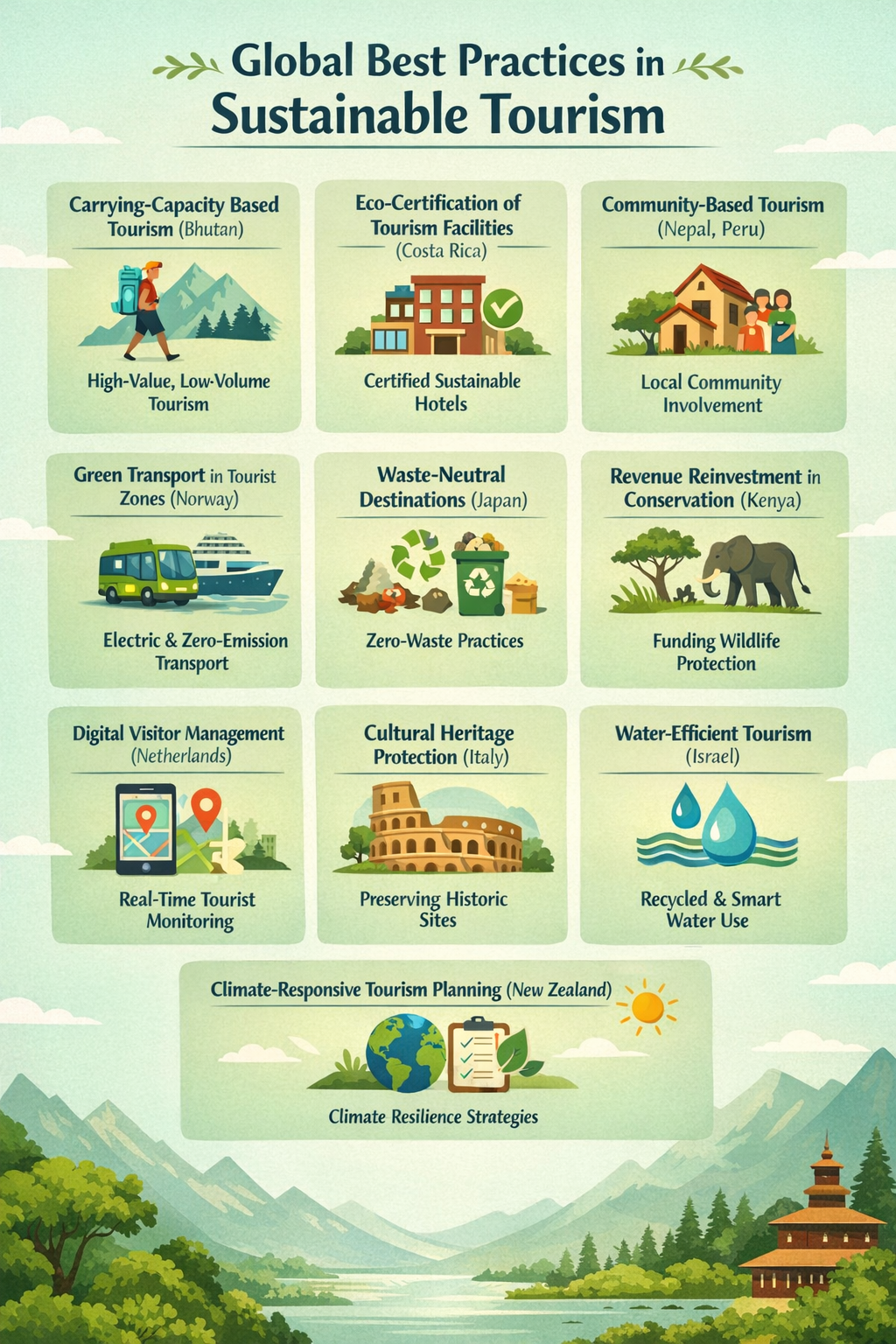
- Scientific Carrying Capacity–Based Visitor Management: Tourism growth in ecologically sensitive areas must be regulated through scientific carrying-capacity assessments that evaluate ecological, infrastructural, and social limits of destinations.
- Based on these assessments, permit-based systems, daily visitor quotas, and timed-entry mechanisms should be introduced to prevent overcrowding, especially during peak seasons.
- These limits should be dynamically enforced using digital tools such as real-time visitor tracking, GIS mapping, online permits, and destination dashboards, enabling authorities to monitor tourist flows, water use, and waste generation.
- Such an integrated, technology-enabled approach—successfully adopted at destinations like Machu Picchu and national parks worldwide—can ensure that tourism remains within sustainable limits while protecting fragile ecosystems and local livelihoods.
Conclusion :
Addressing regulatory and institutional bottlenecks in India’s tourism sector is essential to unlock its full economic and social potential. By leveraging its rich cultural heritage, biodiversity, and living traditions, tourism can also strengthen India’s soft power and global cultural presence. With coherent regulation and sustainable practices, tourism can emerge as a catalyst for inclusive growth, heritage conservation, and India’s civilisational outreach to the world.
|
Drishti Mains Question “Despite possessing rich cultural and natural assets, India has not fully realised its tourism potential.”Examine the regulatory and institutional challenges facing India’s tourism sector and suggest reforms to enhance its global competitiveness. |
FAQs
1. Why is India’s tourism potential considered underutilised?
India attracts only about 1.5% of global tourists due to regulatory complexity, slow approvals, and infrastructure gaps despite rich cultural and natural assets.
2. How does fragmented regulation affect tourism businesses?
Multiple overlapping licences from different authorities raise compliance costs, delay projects, and discourage formalisation and private investment.
3. Why are environmental clearances a challenge for tourism projects?
Tourism projects are often subjected to industrial-scale EIA norms, causing delays even for low-impact hotels and resorts.
4. What difficulties do small hotels and homestays face?
Fixed compliance costs, frequent inspections, and restrictive homestay norms make small units economically unviable and push them into informality.
5. How does poor Centre–State coordination impact tourism development?
States promote tourism but lack control over key central approvals, leading to delays, duplication, and weak accountability.
UPSC Civil Services Examination, Previous Year Question (PYQ)
Mains
Q.1 How can the mountain ecosystem be restored from the negative impact of development initiatives and tourism? (2019)
Q.2 The states of Jammu and Kashmir, Himachal Pradesh and Uttarakhand are reaching the limits of their ecological carrying capacity due to tourism. Critically evaluate. (2015)



