
Indian Economy
MSMEs- The Backbone of India’s Economy
This editorial is based on “MSMEs and their economic footprint in India's journey to Viksit Bharat” which was published in The Business Standard on 01/01/2026. The article highlights the contribution of MSME in the economic growth of the country. Further it argues how MSME are key to realising the dream of Viksit Bharat.
For Prelims:Udyam Portal, Pradhan Mantri Mudra Yojana,ESG norms,CHAMPIONS Portal for MSME,Mutual Credit Guarantee Scheme for MSMEs.
For Mains: MSME’s contribution to the economy, key issues faced by the sector,measures for improvement.
Micro, Small and Medium Enterprises (MSMEs) form the backbone of India’s productive economy, anchoring growth, employment, and regional balance in the journey towards Viksit Bharat. Contributing nearly one-third of India’s GDP and about 45% of manufacturing output, MSMEs act as vital linkages between agriculture, industry, and services. They are the largest generators of non-farm employment, especially for women, youth, and informal workers, thereby deepening social and economic inclusion. As engines of innovation, local entrepreneurship, and export competitiveness, MSMEs enhance India’s resilience in a volatile global economy. Strengthening this sector is thus not merely an economic imperative but a strategic pathway to sustainable, inclusive, and self-reliant national development.
What Constitutes the Micro, Small, and Medium Enterprises (MSME) Sector in India?
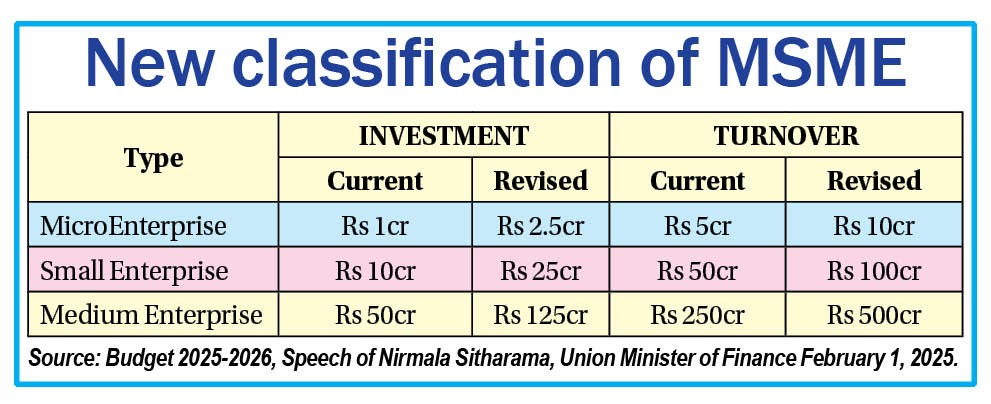
- About: Micro, Small and Medium Enterprises (MSMEs) are business entities engaged in manufacturing, processing, or providing services, classified on the basis of their investment in plant & machinery/equipment and annual turnover, as defined under India’s MSME framework.
What Makes the MSME Sector Central to India’s Economic Structure?
- Strengthening Industrial Clusters and Economic Output: MSMEs contribute around 30.1% of India’s GDP. Further MSME accounts for 35.4% of manufacturing in the country.
- They act as suppliers of raw materials, components, and intermediate goods to large industries, strengthening industrial clusters such as auto, textiles, and pharmaceuticals.
- Rapid formalisation via the Udyam Portal with over 7 crore registrations as of January 2026 has expanded their role in structured and tax-compliant growth.
- Engines of Employment and Inclusive Livelihood: The micro, small, and medium enterprises (MSMEs) in India contribute 62% to employment.
- Digitalisation and fintech platforms have expanded and simplified credit access for micro-enterprises, while targeted government initiatives such as Pradhan Mantri Mudra Yojana,PM Vishwakarma, Stand-Up India, PM SVANidhi, and the Credit Guarantee Fund Trust for Micro and Small Enterprises (CGTMSE) have collectively strengthened self-employment, formalisation, and grassroots entrepreneurship across urban and rural India.
- Accelerating Digitalisation and Technology-Driven Growth: Indian MSMEs are steadily evolving into digitally integrated and technology-oriented enterprises, with a large share of payments, procurement, and customer interactions now conducted through digital modes.
- Platforms such as the Open Network for Digital Commerce (ONDC) are democratising e-commerce by lowering entry barriers, while the RBI’s Public Tech Platform for Frictionless Credit is enabling faster, data-driven, and largely collateral-free lending to small businesses.
- Growing MSME participation in aerospace supply chains, pharmaceutical manufacturing clusters, and electronics and defence production ecosystems highlights the sector’s expanding innovation capacity and its role in building technologically resilient domestic industries.
- Enhancing India’s Export Competitiveness: MSMEs constitute a critical pillar of India’s external trade, with a strong presence in export-oriented sectors such as textiles, leather, gems and jewellery, engineering goods, pharmaceuticals, and processed foods.
- In 2023–24, MSME-associated products accounted for 45.73% of India’s total exports, reflecting their cost efficiency, adaptability, and ability to cater to diverse international markets.
- Advancing Women-Led and Social Entrepreneurship: Women-led MSMEs are increasingly emerging as catalysts of gender-inclusive growth, livelihood security, and social empowerment.
- Credit and enterprise-support initiatives such as Pradhan Mantri Mudra Yojana, Stand-Up India, DAY–NRLM, and Mahila Coir Yojana have significantly expanded access to finance, skills, and markets for women entrepreneurs, particularly in rural and semi-urban areas.
- By integrating self-help groups, home-based workers, and social enterprises into formal value chains, the MSME ecosystem is playing a critical role in democratising entrepreneurship, enhancing social mobility, and advancing inclusive development outcomes.
- Revitalising Rural Livelihoods and Agri-Based MSME Ecosystems: Rural and agri-based MSMEs play a pivotal role in strengthening the village economy, curbing distress-driven migration, and creating non-farm employment through activities such as agro-processing, food and dairy industries, handicrafts, fisheries, and forest-based enterprises.
- Government interventions such as PM Vishwakarma, the Self-Reliant India (SRI) Fund, PM Formalisation of Micro Food Processing Enterprises (PMFME), and cluster-based initiatives are accelerating rural industrialisation and enterprise formalisation.
- Promoting Green, Resilient, and Sustainable MSME Growth: MSMEs are increasingly becoming key enablers of India’s shift towards green growth and circular economy practices by adopting renewable energy solutions, energy-efficient machinery, waste recycling, and cleaner production processes.
- National initiatives such as the Raising and Accelerating MSME Performance (RAMP) Programme, supported by multilateral institutions, along with schemes like ZED Certification, Energy Efficiency Financing Platform, and forward-looking state policies like Telangana’s MSME Policy, are mainstreaming sustainability, compliance, and resource efficiency into MSME growth pathways, aligning economic competitiveness with environmental responsibility.
What are the Key Issues Associated with India's MSME Sector?
- Incomplete Formalisation & Informality: Although over 7 crore MSMEs are registered on the Udyam Portal, NITI Aayog’s Report on India’s MSMEs highlight that nearly 90% of MSMEs continue to operate in the informal sector, reflecting the sector’s high degree of fragmentation.
- Compliance fear, low digital literacy, and cost of formalisation deter registration, restricting access to institutional credit, insurance, export incentives, and government procurement.
- The "Missing Middle" and Stunted Scalability: The sector is characterized by a "pyramid" structure where the majority of units are micro-enterprises that fail to transition into small or medium categories due to regulatory "cliff-effects." Businesses often intentionally stay small to avoid complex labor laws and tax compliance that kick in once they cross specific turnover or employment thresholds.
- For example, 95% of registered MSMEs remain in the "Micro or Small" category. While the Union Budget 2025-26 raised classification limits, the "missing middle" persists.
- Delayed Payments & Working Capital Stress: Delayed payments remain one of the most critical operational bottlenecks. Payments totalling ₹21,108 crore to micro, small and medium enterprises (MSMEs) are pending across 90,000 applications, as per the latest data from the MSME Samadhaan portal.
- Weak enforcement forces MSMEs into distress borrowing, disrupting wage payments and production cycles.
- Productivity Constraints and Technological Gaps: MSMEs continue to face structural productivity constraints due to low capital intensity, outdated machinery, and limited access to advanced technologies. Inadequate digital integration and weak quality certification reduce their ability to compete in high-value domestic and global markets.
- Technology adoption remains uneven, with benefits concentrated in a small segment of enterprises. As a result, a large proportion of MSMEs remain trapped in low-productivity, low-income equilibria.
- According to the MSME Annual Report 2024-25 , the RAMP programme (which includes technology upgradation, digitisation and innovation support) is envisaged to benefit about 5.5 lakh MSMEs, a small fraction relative to the millions of MSMEs , which means many MSMEs remain outside the ambit of structured technology upgradation support.
- Persistent Credit Constraints and Limited Formal Finance: Despite multiple schemes, MSMEs continue to face a structural credit gap of ₹25–30 lakh crore (RBI–IFC estimate).
- Informal borrowing remains prevalent, with 12% of micro enterprises, 3% of small industries, and 2% of MSMEs overall still relying on informal lending sources, leading to high interest burdens.
- While Pradhan Mantri Mudra Yojana expanded access, micro enterprises still receive small-ticket, short-tenure loans, limiting capital formation and scale.
- Skill Gaps & Human Capital Constraints: As per NSDC and Periodic Labour Force Survey (PLFS) data, a majority of MSME workers remain informally trained, with low exposure to modern manufacturing and digital skills.
- According to the National Skill Development Corporation (NSDC) around 47 per cent of businesses said they struggle to find employees with the right skill sets. This is exacerbated in sectors like manufacturing and IT-enabled services, where specialised talent is essential for growth.
- High labour turnover and weak apprenticeship linkages reduce enterprise efficiency, particularly in export-oriented and technology-intensive sectors.
- Regulatory & Compliance Burden: Multiple compliances under GST, labour codes, environment laws, and local regulations impose disproportionately high costs on small firms.
- A detailed report by TeamLease Regtech highlights that India’s MSMEs, especially manufacturing units , must comply with over 998 unique regulatory obligations and 1,450 total requirements annually, covering tax, labour, environment, industry, and local statutory norms.
- Many of these include over 480 clauses that could attract imprisonment for procedural lapses, further increasing risk for small firms.
- A detailed report by TeamLease Regtech highlights that India’s MSMEs, especially manufacturing units , must comply with over 998 unique regulatory obligations and 1,450 total requirements annually, covering tax, labour, environment, industry, and local statutory norms.
- Market Access & Scale Limitations: Most MSMEs operate in local or regional markets, lacking branding, logistics, and marketing capacity.
- While Government e-Marketplace has expanded access, micro enterprises face challenges related to documentation, quality standards, and price competition, limiting their effective participation.
- A SIDBI sector survey finds that a large share of Indian MSMEs continue to rely on traditional/local modes of marketing (~70% in the sample survey), which hinders their ability to expand into wider domestic or foreign markets.
- This slow uptake of modern channels limits visibility, branding and customer reach
- Export Competitiveness Constraints: Though MSMEs contribute 45.73% of India’s exports (2023–24), DGFT and Commerce Ministry data highlight issues such as high logistics costs, lack of export finance, and difficulty meeting ESG and quality norms.
- The Commerce Ministry has flagged that small exporters struggle to meet emerging ESG norms, carbon disclosure requirements, and product traceability standards (EU CBAM, sustainability-linked sourcing), due to high certification and compliance costs.
- Since much of Indian manufacturing is still dependent on coal-fired energy, its exporters will face CBAM rates of between 20%-35% in the EU.
- Green Transition & Sustainability Challenges: A large proportion of MSMEs face constraints in adopting clean energy solutions and circular economy practices due to limited financial capacity, inadequate technical expertise, and low awareness of green technologies and sustainability standards.
- Due to this, MSMEs contribute significantly to India's carbon footprint, accounting for 10-15% of industrial sector emissions.
- Without targeted green finance and technology support, MSMEs risk exclusion from future export markets driven by ESG norms.
What Measures can be Adopted to Strengthen India’s MSME Sector?
- Deepening Access to Affordable & Timely Credit: Bridging the MSME credit gap requires shifting from collateral-based lending to cash-flow and data-driven finance.
- Full operationalisation of RBI’s Public Tech Platform for Frictionless Credit, expansion of CGTMSE coverage, and development of MSME-focused credit scoring models using GST, Udyam and bank data can lower risk perception. Long-term credit at reasonable rates is essential for capital formation, not just survival lending.
- Ensuring Time-bound Payments & Strong Enforcement: Delayed payments must be addressed through automatic enforcement mechanisms under the MSME Act.
- Mandatory integration of large buyers and PSUs with the MSME Samadhaan system, interest auto-accrual on delayed dues, and stricter penalties for habitual defaulters can ease working capital stress.
- Fast-track MSME facilitation councils can improve dispute resolution efficiency.
- Mandatory integration of large buyers and PSUs with the MSME Samadhaan system, interest auto-accrual on delayed dues, and stricter penalties for habitual defaulters can ease working capital stress.
- Simplifying Compliance & Reducing Regulatory Burden: A single-window, risk-based compliance framework should replace multiple inspections and filings.
- Stabilising regulatory changes, and extending self-certification for low-risk MSMEs can reduce transaction costs.
- Digitisation of approvals and decriminalisation of minor offences will encourage scaling up rather than remaining small.
- Accelerating Technology Upgradation & Productivity: Technology adoption must move beyond subsidies to cluster-based solutions. Expanding common facility centres (CFCs), shared R&D labs, and plug-and-play industrial infrastructure can raise productivity.
- Targeted incentives for automation, quality certification, and Industry 4.0 tools will help MSMEs integrate into global value chains.
- Strengthening Skilling, Apprenticeship & Human Capital: MSME growth requires a demand-driven skilling ecosystem aligned with local industry needs.
- Expanding apprenticeships, modular short-term skilling, and recognition of prior learning can address skill gaps.
- Industry–ITI–MSME linkages should be strengthened to ensure continuous upgradation of workforce capabilities.
- Expanding Market Access & Scale: MSMEs need support to move from local markets to national and global platforms. Simplified onboarding and handholding on platforms like GeM and ONDC, logistics support, branding assistance, and export facilitation desks can improve market reach.
- Encouraging MSME participation in public procurement and large private supply chains will drive scale.
- Boosting Export Competitiveness: Dedicated export finance windows, assistance for meeting global quality and ESG standards, and cluster-based export hubs can improve MSME export performance.
- Trade facilitation through digital documentation, reduced logistics costs, and targeted market intelligence will help MSMEs withstand global competition.
- Strengthening Rural & Agro-based MSMEs: Rural MSMEs should be integrated with value addition, food processing, and agri-logistics ecosystems.
- Improved access to storage, cold chains, digital marketplaces, and credit guarantees can reduce migration and boost rural incomes.
- Artisan and traditional enterprise clusters should be promoted for modern design, branding, and global market linkage.
- Supporting Green Transition & Sustainable MSMEs: The shift to sustainability requires dedicated green MSME finance, interest subvention for renewable energy adoption, and affordable access to clean technologies.
- Capacity building on ESG norms, carbon accounting, and circular economy practices will help MSMEs remain export-competitive in a low-carbon global economy.
- Enhancing Institutional Coordination & Governance: Better coordination between the Union, States, financial institutions, and industry bodies is crucial. Outcome-based monitoring of schemes, real-time dashboards, and feedback-driven policy design can improve effectiveness.
- Strengthening MSME clusters through local governance institutions will improve last-mile delivery.
Conclusion:
Strengthening MSMEs is central to achieving Viksit Bharat@2047, with clear targets of raising MSME contribution to GDP ,creating quality jobs, and enhancing their share in exports beyond 60%. Bridging the credit gap, ensuring timely payments, accelerating digital and green transitions, and enabling scale will be decisive. A globally competitive, sustainable, and inclusive MSME ecosystem can transform India’s demographic and entrepreneurial potential into long-term economic leadership.
|
Drishti Mains Question Discuss the role of MSMEs in achieving employment-led and inclusive growth in India. How can reforms in credit delivery, technology upgradation, and market access enhance their contribution to GDP and exports? |
FAQs
1.Why are MSMEs called the backbone of India’s economy?
They generate large-scale employment, contribute ~30% of GDP, and account for nearly 46% of India’s exports.
2.What is the biggest financial challenge faced by MSMEs?
A persistent credit gap of about ₹25–30 lakh crore and dependence on informal finance.
3.How does delayed payment affect MSMEs?
It causes severe working capital stress, forcing MSMEs to borrow at high interest or cut production.
4.Why is the green transition difficult for MSMEs?
High upfront costs, limited technical know-how, and lack of access to green finance.
5.What is the key reform needed to strengthen MSMEs?
Time-bound payments, easier credit, technology upgradation, and simplified compliance.
UPSC Civil Services Examination, Previous Year Question:(PYQ)
Prelims:
Q.Consider the following statements with reference to India : (2023)
- According to the Micro, Small and Medium Enterprises Development (MSMED) Act, 2006, the ‘medium enterprises’ are those with investments in plant and machinery between 15 crore and 25 crore.
- All bank loans to the Micro, Small and Medium Enterprises qualify under the priority sector.
Which of the statements given above is/are correct?
(a) 1 only
(b) 2 only
(c) Both 1 and 2
(d) Neither 1 nor 2
Ans: (b)
Mains
Q.Faster economic growth requires increased share of the manufacturing sector in GDP, particularly of MSMEs. Comment on the present policies of the Government in this regard.(2023)



