
- Filter By :
- Geography
- History
- Indian Heritage & Culture
- Indian Society
-
Q. Plate tectonics has fundamentally reshaped our understanding of the Earth’s surface processes. Discuss its role in explaining major geological features. (150 words)
09 Mar, 2026 GS Paper 1 GeographyApproach:
- Introduce the answer by briefly explaining how the Plate Tectonics Theory.
- In the body, explain how different plate boundary interactions- convergent, divergent, and transform boundaries, along with intra-plate hotspot activity, lead to the formation of major geological features.
- Conclude accordingly
Introduction:
Prior to the 1960s, the Earth's surface was largely viewed through the lens of static models or fragmented theories like Continental Drift. The advent of the Plate Tectonics Theory ( McKenzie, Parker, and Morgan) fundamentally reshaped our understanding by introducing a dynamic Earth model.
- This grand unifying theory elegantly explains the genesis, distribution, and evolution of almost all major geological features on the Earth's surface through the interactions at plate boundaries.
Body:
Role of Plate Tectonics in Explaining Major Geological Features
- The diverse geological features of the Earth can be systematically explained by the three primary types of plate boundaries, along with intra-plate activity.
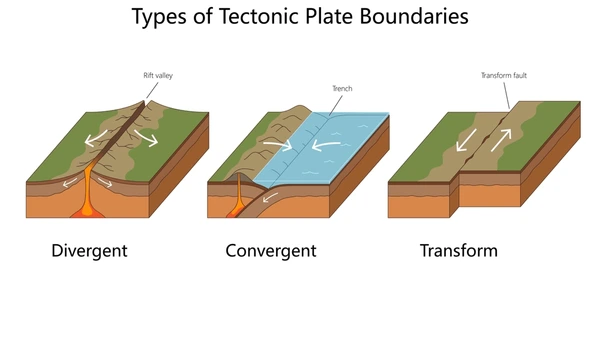
- Convergent Boundaries (Destructive Margins)
- Here, plates collide, leading to the destruction of the crust and intense compressive forces. The features formed depend on the types of interacting plates:
- Continental-Continental (C-C) Convergence: When two low-density continental plates collide, neither subducts easily. Instead, the crust crumples and is thrust upwards, forming massive folded mountains.
- Example: The mighty Himalayas formed from the collision of the Indian and Eurasian plates.
- Continental-Continental (C-C) Convergence: When two low-density continental plates collide, neither subducts easily. Instead, the crust crumples and is thrust upwards, forming massive folded mountains.
- Oceanic-Continental (O-C) Convergence: The denser oceanic plate subducts under the lighter continental plate.
- This process creates deep-sea trenches at the subduction zone and continental volcanic mountain ranges as the melting subducting plate forces magma upwards.
- Example: Peru-Chile Trench (Nazca plate subducting under the South American plate).
- Oceanic-Oceanic (O-O) Convergence: The older, denser oceanic plate subducts.
- This leads to submarine trench formation and the eruption of magma onto the ocean floor, eventually breaching the surface to form volcanic island arcs.
- Example: The Mariana Trench.
- Here, plates collide, leading to the destruction of the crust and intense compressive forces. The features formed depend on the types of interacting plates:
- Divergent Boundaries (Constructive Margins)
- Here, plates pull apart, driven by upwelling mantle convection currents. New crust is continuously created.
- Mid-Oceanic Ridges (MORs): In oceanic lithosphere, the pulling apart of plates allows magma to rise and solidify, creating continuous underwater mountain chains and driving seafloor spreading.
- Example: The Mid-Atlantic Ridge, stretching from the Arctic to the Southern Ocean.
- Rift Valleys: When a continental plate undergoes tensional forces and begins to split apart, the crust thins and faults, dropping down to form a linear valley.
- Example: The Great African Rift Valley, which may eventually flood to form a new ocean basin.
- Mid-Oceanic Ridges (MORs): In oceanic lithosphere, the pulling apart of plates allows magma to rise and solidify, creating continuous underwater mountain chains and driving seafloor spreading.
- Here, plates pull apart, driven by upwelling mantle convection currents. New crust is continuously created.
- Transform Boundaries (Conservative Margins)
- At these boundaries, plates slide past one another horizontally. Crust is neither created nor destroyed.
- Transform Faults: The intense friction between sliding plates results in massive stress accumulation, which is periodically released as powerful, shallow-focus earthquakes. While they do not build mountains or volcanoes, they create distinct linear topographical scars and offset drainage systems.
- Example: The San Andreas Fault in California.
- At these boundaries, plates slide past one another horizontally. Crust is neither created nor destroyed.
- Intra-Plate Features (Hotspots)
- While Plate Tectonics primarily focuses on boundaries, it also integrates the concept of mantle plumes to explain features far from plate edges.
- As a tectonic plate moves steadily over a stationary, superheated mantle plume (hotspot), a sequential chain of volcanoes is formed.
- Example: The Hawaiian Islands chain, where the islands get progressively older the further they are from the active hotspot.
- While Plate Tectonics primarily focuses on boundaries, it also integrates the concept of mantle plumes to explain features far from plate edges.
Conclusion
The Plate Tectonics theory is the "alphabet" with which the geological history of the Earth is written. By comprehensively explaining the formation of fold mountains, ocean basins, rift valleys, and the global distribution of seismic and volcanic zones (like the Pacific Ring of Fire), it transitioned geology from a descriptive science to a deeply analytical and predictive one.
To get PDF version, Please click on "Print PDF" button.
Print PDF



