
- Filter By :
- Theoretical Questions
- Case Studies
-
Q. “Probity ensures the moral compass of a civil servant, while aptitude ensures functional excellence”. Elucidate with suitable examples . (150 words)
11 Dec, 2025 GS Paper 4 Theoretical QuestionsApproach:
- Introduce your answer by defining the terms briefly.
- In the body part explain how probity acts as moral compass and aptitude as functional necessity
- Further show how synergy between them enhances governance.
- Next explain why both are indispensable for the bureaucracy.
- Conclude highlighting their importance to achieve constitutional vision.
Introduction
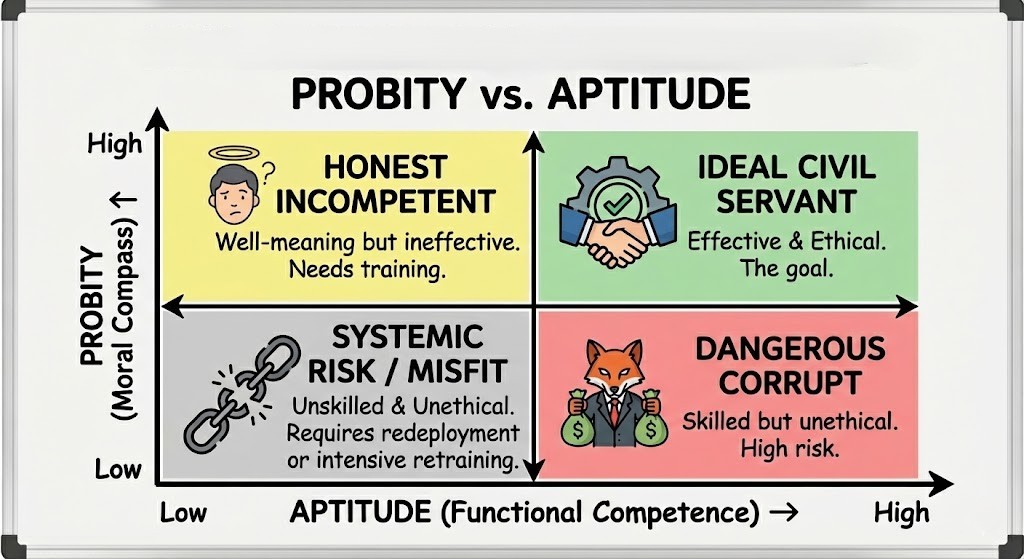
Probity refers to steadfast adherence to ethical values such as integrity, honesty, transparency, and accountability in public life. Aptitude denotes the set of abilities, skills, attitudes, and behavioural competencies that enable an officer to perform duties effectively. Together, probity provides the moral compass, while aptitude ensures functional excellence.
- For example, an honest district magistrate who resists political pressure in awarding a contract while using data-based evaluation to choose the best bidder demonstrates the synergy of probity and aptitude in governance.
Body:
Probity as the Moral Compass of a Civil Servant
- Guides Ethical Decision-Making in dilemmas involving conflict of interest, favoritism, or pressure from vested groups.
- Ensures Adherence to Constitutional Values such as equity, justice, and neutrality, irrespective of political change.
- Promotes Transparency and Accountability, reducing scope for corruption or misuse of public funds.
- Builds Public Trust in administration, strengthening legitimacy in democratic governance.
- Example: Officers implementing Direct Benefit Transfer (DBT) resisted local pressure from intermediaries benefiting from leakages; probity helped them maintain fairness and transparency.
Aptitude as the Driver of Functional Excellence
- Analytical Aptitude enables evidence-based decision-making, policy evaluation, and crisis handling.
- Emotional Intelligence helps officers manage public grievances, maintain team morale, and negotiate conflict.
- Leadership and Administrative Skills ensure coordination across departments and effective service delivery.
- Communication Aptitude promotes public awareness and behavioural change, vital for mass programmes.
- Example: District magistrates during the COVID-19 pandemic used data analytics, empathetic communication, and logistical planning to manage containment zones effectively.
Synergy of Probity and Aptitude in Enhancing Governance
- Ethical Intent and Technical Competence results in sustainable and citizen-centric administration.
- Probity Ensures That Decisions Are Unbiased, while aptitude ensures that decisions are timely and implementable.
- Enables Officers to Resist External Pressures—political, economic, or social—while providing fact-based justifications.
- Example: A civil servant detecting irregularities in MGNREGA payments requires probity to report them and aptitude to redesign audit mechanisms and improve transparency.
Why Both Are Indispensable for The Bureaucracy
- Probity Without Aptitude leads to ethical but inefficient administration.
- Aptitude Without Probity results in skilled officers misusing systems—fueling corruption or bias.
- Balanced Attributes Prevent Policy Capture, promote rule of law, and uphold long-term institutional credibility.
- Example: Public procurement scandals often occur when technically skilled officers lack integrity, highlighting the danger of aptitude without probity.
Conclusion:
As the Bhagavad Gita reminds us, “Yogasthaḥ kuru karmāṇi” (perform your duties with righteousness and skill). This ideal captures the essence of modern public service: probity as the moral foundation and aptitude as the instrument of effective action, together ensuring governance that is principled, efficient, and aligned with India’s constitutional vision.
To get PDF version, Please click on "Print PDF" button.
Print PDF



