


Indian Economy
Workers Unrest and Labour Reforms
- 17 Apr 2026
- 16 min read
For Prelims: Code on Wages, 2019, Industrial Relations Code, 2020, Code on Social Security, 2020, Occupational Safety, Health and Working Conditions (OSH) Code, 2020, Gig workers
For Mains: Labour Reforms in India: Evolution, objectives, and challenges, Impact of Labour Codes on Informal Sector and Gig Economy, Balance between Ease of Doing Business and Workers’ Rights
Why in News?
A wave of strikes by gig workers and factory workers in Noida (Uttar Pradesh) and nearby industrial regions have exposed deep concerns over low wages, job insecurity, and poor working conditions, posing a serious test for the implementation of India’s Four Labour Codes.
Summary
- Worker protests in India are driven by rising inflation and stagnant wages, along with delayed revisions in base minimum wages and regional wage disparities.
- Ambiguities in labour codes and delayed rule implementation have created confusion over wages, working hours, and legal protections.
- Growing job insecurity and exploitation, including contract employment, gig worker precarity, and longer working hours, have intensified unrest.
What are the Reasons for Workers Protest in India?
- Inflation-Driven Wage Erosion: The minimum wage system follows a two-component structure, comprising a base wage revised every five years and a variable component (dearness allowance) linked to inflation and updated twice a year using Consumer Price Index for Industrial Workers (CPI-IW) .
- Between 2021 and 2026, the Consumer Price Index for Industrial Workers (CPI-IW) surged by nearly 25%.
- However, while states have revised the inflation-linked component, they have delayed updating the base wage, resulting in inadequate overall wage growth.
- Protests were further triggered by a 35% minimum wage hike in Haryana in April 2026, which raised expectations among workers in neighbouring regions like Noida.
- Additionally, regional disparities in wage levels across areas within states, such as differences between Noida, municipalities, and other regions in Uttar Pradesh, have intensified worker dissatisfaction.
- Protests were also partially fueled by a false expectation that the new Labour Codes guaranteed a flat Rs 20,000 minimum wage, a rumor stemming from a misread Central government notification.
- Statutory Right to Minimum Wages: The Code on Wages, 2019 establishes a statutory right to minimum wages for all employees across both organized and unorganized sectors.
- Earlier, the Minimum Wages Act, 1948 applied only to scheduled employment covering ~30% of workers.
- However, over 90% of India's workforce operates in the informal sector. Without credible enforcement, statutory right to minimum wage remains non-binding on paper and is routinely ignored.
- Global Supply Chain Shocks: Input cost pressures stemming from US tariffs and the 2026 West Asia conflict have squeezed factory profit margins, leading directly to delayed wage payouts and heightened job insecurity on the factory floor.
- Factory workers, predominantly migrants, are disproportionately hit by surging local room rents, food prices, and reliance on black-market essentials (like heavily inflated LPG cylinders).
- Exploitation of Working Hour "Flexibility": The new Occupational Safety, Health and Working Conditions (OSH) Code, 2020 shifts daily shift regulations from strict parliamentary law (the old Factories Act) to executive rules.
- While the Code prescribes a 48-hour work week, it does not clearly define daily working hours, rest intervals, or spread-over limits, leading to confusion.
- This has allowed some employers to exploit draft provisions by enforcing 12-hour shifts under the guise of a 4-day workweek, often without adequate overtime compensation.
- Since labour is a subject on the Concurrent List, delays by states in finalizing rules have created a transitional grey area, leaving workers vulnerable to exploitation and without clear legal safeguards.
- While the Code prescribes a 48-hour work week, it does not clearly define daily working hours, rest intervals, or spread-over limits, leading to confusion.
- Rise of Precarity and Diluted Rights: The Industrial Relations Code, 2020 expands the threshold for prior government approval in cases of lay-offs, retrenchment, and closure from 100 to 300 workers, with states empowered to increase it further.
- While this aims to simplify compliance and encourage formalisation, it raises concerns about reduced job security and increased vulnerability of workers.
- The Code also mandates a 60-day notice period before strikes and restricts strikes during conciliation proceedings, significantly limiting the scope of legal industrial action.
- Additionally, it promotes the use of Fixed Term Employment (FTE) and contract labour for core activities, potentially replacing permanent jobs with roles that offer little or no long-term security.
- Weak Collective Bargaining: Recognition of trade unions and bargaining processes are left to states, leading to fragmented labour representation.
- Gig and Platform Economy Crisis: Platform workers protest due to unilateral changes to piece-rate wages (e.g., reducing per-delivery payouts).
- They face "algorithmic tyranny" where ratings and dark-store software dictate their earnings without human recourse.
- Platforms classify these workers as "independent contractors" or "partners" rather than employees, deliberately circumventing the Minimum Wages Act, 1948, and bypassing traditional employer liabilities.
Right to Strike
- The right to strike refers to the collective refusal by workers to work in order to demand better wages, working conditions, or labour practices, and is generally recognized across political systems as a legitimate, though last-resort, tool.
- In India, while the right to protest is a fundamental right under Article 19 of the Constitution, the right to strike is not a fundamental right but a legal right subject to statutory restrictions.
- It was first given limited recognition under the Trade Unions Act, 1926 and later regulated by the Industrial Disputes Act, 1947, now subsumed under the Industrial Relations Code, 2020.
- The right to strike in India is not absolute and flows from the fundamental right to form associations, making it subject to reasonable restrictions imposed by the state.
- At the international level, the right to strike is recognized under conventions of the International Labour Organization, of which India is a founding member.
What are India's Four Labour Codes?
- Labour Code: A labour code is a consolidated set of laws regulating employer–employee relations, including wages, social security, industrial relations, and workplace safety.
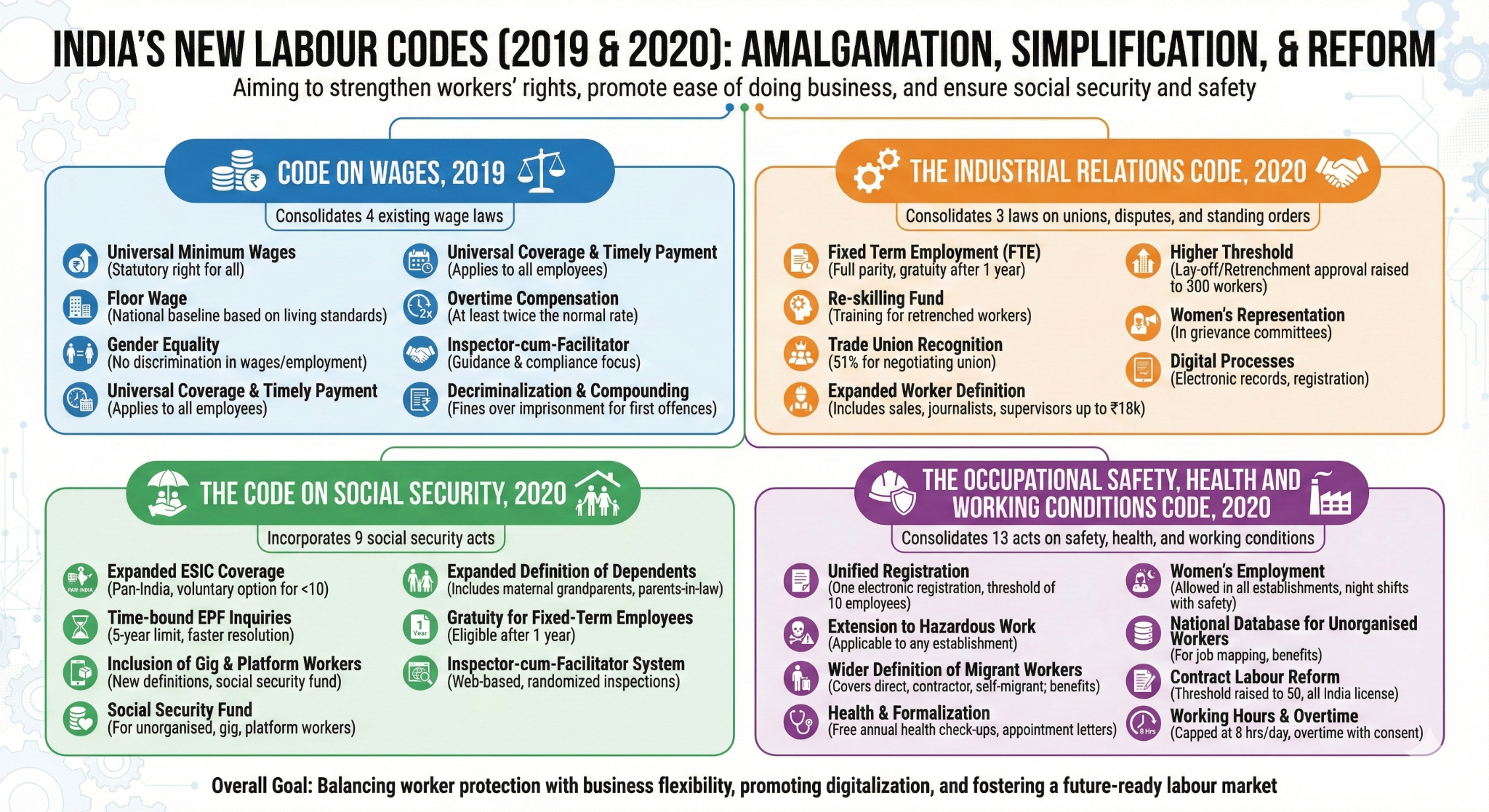
- To rationalise India’s complex and archaic labour regulatory framework, the Central Government consolidated 29 central labour laws into four distinct codes (passed in 2019 and 2020).
- These were designed to improve ease of doing business while safeguarding worker welfare
- The Code of Wages, 2019: It merges four key laws (The Payment of Wages Act, 1936; The Minimum Wages Act, 1948; The Payment of Bonus Act, 1965; and The Equal Remuneration Act, 1976) into a single framework.
- It brings uniformity in wage rules, ensures fair and timely payment, promotes gender equality and simplifies compliance for employers while strengthening workers’ rights.
- The Industrial Relations Code, 2020: It combines and simplifies provisions from earlier laws like the Trade Unions Act, 1926, the Industrial Employment (Standing Orders) Act, 1946 and the Industrial Disputes Act, 1947.
- It seeks to balance worker rights with industrial stability by streamlining rules on union recognition, employment terms and dispute resolution.
- The Code on Social Security, 2020: It merges nine existing laws like The Employee's Compensation Act, 1923, The Employees' State Insurance Act, 1948, The Employees' Provident Funds and Miscellaneous Provisions Act, 1952 into one unified framework and extends benefits to all workers, including those in the unorganised, gig and platform sectors.
- It covers maternity, health, life insurance and provident fund benefits while promoting digital processes and easier compliance.
- The Occupational Safety, Health and Working Conditions Code 2020: It consolidates 13 labour laws such as Factories Act, 1948, Plantations Labour Act, 1951, and Mines Act, 1952.
- The Code aims to ensure safer working conditions while simplifying compliance for businesses, creating a more efficient, fair and future-ready labour framework.
What Measures can Strengthen Labour Reforms?
- Adopt the Rajasthan Model for Gig Workers: The Union Government should look at the Rajasthan Platform Based Gig Workers (Registration and Welfare) Act, 2023. It established a welfare board with mandatory representation of gig workers and an algorithmic tracking of all platform transactions to automatically deduct a welfare cess.
- Algorithmic Transparency: Mandate that aggregators share data regarding wage calculation algorithms, penalization metrics, and working hours with the Ministry of Labour to prevent exploitation.
- Moving away from physical "Inspector Raj," the government must invest in data-driven, risk-profiled inspection systems. Mandating digital wage payments and electronic employment records can drastically improve compliance.
- Establish a Binding National Floor Wage: National Floor Wage must be made strictly binding on all states and revised dynamically based on the Consumer Price Index (CPI).
- The national floor wage must be set at a "Goldilocks" level binding enough to protect workers, yet sustainable enough for employers to manage without resorting to job cuts.
- Strengthen Tripartism: The cornerstone of industrial peace is the tripartite model (State, Employer, Employee).
- The government must actively revive the Indian Labour Conference (ILC) to build consensus regarding the rules of the four labour codes.
Conclusion
The ongoing unrest shows that labour reforms without ground-level protection can deepen precarity rather than create quality jobs. Unless issues like job security, gig worker rights, and enforcement gaps are addressed, the codes may remain pro-industry on paper but weak in practice. India’s challenge is to ensure growth with dignity, not growth at the cost of its workforce.
Frequently Asked Questions (FAQs)
1. What are India’s Four Labour Codes?
Consolidation of 29 labour laws into four codes covering wages, industrial relations, social security, and workplace safety.
2. What is the key concern with the Industrial Relations Code, 2020?
Raises threshold to 300 workers for layoffs without approval, weakening job security.
3. How does the Code on Social Security address gig workers?
Recognises gig workers but does not grant employee status, limiting access to core labour rights.
4. Why is the OSH Code criticised?
High thresholds exclude millions in the informal sector, leaving them outside safety protections.
5. What is the main implementation challenge of Labour Codes?
Delayed state-level rules due to labour being in the Concurrent List, causing legal uncertainty.
UPSC Civil Services Examination, Previous Year Questions (PYQs)
Prelims
Q. In India, which one of the following compiles information on industrial disputes, closures, retrenchments and lay-offs in factories employing workers? (2022)
(a) Central Statistics Office
(b) Department for Promotion of Industry and Internal Trade
(c) Labour Bureau
(d) National Technical Manpower Information System
Ans: (c)
Mains
Q. Discuss the merits and demerits of the four ‘Labour Codes’ in the context of labour market reforms in India. What has been the progress so far in this regard? (2024)



