


Economy
Sustainable Tourism Push in Budget 2026-27
- 27 Feb 2026
- 12 min read
For Prelims: Union Budget 2026-27, Buddhist Circuit, Swadesh Darshan Scheme, Eastern Ghats, Western Ghats, Turtle trails, Pulicat Lake, Global Big Cat Summit, Lothal, Dholavira, Swadesh Darshan 2.0, PRASHAD, AYUSH, UDAN Scheme, Dekho Apna Desh.
For Mains: New initiatives announced for tourism development in Union Budget 2026-27, Challenges associated with tourism development in India and way forward.
Why in News?
Tourism has emerged as a focal point in the Union Budget 2026-27, with the government unveiling a comprehensive set of measures aimed at positioning the sector as a strategic growth driver for the Indian economy.
- The tourism sector accounts for 5.22% of India's GDP (total impact) with a direct share of 2.72%, while supporting an impressive 13.34% of total employment, according to the India Tourism Data Compendium 2025 by the Ministry of Tourism.
Summary
- Budget 2026-27 boosts tourism with Buddhist circuits, eco-trails, Global Big Cat Summit, National Institute of Hospitality, guide upskilling, heritage sites, medical hubs, and Purvodaya development.
- The sector faces infrastructure gaps, overcrowding (e.g., 1.1 crore tourists in Goa), safety, hygiene, visa issues, and low foreign arrivals (1 crore vs Thailand's 3.5 crore).
- Focus on infrastructure (UDAN), Incredible India 2.0, tourism-ready certification, agri-tourism, community participation, and green certification.
What New Initiatives have been Announced for Tourism Development in Union Budget 2026-27?
- Development of Buddhist Circuits in Northeast Region: A dedicated scheme was announced to develop Buddhist circuits across Northeast India (Arunachal Pradesh, Assam, Sikkim, Manipur, Mizoram, Tripura), including pilgrimage interpretation centres, improved connectivity, pilgrim amenities, and heritage infrastructure.
- This initiative builds on the experience of the Swadesh Darshan Scheme (launched 2014-15), under which 76 projects were sanctioned and 75 completed.
- Eco-Trails and Sustainable Tourism Initiatives: The Budget has proposed the development of ecologically sustainable mountain and nature trails in Himachal Pradesh, Uttarakhand, Jammu & Kashmir, Araku Valley in the Eastern Ghats, and Podhigai Malai in the Western Ghats.
- Turtle trails along key nesting sites in the coastal areas of Odisha, Karnataka and Kerala, and bird-watching trails along Pulicat Lake in Andhra Pradesh have also been announced.
- Global Big Cat Summit 2026: India will host the first-ever Global Big Cat Summit in 2026, inviting heads and ministers from 95 range countries to deliberate on conservation, habitat protection, scientific collaboration, and sustainable wildlife tourism.
- This initiative reflects the Government's intent to elevate India's role in eco-tourism and international wildlife cooperation. India is home to five of the world's seven big cat species, i.e., tiger, lion, leopard, snow leopard and cheetah.
- National Institute of Hospitality: The National Council for Hotel Management and Catering Technology, Noida (Uttar Pradesh), will be upgraded to a National Institute of Hospitality, aimed at providing high-quality professional education. It will also function as a bridge between academia, industry and the Government, addressing skill gaps and aligning academic training with industry requirements.
- Tourist Guide Upskilling Programme: A pilot scheme for upskilling 10,000 tourist guides across 20 iconic destinations has been announced. It will follow a 12-week hybrid training model combining classroom instruction, field training, and digital modules.
- National Destination Digital Knowledge Grid: A digital platform will be created to document cultural, spiritual, and heritage sites across India, providing resources for researchers, content creators, historians, and tourism stakeholders.
- Experiential Cultural Destinations: The Budget proposed development of 15 archaeological sites into vibrant experiential cultural destinations, including Lothal, Dholavira, Rakhigarhi, Sarnath, Hastinapur, and Leh Palace. It will complement existing schemes like Swadesh Darshan 2.0 and PRASHAD.
- Regional Medical Hubs: A Scheme to Support States in establishing five Regional Medical Hubs has been introduced, aimed at promoting India as a global destination for medical and wellness tourism. The hubs will integrate advanced healthcare services, AYUSH centres, and medical value tourism facilitation centres.
- Tourism Development in Purvodaya States: The Budget proposes the creation of five tourism destinations, one in each Purvodaya state—Bihar, Jharkhand, West Bengal, Odisha and Andhra Pradesh—under an integrated framework including the East Coast Industrial Corridor with a node at Durgapur (West Bengal).
- Additionally, provisions for 4,000 electric buses were announced to support improved connectivity, cleaner transport, and greater accessibility across these regions.
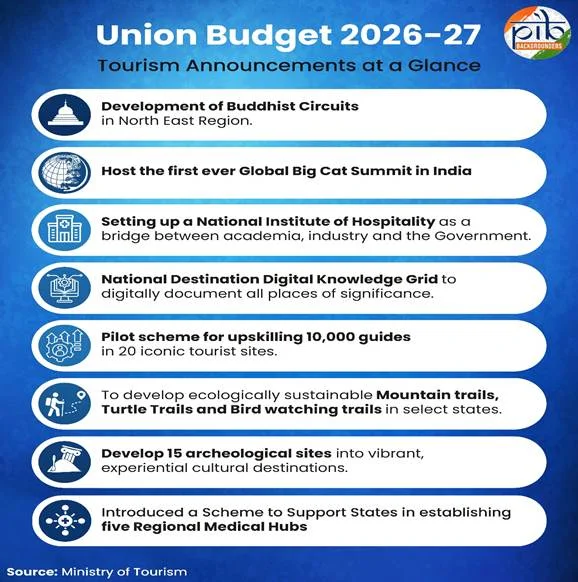
Initiatives Related to Tourism in India
What Challenges are Associated with Tourism Development in India?
- Inadequate Infrastructure: Deficient transportation networks and poor last-mile connectivity persist as major barriers. In 2025, Vyas Valley (Uttarakhand) saw tourist footfall surge from 200 to 30,000 over a decade, but local infrastructure failed to keep pace, causing capacity strains and degraded visitor experiences.
- Environmental Degradation: Overcrowding in fragile regions leads to pollution, waste accumulation, and biodiversity loss.
- From 68.9 lakh domestic tourists in 2017, Goa's total arrivals surged to nearly 1.1 crore by 2025, leading to congested roads, garbage heaps, beach erosion, and calls for carrying capacity limits.
- The 2025 Char Dham Yatra attracted over four million pilgrims, exacerbating environmental pressures in hill stations.
- Safety and Security Concerns: Persistent safety issues, particularly for women and solo travellers, continue to deter visitors. Travel advisories from the US and UK have been issued, while incidents involving foreign tourists reinforce negative perceptions, pushing travellers toward Southeast Asian competitors.
- Hygiene and Service Quality: Inconsistent sanitation standards undermine visitor satisfaction, with international travellers often confining themselves to luxury accommodations, limiting economic benefits to local communities.
- Visa and Regulatory Complexities: Despite e-visa expansion, processing delays persist. Overseas promotion funding was slashed from Rs 33 crore to Rs 3.07 crore in Budget 2025-26, hampering efforts to compete with visa-on-arrival destinations like Thailand and Vietnam.
- Global Competitiveness Gap: India attracted only 10 million foreign tourists in 2024, versus Thailand's 35 million, Malaysia's 25 million, and Vietnam's 17 million. In 2023, Indians spent an estimated USD 33 billion on overseas holidays, citing better value, services, and transparency abroad.
What Steps are Needed to Promote Tourism Development in India?
- Enhance Infrastructure and Connectivity: Prioritize investment in transportation networks including high-speed rail, multimodal corridors, and regional airports under UDAN scheme to ensure equitable dispersal of tourism beyond major metros.
- Revamped "Incredible India 2.0" Campaign: Move beyond generic promotion with data-driven, hyper-personalized global marketing targeting specific demographics like millennials, luxury travelers, and adventure enthusiasts.
- Expand domestic promotion via Dekho Apna Desh to encourage exploration of lesser-known sites.
- Establish "Tourism-Ready" Certification for Destinations: Develop mandatory accreditation program for tourist destinations based on benchmarks for cleanliness, safety, accessibility, and sustainability, creating healthy competition among states to improve standards.
- Integrate Tourism with Rural Development: Promote agri-tourism and rural tourism by connecting working farms and rural communities with urban and international tourists, providing authentic cultural experiences and generating additional income for farmers.
- Integrate local communities under programmes like Paryatan Mitra/Paryatan Didi, ensuring equitable benefits reach rural, tribal, and underserved regions.
- Incentivize Green Certification for the Hospitality Industry: Launch national program to encourage hotels, resorts, and homestays adopting sustainable practices like water conservation, waste reduction, and renewable energy use. Provide marketing support to "Green Key" certified properties to attract environmentally conscious travelers.
Conclusion
The Union Budget 2026-27 presents a transformative vision for Indian tourism through targeted initiatives like Buddhist circuits, eco-trails, Global Big Cat Summit, and hospitality upgrades. However, addressing infrastructure gaps, environmental concerns, and global competitiveness challenges through sustainable practices and community participation will determine the sector's success in becoming a true economic growth driver.
|
Drishti Mains Question Q. Examine the major challenges confronting the Indian tourism sector. Suggest a comprehensive framework for sustainable tourism development in India |
Frequently Asked Questions (FAQs)
1. What is the economic contribution of tourism to India’s economy?
Tourism contributes 5.22% to GDP (total impact) and supports 13.34% of total employment, as per India Tourism Data Compendium 2025.
2. Which archaeological sites are being developed as experiential cultural destinations?
The Budget proposed development of 15 archaeological sites including Lothal, Dholavira, Rakhigarhi, Sarnath, and Hastinapur with curated walkways, interpretation centres, and heritage infrastructure.
3. What is the National Destination Digital Knowledge Grid?
It is a digital platform to document cultural, spiritual, and heritage sites across India, providing resources for researchers, content creators, and tourism stakeholders to support data-driven decision-making.
UPSC Civil Services Examination, Previous Year Question (PYQ)
Mains
Q.1 How can the mountain ecosystem be restored from the negative impact of development initiatives and tourism? (2019)
Q.2 The states of Jammu and Kashmir, Himachal Pradesh and Uttarakhand are reaching the limits of their ecological carrying capacity due to tourism. Critically evaluate. (2015)



