


Rapid Fire
Supreme Court Stays its Aravallis Judgment
- 01 Jan 2026
- 2 min read
The Supreme Court (SC) has kept in abeyance its November 2025 judgment that upheld a restrictive definition of the Aravalli hills based on 100-metre elevation and 500-metre cluster criteria.
- Suo Motu Cognisance: Taking suo motu cognisance, the SC noted that in Rajasthan, only 1,048 of 12,081 hills would qualify under the 100-metre criterion, and could strip lower hill ranges of environmental protection.
- Proposal for Expert Committee: The SC proposed a high-powered expert committee to assess the short- and long-term ecological impacts of sustainable or regulated mining in areas excluded by the current definition.
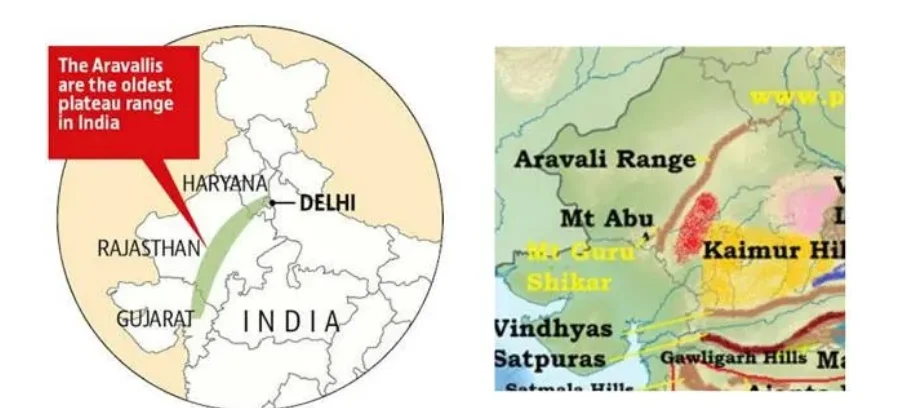
Aravalli Range
- About: It is one of the world’s oldest fold mountain systems, dating to the Proterozoic era, and stands as a classic example of an ancient, highly eroded mountain system.
- Geographical Extent: The range runs diagonally (northeast–southwest, 690–800 km) across Gujarat, Rajasthan, Haryana, and Delhi.
- Physiographic Divisions: The Aravallis are divided into two major sections:
- Sambhar–Sirohi Range: Southern section, more elevated and forested, includes Guru Shikhar (highest peak, Mount Abu, Rajasthan).
- Sambhar–Khetri Range: Northern section, lower and more eroded.
- Climatic and Environmental Role: It acts as a crucial natural barrier against the Thar Desert’s eastward spread, while also playing a vital role in groundwater recharge and local climate regulation.
- It forms a crucial watershed divide between the Indus and Ganga river systems.
- Drainage: Banas and Sahibi (tributaries of the Yamuna), Luni, flowing westwards into the Rann of Kutch (inland drainage).
| Read More: Protection of Aravalli Hills |



