


Biodiversity & Environment
Protection of Aravalli Hills
- 22 Dec 2025
- 19 min read
For Prelims: Aravalli Hills, Indian Council of Forestry Research and Education, Aravali Green Wall initiative
For Mains: Environmental governance and the role of the judiciary, Mining regulation vs ecological protection, Biodiversity conservation
Why in News?
In November 2025, the Supreme Court (SC) of India adopted a uniform definition of the Aravalli Hills as hills 100 meters or higher above local ground, sparking concerns that this could weaken legal protection for the range and make large parts of the Aravalli range vulnerable to mining and construction activities.
- The decision triggered public protests, political reactions, and the #SaveAravalli campaign.
Summary
- In 2025, the Supreme Court adopted a uniform definition of the Aravalli Hills, froze new mining leases, and mandated a sustainable mining plan.
- The government says the framework strengthens protection, bans mining in core areas, and focuses on curbing illegal mining.
- Critics fear the 100-metre rule may exclude large areas, risking groundwater, biodiversity, and desertification control, underscoring the need for landscape-level restoration.
What is the Supreme Court of India’s Ruling on the New Aravalli Definition?
- About: The Supreme Court accepted a uniform, scientific definition of the Aravalli Hills and Ranges proposed by a committee under the Ministry of Environment, Forest and Climate Change (MoEF&CC) to regulate mining and protect the ecosystem.
- The Supreme Court banned mining in core/inviolate areas such as protected areas, eco-sensitive zones, tiger reserves and wetlands, permitting exceptions only for atomic minerals (Part B of the First Schedule), critical and strategic minerals (Part D), and minerals listed in the Seventh Schedule of the MMDR Act, 1957.
- Aravalli Hills: Defined as any landform that rises 100 metres or more above the surrounding local terrain.
- Local relief is determined using the lowest contour line encircling the landform.
- Protection extends to the entire hill system, including supporting slopes and associated landforms, irrespective of height.
- Aravalli Ranges: Defined as clusters of two or more such hills located within 500 metres of each other. The entire intervening area between these hills, including slopes and smaller hillocks, is included as part of the range.
- The aim of this definition was to provide clarity and objectivity in regulating activities like mining across the Aravalli landscape.
- SC Directions: The Court also directed a temporary ban on issuing new mining leases in areas falling under this definition until a Management Plan for Sustainable Mining (MPSM) is prepared by the Indian Council of Forestry Research and Education (ICFRE).
- The plan must identify no-mining zones, strictly regulated mining areas, sensitive habitats and wildlife corridors, assess cumulative ecological impacts and carrying capacity, and prescribe restoration and rehabilitation measures.
- The Court noted that blanket bans often fuel illegal mining, so it adopted a calibrated approach: existing legal mining under strict regulation, a pause on new mining, and permanent protection of ecologically sensitive areas.
Government’s Stance on the Aravalli Issue
- The Centre clarified that the Supreme Court–approved framework does not dilute Aravalli protection or allow large-scale mining.
- No new mining leases will be granted until a Management Plan for Sustainable Mining is finalised.
- The government identifies illegal mining as the main threat and supports stronger monitoring and enforcement, including use of drones and surveillance technologies.
Earlier Interventions for Protection and Restoration of the Aravalli Range
- MoEF Restrictions (1990s): Environment Ministry imposed restrictions limiting mining to sanctioned projects in the Aravalli range.
- Weak enforcement by States led to large-scale non-compliance with mining regulations.
- Defining Aravalli Hills: Earlier, only Rajasthan had a formally notified definition for regulating mining in the Aravallis, based on the 2002 State Committee Report using Richard Murphy landform classification, identifying hills as landforms rising 100 metres above local relief and prohibiting mining on hills and their supporting slopes.
- Supreme Court Ban on Mining (2009): Blanket ban imposed on mining in Faridabad, Gurugram and Mewat districts of Haryana.
- In 2024, the Court prohibited granting of fresh mining leases and renewals across the Aravalli range and directed the Central Empowered Committee (CEC) to conduct a detailed examination.
- CEC Recommendations (2024): It recommended complete scientific mapping of the Aravalli range across all States.
- Suggested a macro-level Environmental Impact Assessment (EIA) of mining activities.
- Recommended that no new mining leases or renewals be allowed until mapping and impact assessments are completed.
- Aravalli Green Wall Initiative: Inspired by Africa’s Great Green Wall, the Aravali Green Wall initiative is a landscape-level ecological restoration programme led by the MoEF&CC to reverse land degradation, strengthen ecological resilience, and prevent desertification in the Aravalli range.
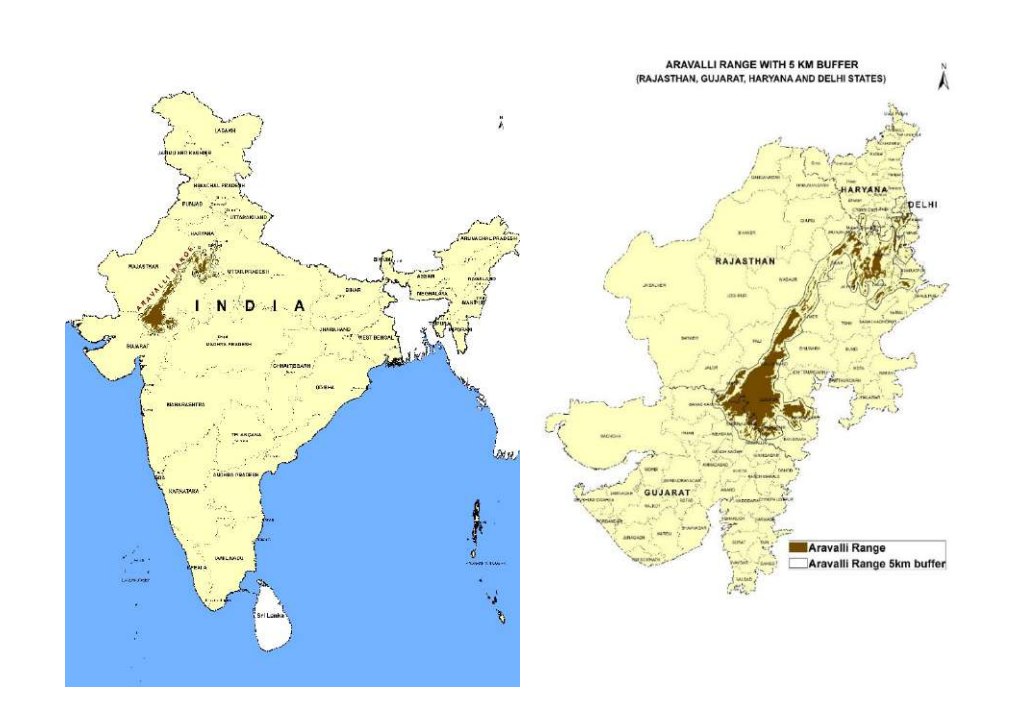
- The initiative proposes a 1,400 km long and 5 km wide green belt along the Aravalli range, covering Gujarat, Rajasthan, Haryana and Delhi, including the core Aravalli region and its surrounding buffer zones.
- The initiative aims to restore more than 1.1 million hectares of degraded land in the Aravalli hills by 2027 by plugging ecological gaps and reviving natural vegetation.
- The green wall is expected to reduce sand and dust storms, improve air quality, and mitigate micro-climatic stress, particularly in the Delhi-NCR region.
What are the Criticisms Regarding the New Definition of Aravalli Hills?
- Exclusion of Majority Landscape: An internal Forest Survey of India (FSI) assessment shows that the 100-metre threshold excludes over 90% of the Aravalli system from the new definition.
- This raises significant ecological, environmental, and governance concerns, especially for the Delhi-NCR region, as the Aravalli range acts as a natural dust and pollution sink, supporting air quality control, groundwater recharge, and climate regulation.
- Threat of Expanded Mining: Areas falling outside the definition may become vulnerable to mining, construction, and urban expansion, potentially reversing decades of conservation efforts.
- Ignoring Ecological Continuity: The Aravallis function as a continuous ecological system, but the definition is seen as peak-centric, overlooking the ecological role of foothills, valleys, and connecting ridges.
- Risk to Groundwater Recharge: Lower hills and slopes are crucial for rainwater percolation and aquifer recharge; their disturbance could lower water tables across Rajasthan, Haryana, Gujarat, and Delhi-NCR.
- Accelerated Desertification: Weakening the Aravalli barrier could allow the Thar Desert to advance eastward, intensifying dust storms, land degradation, and aridity, undermining India’s obligations under the UN Convention to Combat Desertification.
- Implementation and Enforcement Challenges: Without comprehensive mapping and strict oversight, the new definition may create regulatory loopholes, making illegal mining harder to curb.
What are the Key Facts About Aravalli Range?
- Geological Origin and Evolution: The Aravalli Range is one of the oldest mountain systems in the world and the oldest in India, dating back nearly 2,000 million years to the Precambrian era.
- It was formed during the Aravalli–Delhi orogeny due to tectonic plate collisions. The present-day Aravallis are highly eroded remnants of a much larger prehistoric mountain system, having been reduced over millions of years by weathering and erosion.
- Guru Shikhar Peak on Mount Abu is the highest peak in the Aravalli Range (1,722 m).
- It spans over 800km from Gujarat to Delhi (through Rajasthan and Haryana).
- Climatic and Ecological Importance: The Aravallis acts as a natural barrier against Thar Desert expansion into north-western India.
- Deforestation and degradation have created multiple gaps, allowing desert sand to drift toward fertile plains and worsening air pollution and dust storms.
- Contribution to Water Regime: Located in a semi-arid region receiving 500–700 mm of rainfall annually, the Aravalli range functions as a major watershed dividing drainage between the Bay of Bengal and the Arabian Sea systems.
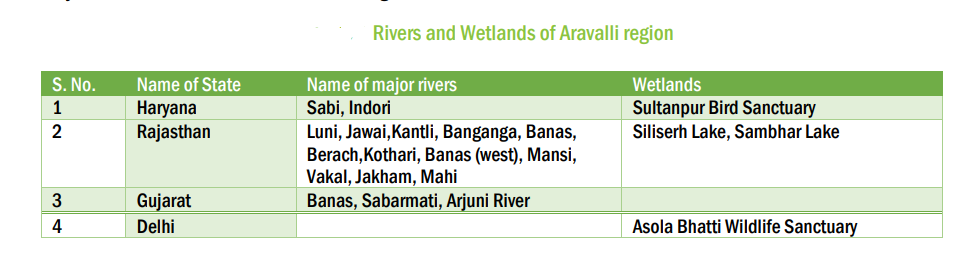
- Biodiversity and Wildlife Significance: The Aravalli landscape supports dry deciduous forests, grasslands, and wetlands with a unique mix of Saharan, Peninsular, and Oriental biodiversity.
- It houses 22 wildlife sanctuaries and three tiger reserves, and provides habitat for endangered species such as the tiger, leopard, Indian wolf, sloth bear, and Great Indian Bustard.
- Agriculture, Livelihoods, and Livestock: Agriculture in the Aravalli region is rainfed and subsistence-based, with bajra, maize, wheat, mustard, and pulses, while large livestock dependence and forest resources make ecosystem health vital for rural livelihoods.
- Economic and Mineral Importance: The Aravalli region is rich in minerals, with over 70 commercially valuable minerals including zinc, lead, silver, tungsten, marble, and granite.
- Mining has emerged as a major economic activity, particularly in Rajasthan, which accounts for around 80% of the range.
- Industrial Development and Urban Pressure: Due to its strategic location, the Aravalli belt hosts major industrial and urban clusters such as Gurugram, Faridabad, Jaipur, Alwar, and Ajmer.
- It supports industries ranging from IT and textiles to automobiles, chemicals, and steel.
- Cultural and Heritage Significance: The Aravalli range houses UNESCO World Heritage Sites like Chittorgarh and Kumbhalgarh forts.
- It is also home to major religious centres such as Pushkar, Ajmer Sharif, Mount Abu, and Ranakpur, making it sacred to Hindu, Islamic, and Jain traditions and reinforcing its civilisational value.
- Degradation and Environmental Decline: Over the decades, the Aravallis have experienced severe deforestation, mining, urbanisation, and grazing pressure.
- Several hills have completely disappeared, forest cover has declined sharply, and rainfall duration has reduced significantly.
- These changes have triggered soil erosion, aquifer damage, desert gap expansion, and worsening air pollution, especially affecting Delhi-NCR.
What Measures are Required to Strengthen Protection of the Aravalli Range?
- Scientific Identification and Mapping: Undertake comprehensive, standardised mapping of hills, ranges, slopes, valleys, recharge zones, and wildlife corridors using authoritative datasets.
- Apply graded and risk-based controls on mining activities, supported by clear criteria for prohibition, regulation, and monitoring
- Prevention of Illegal mining: Strengthen monitoring, surveillance, and enforcement mechanisms through institutional coordination and technology-based tools.
- Use drones, satellite imagery, CCTV, e-challans, and district task forces to curb illegal mining and sand mafias.
- Ecosystem restoration and management: Promote restoration of degraded forests, grasslands, and mined areas based on ecological suitability and long-term sustainability.
- Indigenous systems like taankas, jhalaras, talab-bandis strengthen watershed management in Aravalli villages.
- Wind Erosion & Sand Drift Control: Surface vegetation using species like Calligonum and Acacia stabilised sand dunes and reduced wind erosion.
- It helps control dust storms and desertification in Aravalli gap areas.
- Restoration and Global Commitments: The New Delhi Declaration (UNCCD CoP-14) highlights that desertification undermines livelihoods and development, stressing sustainable land management.
- Restoring the Aravalli ecosystem is vital to protect water regulation, biodiversity, climate resilience, and to meet India’s commitments under the Paris Agreement, Bonn Challenge, and Land Degradation Neutrality, while safeguarding local livelihoods.
Conclusion
The Aravalli Range is not merely a geological feature but a life-support system for north-western India. Its degradation threatens climate stability, and livelihoods. Conservation and restoration of the Aravallis are therefore ecological, economic, and civilisational imperatives, requiring landscape-level protection, and community-based restoration.
|
Drishti Mains Question: How can India balance mineral extraction with ecological security in fragile landscapes like the Aravallis? |
Frequently Asked Questions (FAQs)
Q. What did the Supreme Court of India decide on the Aravalli Hills in 2025?
The Court approved a uniform, scientific definition of Aravalli Hills and Ranges, imposed a freeze on new mining leases, and mandated preparation of a Management Plan for Sustainable Mining (MPSM).
Q. How are Aravalli Hills defined under the Supreme Court–approved framework?
Aravalli Hills are defined as landforms rising 100 metres or more above local relief, with protection extending to the entire hill system, including supporting slopes and enclosed landforms.
Q. What constitutes an Aravalli Range under the new definition?
Two or more Aravalli Hills located within 500 metres of each other are treated as a single range, and the entire intervening area is included for protection.
Q. What is the Aravalli Green Wall Initiative?
It is a MoEF&CC-led landscape restoration programme covering the Aravalli range and its buffer zones across Gujarat, Rajasthan, Haryana, and Delhi, aimed at combating desertification and land degradation.
UPSC Civil Services Examination, Previous Year’s Question (PYQs)
Mains
Q. What are the consequences of Illegal mining? Discuss the Ministry of Environment and Forests’ concept of GO AND NO GO zones for coal mining sector. (2013)
Q. “The most significant achievement of modern law in India is the constitutionalization of environmental problems by the Supreme Court.” Discuss this statement with the help of relevant case laws. (2022)



