


Social Issues
Supreme Court Guidelines on Child Trafficking
- 22 Dec 2025
- 13 min read
For Prelims: Supreme Court of India, Article 23, UNCTOC, National Commission for Protection of Child Rights
For Mains: Safeguards against human trafficking, Supreme Court’s role in evolving victim-centric criminal jurisprudence, Preventive and rehabilitative strategies for child protection
Why in News?
The Supreme Court of India, described child trafficking and commercial sexual exploitation as a “deeply disturbing reality” in the country.
- It laid down guidelines directing courts to treat trafficked children as injured witnesses and to assess their testimony sensitively, without rejecting it merely due to minor inconsistencies.
Summary
- The Supreme Court has recognised child trafficking and commercial sexual exploitation as grave violations of children’s dignity and fundamental rights, directing courts to treat trafficked children as injured witnesses and not discard their testimony due to minor inconsistencies.
- Effective response requires a prevention-first approach, combining strong legal enforcement with community vigilance, welfare convergence, transit monitoring, and rehabilitation mechanisms for rescued children.
What are the Supreme Court of India Guidelines Aimed at Addressing the Issue of Child Trafficking?
- Victim's Testimony as Credible Evidence: Courts must treat a trafficked child’s testimony as that of an injured witness, giving it due credence.
- Minor inconsistencies in the testimony should not discredit the victim’s account, and her sole testimony can be enough for conviction if credible.
- Given the layered nature of trafficking operations, courts should not expect victims to provide precise details. The complexity of the crime makes it difficult for victims to recount events clearly.
- Sensitivity to Vulnerabilities: Courts must consider the socio-economic and cultural vulnerabilities of victims, especially those from marginalized communities. Judicial appreciation should be marked by sensitivity and realism.
- SC also noted that child trafficking and sexual exploitation violate children’s dignity and bodily integrity and undermine their fundamental rights to life, dignity and safety.
- Minimising Secondary Victimisation: The court emphasized protecting victims from further trauma during legal proceedings, ensuring their dignity is upheld and avoiding additional distress.
- Avoiding Prejudicial Assumptions: Courts should refrain from making assumptions based on a victim’s behavior, such as a lack of immediate protest, which could undermine her credibility.
What is Child Trafficking?
- About: Child trafficking refers to the recruitment, transportation, transfer, harbouring, or receipt of a child through coercion, deception, abuse of power, or exploitation of vulnerability for the purpose of exploitation.
- Exploitation includes sexual exploitation, forced labour, slavery or servitude, and removal of organs, and constitutes a grave violation of child rights, human dignity, and bodily integrity.
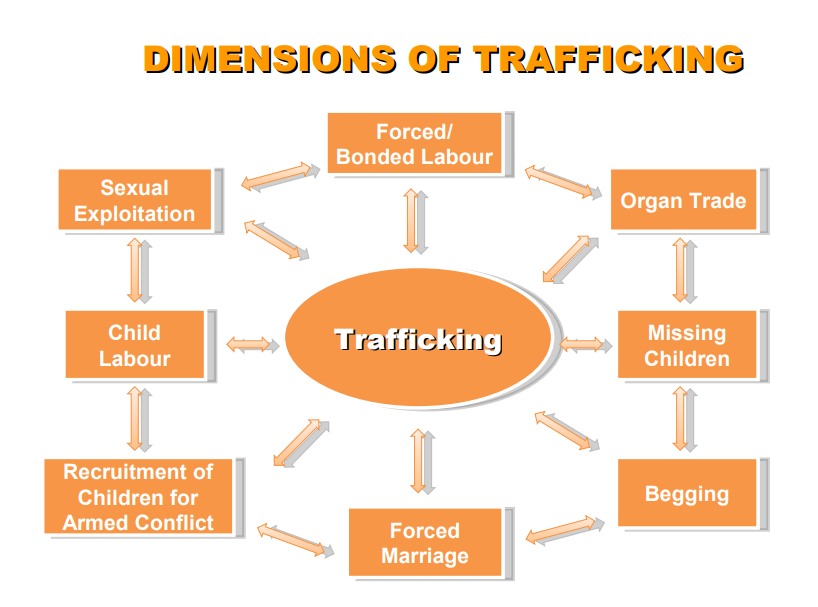
- Regulation of Child Trafficking and Commercial Sexual Exploitation in India
- Constitutional Framework:
- Article 23 prohibits trafficking in human beings and forced labour, making it a fundamental rights violation.
- Legal Framework:
- Bharatiya Nyaya Sanhita (BNS), 2023: Sections 143 and 144 of BNS, 2023 provide for stringent punishment for human trafficking and sexual exploitation of trafficked children, including imprisonment up to life, with beggary recognised as a form of exploitation.
- Immoral Traffic (Prevention) Act, 1956 (ITPA): Core law against trafficking for commercial sexual exploitation; penalises brothel-keeping, procuring, and related offences.
- Protection of Children from Sexual offences (POCSO) Act, 2012: Special law to protect children from sexual abuse and exploitation; mandates child-friendly procedures.
- Criminal Law Amendment Act, 2013: Provide a comprehensive definition of trafficking, including sexual exploitation, slavery, servitude, forced labour, and organ removal; cover trafficking of children irrespective of consent.
- Juvenile Justice (Care and Protection of Children) Act, 2015: Mandates a safety net of institutional and non-institutional care and protection services for children in conflict with law and children in need of care and protection.
- Allied legislations addressing trafficking and exploitation include the Bonded Labour System (Abolition) Act, 1976, Child Labour (Prohibition and Regulation) Act, 1986, Prohibition of Child Marriage Act, 2006, and the Transplantation of Human Organs and Tissues Act, 1994, which collectively aim to prevent forced labour, child exploitation, early marriage, and illegal organ trade.
- SC Judgements and Guidelines:
- Vishal Jeet v. Union of India (1990): The SC held trafficking and child prostitution to be a serious socio-economic problem and stressed a preventive, humanistic approach.
- SC directed States set up advisory committees to eradicate child prostitution and Devadasi/Jogin practices.
- MC Mehta v. State of Tamil Nadu (1996): The SC prohibited the employment of children in hazardous industries. It ordered the creation of a Child Labour Rehabilitation Welfare Fund.
- Bachpan Bachao Andolan v. Union of India (2011): The SC imposed a total ban on the employment of children in Indian circuses and issued key directions to the Central and State governments to address the widespread exploitation and trafficking of children in circuses.
- Vishal Jeet v. Union of India (1990): The SC held trafficking and child prostitution to be a serious socio-economic problem and stressed a preventive, humanistic approach.
- International obligations: India has ratified the UN Convention on Transnational Organized Crime (UNCTOC) and its Trafficking Protocol.
- Constitutional Framework:
What Challenges Hinder Effective Prevention of Child Trafficking and Exploitation in India?
- Entrenched Socio-economic Distress: Poverty, unemployment, migration, disasters, and family breakdown continuously push children into vulnerability, creating a steady supply for traffickers.
- Demand for cheap labour, domestic servitude, begging, and commercial sex continues to sustain trafficking markets.
- The rise of quick-commerce delivery apps has created hidden demand for child labour in unregulated dark stores and sorting hubs, where children work long night shifts to meet rapid delivery targets.
- Invisible and Organised Trafficking Chains: Trafficking networks operate through layered and fragmented structures across source, transit, and destination areas, making detection and disruption extremely difficult.
- For instance, traffickers exploit the porous India–Nepal border and route children through multiple States, making it difficult for any single State police force to track the entire trafficking chain.
- Silence of Victims: Fear, stigma, trauma, and threats suppress reporting, allowing exploitation to remain hidden and unaccounted for.
- Insensitive questioning procedures retraumatise victims, discouraging cooperation with justice processes.
- Misuse of Technology: Social media and online platforms enable grooming, recruitment, and sexual exploitation, often beyond the reach of traditional policing.
- For instance, in the "Virtual Recruitment" model, traffickers use fake "talent hunt" profiles on Instagram to lure aspiring teenage influencers with promises of modeling contracts, eventually trafficking them into commercial sexual exploitation.
- Gaps in Data and Monitoring: Delays in updating National Crime Records Bureau (NCRB) data and fragmented databases on missing, rescued, and trafficked children limit effective early warning, tracking, and prevention efforts.
What Measures Can Effectively Curb Child Trafficking and Exploitation?
The National Commission for Protection of Child Rights emphasised that prevention is the most effective strategy against child trafficking and accordingly recommended targeted measures to curb the menace:
- Source-area Recommendations: Identify trafficking-prone villages and urban habitations and map children at risk and vulnerable families using defined indicators (school dropouts, poverty, migration, family distress).
- Ensure convergence of welfare schemes (ration, MGNREGA, education, health) so that economic distress does not push families towards traffickers.
- Strengthen Panchayat-level vigilance through Village Child Protection Committees (VCPCs), Anganwadi workers, and school authorities, and local police.
- Maintain village-level registers tracking the movement of children and outsiders, with regular updates on the TrackChild Portal and the GHAR – GO Home and Re-Unite portal, as traffickers often operate under the guise of education or employment offers.
- Transit-area Recommendations: Sensitise and train GRP (Government Railway Police) and RPF (Railway Protection Force), transport staff, porters, vendors, and police to identify suspicious movement of children and accompanying adults.
- Display helpline numbers (1098, 112) and child rights information in local languages at all transit points.
- Destination-area Recommendations: Conduct regular inspections of placement agencies, factories, brick kilns, hotels, massage parlours, domestic work sites, and entertainment establishments.
- Enforce zero tolerance for child labour, child marriage, and domestic servitude.
- Ensure availability of child care institutions, shelters, and rehabilitation facilities under the JJ Act, 2015, for rescued children.
Conclusion
Child trafficking is a serious violation of children’s dignity and fundamental rights. The Supreme Court’s guidelines strengthen justice by treating trafficked children as injured witnesses and rejecting stereotypes and minor inconsistencies.
|
Drishti Mains Question: Discuss child trafficking as a violation of fundamental rights with reference to constitutional and legal provisions. |
Frequently Asked Questions (FAQs)
Q. Which constitutional provision directly prohibits child trafficking?
Article 23 of the Constitution prohibits trafficking in human beings and forced labour, making it a fundamental rights violation.
Q. What are the key laws addressing child trafficking in India?
Bharatiya Nyaya Sanhita, 2023; ITPA, 1956; POCSO Act, 2012; Criminal Law Amendment Act, 2013, along with allied labour and child protection laws.
Q. Why is child trafficking difficult to detect and prevent?
It operates through organised, invisible networks across regions, compounded by poverty, migration, stigma, and underreporting by victims.
UPSC Civil Services Examination Previous Year Question (PYQ)
Q. India’s proximity to two of the world’s biggest illicit opium-growing states has enhanced her internal security concerns. Explain the linkages between drug trafficking and other illicit activities such as gunrunning, money laundering and human trafficking. What counter-measures should be taken to prevent the same? (2018)



