


Governance
NEP 2020: India’s Innovation Push in School Education
- 08 Dec 2025
- 10 min read
For Prelims: National Education Policy 2020 (NEP 2020), PM e-VIDYA, DIKSHA, Gender Inclusion Fund, National Assessment Centre (PARAKH), School Innovation Ambassador Training Program (SIATP), IPR, Atal New India Challenges (ANIC).
For Mains: National Education Policy 2020 (NEP 2020) and its Role in Transforming the Education System in India, Key India’s Initiatives to Transform the Education System and its Impacts.
Why in News?
India’s education system is making headlines as it undergoes a profound transformation under the National Education Policy 2020 (NEP 2020). The government’s initiatives are moving away from rote learning to inquiry-based, experiential education, fostering creativity, critical thinking, and innovation among students.
How is NEP 2020 Transforming the School Education System in India?
- Multidisciplinary Learning: Students have flexible, multidisciplinary choices (e.g., physics with music) and begin hands-on vocational training from Grade 6 onwards.
- Integration of art, technology, and skill-based learning across levels.
- Assessment Reforms: Shift assessment from rote memorization to testing core competencies. A 360-degree Holistic Progress Card now tracks cognitive, social, and emotional development.
- Digital Integration: Digital platforms like PM e-VIDYA and DIKSHA provide access to virtual labs, teacher training, and online learning for over 25 crore students.
- Equitable and Inclusive Education: A Gender Inclusion Fund and Special Education Zones will support disadvantaged groups and regions. The focus for children with disabilities includes dedicated resource centers, assistive technologies, and inclusive education.
What is National Education Policy (NEP) 2020?
- About: NEP 2020 seeks to tackle challenges related to quality, equity, access, and affordability across all educational levels.
- It replaces the 34-year-old NEP of 1986 and is founded on the recommendations of the Dr. K. Kasturirangan Committee (2019).
- NEP 2020 Structure: Introduces a 5+3+3+4 structure, with foundational years (ages 3–8) being 100% play-based.
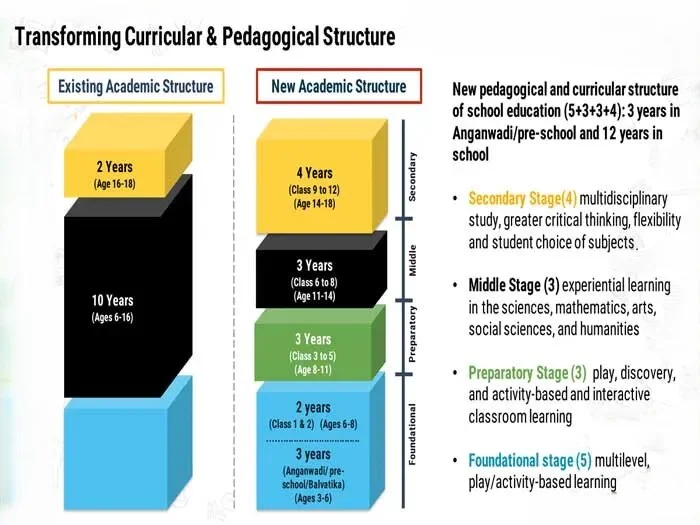
- Performance Evaluation: Every textbook, question paper, and classroom activity must now assess application and innovation rather than simple recall.
- Board exams, overseen by the National Assessment Centre (PARAKH), can be attempted twice a year.
- Key Targets:
|
Key Area |
Target / Objective |
|
Universal School Enrollment |
Achieve 100% Gross Enrollment Ratio (GER) in school education (pre-school to secondary) by 2030. |
|
Out-of-School Children |
Bring 2 crore out-of-school children back into the mainstream education system. |
|
Higher Education Access |
Raise GER in higher education to 50% (from ~27%) by adding 3.5 crore new seats by 2035. |
|
Teacher Qualification |
Make a 4-year integrated B.Ed. degree the minimum qualification for all school teachers by 2030. |
|
Institutional Autonomy |
Phase out the college affiliation system and grant graded autonomy to all colleges within 15 years. |
- Key Initiatives:
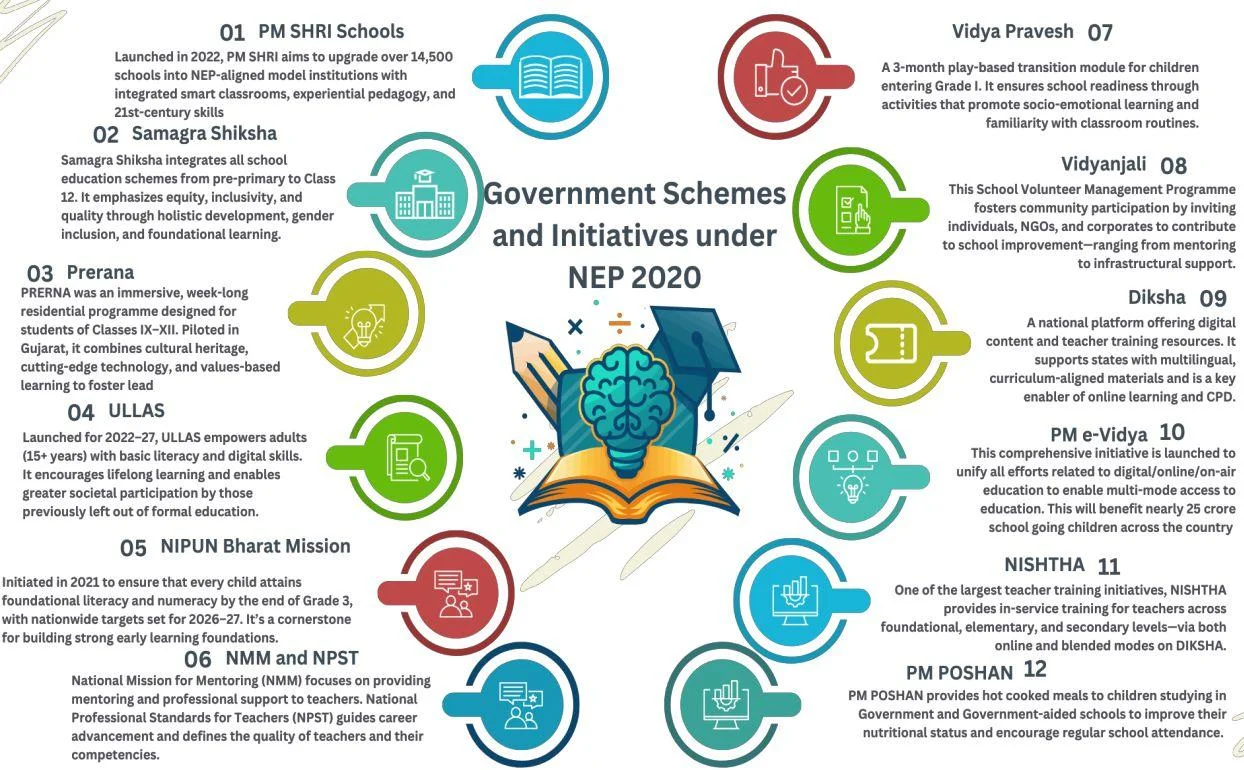
What are India’s Key Initiatives for Transforming the Education System?
- Atal Innovation Mission (AIM): AIM is a flagship initiative launched in 2016 by NITI Aayog to promote innovation and entrepreneurship across schools, colleges, and startups. Key components include:
- Atal Tinkering Labs (ATLs): Innovation labs in schools providing tools like 3D printers, robotics kits, and sensors. Over 1.1 crore students engaged.
- Atal Incubation Centres (AICs): Support startups with mentorship, seed funding, and infrastructure, incubating 3,500+ startups.
- Atal Community Innovation Centres (ACICs): Bring technology-driven innovation to underserved regions.
- Atal New India Challenges (ANIC): Fund and mentor technology-based solutions addressing national priorities
- SICs and SIATP: School Innovation Councils (SICs) have been established in schools to foster creativity, design thinking, and entrepreneurship. Activities include leadership talks, workshops, field visits, and Demo Days.
- School Innovation Ambassador Training Program (SIATP) trains teachers in design thinking, IPR, entrepreneurship, and project mentoring.
- Over 72 hours of intensive training, enabling teachers to mentor students and implement innovation-based pedagogy.
- School Innovation Ambassador Training Program (SIATP) trains teachers in design thinking, IPR, entrepreneurship, and project mentoring.
- INSPIRE Awards – MANAK: Encourages students to propose science and technology solutions addressing societal problems.
- Top innovations receive mentorship, prototypes, and national awards, fostering early-stage entrepreneurship and problem-solving skills.
- School Innovation Marathon: Students solve real-world problems aligned with Viksit Bharat 2047. Includes workshops on design thinking, robotics, and IPR.
- Viksit Bharat Buildathon 2025: Nationwide hackathon for students of classes 6–12 on themes like Vocal for Local, Atmanirbhar Bharat, and Swadeshi.
- Culminates with over 1,000 winners receiving awards from a Rs 1 crore prize pool.
How has Innovation in Education Policy Transformed School Education in India?
- Fostering Critical Thinking: Programs like ATLs, SICs, and INSPIRE Awards – MANAK cultivate hands-on problem-solving, design thinking, and STEM skills among students.
- Encouraging Entrepreneurship: Students transition from idea generation to prototyping and startup creation through ATL Student Innovator Program (SIP), Atal Incubation Centres (AICs), and Atal New India Challenges (ANIC).
- Scaling Innovations Nationally: Hackathons, innovation marathons, and Buildathons provide platforms for national-level recognition, mentoring, and funding, translating school-level ideas into impactful solutions.
- Alignment with National Goals: These initiatives promote self-reliance (Atmanirbhar Bharat), sustainability, and preparation for 2047 challenges, positioning India as a global innovation hub.
|
Drishti Mains Question: Q. The National Education Policy (NEP) 2020 aims to transform India's education system from a content-centric to a competency-based model. Critically examine the key initiatives driving this pedagogical shift and their potential impact on fostering an innovation ecosystem. |
Frequently Asked Questions (FAQs)
Q. What is the primary objective of NEP 2020?
NEP 2020 aims to promote critical thinking, creativity, and experiential learning, replacing rote memorization and enhancing STEM and vocational skills across all school levels.
Q. What are Atal Tinkering Labs (ATLs)?
ATLs are makerspaces in schools providing tools like 3D printers and robotics kits to cultivate innovation, design thinking, and hands-on STEM skills among students.
Q. What is the INSPIRE Awards – MANAK scheme?
It encourages students to propose science and technology solutions for societal problems, offering mentorship, prototypes, and national awards to foster early-stage entrepreneurship.
Summary
- NEP 2020 promotes play-based, experiential, and innovation-driven education, replacing rote learning with critical thinking and creativity.
- Atal Innovation Mission (AIM) and ATLs cultivate STEM, entrepreneurship, and design thinking, engaging over 1.1 crore students.
- Programs like SICs, SIATP, INSPIRE Awards, and national hackathons scale innovation, mentor students, and foster self-reliance.
- Digital platforms PM e-VIDYA and DIKSHA ensure nationwide accessibility, continuity, and equitable participation in India’s evolving education system.
UPSC Civil Services Examination, Previous Year Question (PYQ)
Mains
Q. National Education Policy 2020 is in conformity with the Sustainable Development Goal-4 (2030). It intends to restructure and reorient the education system in India. Critically examine the statement. (2020)



