


Facts for UPSC Mains
Invasive Alien Plant Species Crisis
- 08 Dec 2025
- 7 min read
Why in News?
A Nature Sustainability study finds that invasive alien plants are spreading across 15,500 sq km of India’s natural areas each year, causing economic losses of Rs 8.3 lakh crore over 60 years and threatening ecosystems, wildlife, agriculture, and rural livelihoods.
What are Invasive Alien Plant Species?
- About: Invasive plant species are non-native plants introduced intentionally or unintentionally into an ecosystem, where they outcompete native species and cause economic, environmental, or human health impacts.
- Invasions are being accelerated by climate change, land-use change, altered fire regimes, soil moisture changes, livestock grazing patterns, and biodiversity loss.
- Invasive Plant Species in India: Key invaders include Lantana camara, Chromolaena odorata and Prosopis juliflora.
- These invasions have spread across 266,954 sq km of natural habitats in India.
- High-risk Regions: Include the Shivalik–Terai belt, the Duar region of the Northeast, the Aravallis, the Dandakaranya forests, and the Nilgiris in the Western Ghats.
- Open ecosystems such as dry grasslands, savannas, shola grasslands, and the wet plains along the Ganga–Brahmaputra are among the most vulnerable to rapid invasive plant expansion.
- Invasive Alien Species Transforming India’s Natural Ecosystems:
- Biodiversity Erosion: Invasive plants outcompete native vegetation, leading to ecosystem homogenization, soil degradation, and large-scale ecological disruption.
- As native plants decline, herbivores lose their natural food sources, which in turn displaces predators due to shrinking prey availability.
- Livestock: Invasions reduce the availability of fodder and grazing areas essential for livestock survival.
- Humans: Invasive species reduce access to fodder, fuelwood, and fertile land, directly harming rural livelihoods.
- They also trigger health issues like respiratory problems and deepen poverty by undermining income and resource security.
- By 2022, 144 million people, 2.79 million livestock, and 2 lakh sq km of smallholder farmland were exposed to invasive species, underscoring the scale of ecological and livelihood risks.
- Biodiversity Erosion: Invasive plants outcompete native vegetation, leading to ecosystem homogenization, soil degradation, and large-scale ecological disruption.
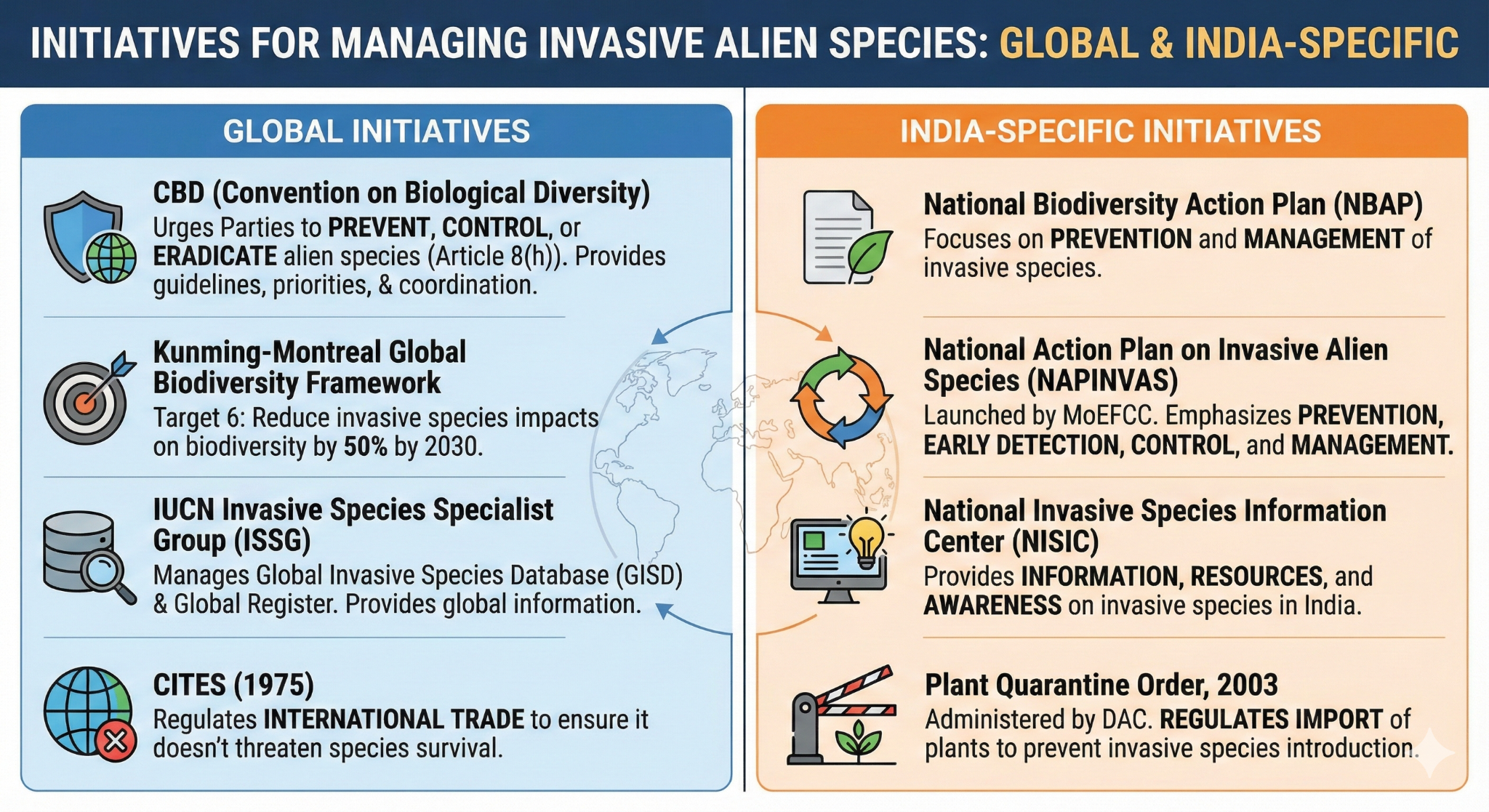
What are the Challenges and Measures for Managing Invasive Plant Species in India?
|
Challenges |
Measures Required |
|
India has no dedicated national mission or central authority to coordinate action on invasive plant species. |
Establish a National Invasive Species Mission with clear leadership and mandates. Integrate invasive control into climate adaptation, watershed management, and restoration programmes |
|
India lacks a unified national database or long-term monitoring system. |
Develop a centralised GIS-based database, early-warning system, and nationwide monitoring network |
|
Weak quarantine and biosecurity systems allowing new introductions |
Strengthen quarantine screening, border biosecurity, and import regulations for plants, seeds, and soil. |
|
There is limited scientific research on species-specific control methods and long-term ecosystem recovery. |
Increase research funding for ecological modelling, biological control, and restoration science. |
|
Manual removal is expensive, labour-intensive, and often ineffective without follow-up restoration. |
Promote community-led removal, mechanical support, and sustainable utilisation options like biofuel production. |
|
Post-removal areas are often not restored, allowing invasives to return quickly. |
Ensure active restoration using native grasses and shrubs to prevent reinvasion. |
Conclusion
India’s rapidly expanding invasive plant species threaten biodiversity, livelihoods, and ecosystem health, requiring urgent national action. A coordinated mission is vital for long-term ecological resilience.
|
Drishti Mains Question: Invasive alien plants are a symptom of systemic environmental mismanagement. Analyse the drivers, ecological impacts. |
Frequently Asked Questions (FAQs)
Q. What are invasive alien plant species?
Non-native plants introduced intentionally or accidentally that establish, spread and outcompete native species, causing ecological, economic or health harm.
Q. Why are invasions accelerating now?
Drivers include climate change, land-use conversion, altered fire regimes, changing soil moisture and increased livestock grazing, which together create favourable conditions for invaders.
Q. What measures are needed to crucial invasive species?
Create a National Invasive Species Mission, build a central GIS database and early-warning system, strengthen quarantine/biosecurity, fund species-specific research, and prioritise restoration with community participation.
Summary
- A Nature Sustainability study shows invasive alien plants are spreading across 15,500 sq km of India’s natural areas every year, severely impacting ecosystems and livelihoods.
- Species like Lantana camara, Chromolaena odorata and Prosopis juliflora now dominate large habitats, affecting 266,954 sq km of natural areas.
- By 2022, invasions had exposed 144 million people, 2.79 million livestock and 2 lakh sq km of farmland to ecological and economic risks.
- Weak biosecurity, poor monitoring and lack of a national mission hinder control efforts, highlighting the need for a coordinated strategy to protect biodiversity and rural communities.
UPSC Civil Services Examination, Previous Year Questions (PYQs)
Mains:
Q. How does biodiversity vary in India? How is the Biological Diversity Act, 2002 helpful in conservation of flora and fauna? (2018)



