


Facts for UPSC Mains
India’s Power Sector Milestones 2025
- 24 Jan 2026
- 9 min read
Why in News?
The year 2025 proved to be a landmark period for the Ministry of Power, as India’s power sector achieved record milestones, establishing a strong foundation for sustainable growth and enhanced energy security.
What are the Key Achievements of the Ministry of Power in the Year 2025?
- Record Supply & Reliability: Successfully met an all-time peak power demand of 242.49 GW in FY 2025-26, reducing national energy shortages to a mere 0.03% from 4.2% in 2013-14. It significantly increased rural and urban power availability to 22.6 and 23.4 hours, respectively.
- India's power sector is poised for massive growth with a projected investment of USD 450 billion by 2032.
- Massive Capacity Expansion: Total installed power generation capacity surged to around 509 GW (as of November, 2025), a 104.4% increase since 2014, with 55.57 GW added in 2025.
- Renewable energy capacity additions since 2014 stand at 178 GW, including 130 GW solar and 33 GW wind.
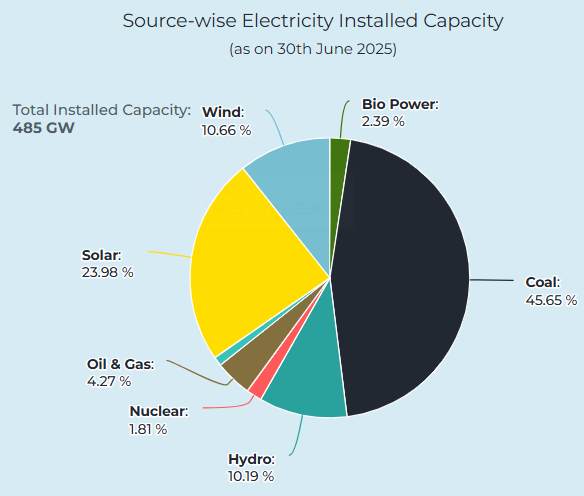
- Thermal & Coal Security: Awarded 13.32 GW of new coal capacity in FY 2025-26, with total capacity at 226.23 GW. Coal stocks were maintained at robust levels (51.7 metric ton (MT), supported by the revised SHAKTI Policy 2025 to enhance coal allocation and energy security.
- Storage & Transmission Push: Set targets for 57 GW of Pump Storage Projects (PSP) by 2031-32 and 43,220 MWh of Battery Energy Storage System (BESS) under Viability Gap Funding (VGF) Schemes.
- The National Electricity Plan (2023-32) aims to expand the transmission network to 6.48 lakh Circuit Kilometers (ckm) by 2032 and approved 25.8 GW of RE-linked Inter State Transmission projects in 2025.
- Currently, India’s national power transmission network stands at around 5 lakh ckm.
- Distribution Reforms & Consumer Focus: Under the Revamped Distribution Sector Scheme (RDSS), sanctioned 19.79 crore prepaid Smart meters, reducing AT&C losses to 16.16% and the Average Cost of Supply (ACS) and the Average Revenue Realized (ARR) gap to Rs 0.11/kWh.
- It also provided electricity connections to 13.65 lakh households under PM-JANMAN and DA-JGUA (Dharti Aaba Janjatiya Gram Utkarsh Abhiyan) initiatives.
- Energy Efficiency & Carbon Market Launch: Introduced the Carbon Credit Trading Scheme (CCTS) for compliance (covering Aluminium, Cement etc.) and offset mechanisms.
- Expanded the Standards & Labelling programme to 41 appliances and launched the ADEETIE (Assistance in Deploying Energy Efficient Technology in Industries and Establishments) scheme for MSME energy efficiency.
- Critical Regulatory Reforms: Late Payment Surcharge Rules, 2022 drastically reduced legacy dues of DISCOMs from Rs 1,39,947 crore to Rs 8,005 crore. The Electricity (Amendment) Rules, 2025 allowed consumer-owned energy storage.
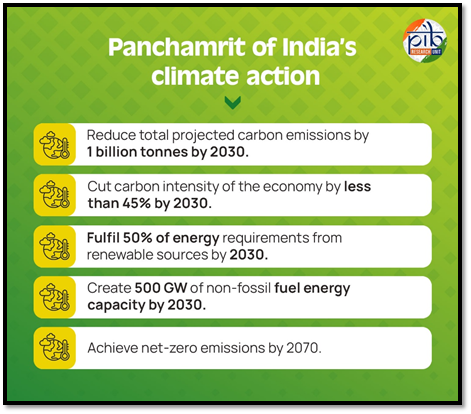
- Climate Commitment Achieved: Achieved its Nationally Determined Contributions (NDCs) target of 50% cumulative non-fossil electric capacity nearly five years early, with the share rising from 32% in 2014 to 51% by October 2025.
Carbon Credit Trading Scheme (CCTS)
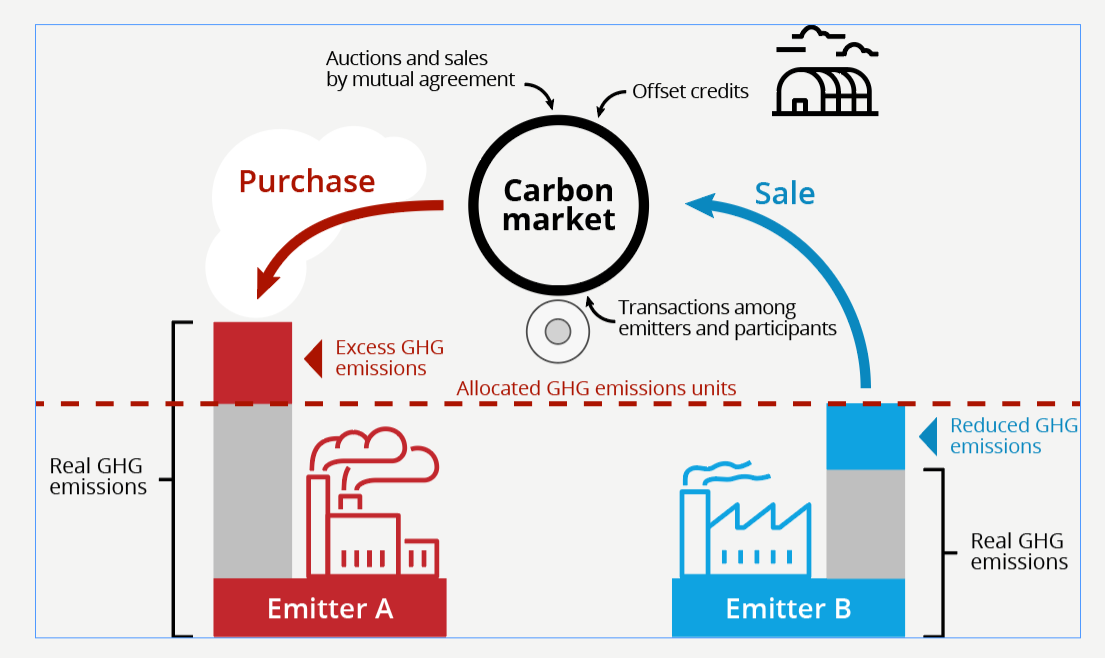
- About: CCTS represents a pivotal policy shift, moving India from a mechanism focused on energy efficiency to a comprehensive market-based system aimed at directly pricing and reducing greenhouse gas emissions (GHGs) to meet its ambitious climate targets.
- Core Objective: The CCTS is a market-based mechanism designed to decarbonize the Indian economy by pricing GHG emissions and facilitating a national carbon trading system.
- Evolution from PAT: It transitions from the Perform, Achieve, and Trade (PAT) scheme (focused on energy efficiency via Energy Savings Certificates (ESCerts)) to a focus on reducing GHG emission intensity per tonne of output.
- Key Instrument: It issues Carbon Credit Certificates (CCC), each representing a reduction of one-tonne CO2 equivalent (tCO2e).
- Dual Mechanism: Operates through:
- Compliance Mechanism: Mandates energy-intensive industries (e.g., Aluminium, Cement, Fertilizers, Iron & Steel) to meet sector-specific GHG reduction targets.
- Offset Mechanism: Allows voluntary participation from entities outside the compliance framework to earn credits.
- Sectoral Coverage: Initially targets sectors accounting for 16% of India’s total emissions (Iron & Steel, Aluminium, etc.). The power sector (40% of emissions) may be included later.
- Regulatory Framework: Overseen by the Bureau of Energy Efficiency (BEE) and the National Steering Committee for Indian Carbon Market (NSCICM).
- Strategic Importance: Directly supports India’s goal to cut emission intensity by 45% by 2030 by driving private sector investment in clean technologies, renewables, and carbon capture.
Conclusion
In 2025, India's power sector achieved transformative milestones in reliability, capacity (509.7 GW), renewables (178 GW), and reforms, dramatically reducing deficits and advancing its NDC target, thereby solidifying its path towards sustainable energy security and a robust green economy.
|
Drishti Mains Question: Examine the role of the Indian Carbon Market and the Carbon Credit Trading Scheme (CCTS) in driving industrial decarbonization and positioning India in the global green finance landscape. |
Frequently Asked Questions (FAQs)
1. What was India’s peak power demand met in FY 2025–26?
India successfully met a record 242.49 GW peak demand, with energy shortages reduced to 0.03%.
2. How much total installed power capacity did India achieve by 2025?
Installed capacity reached 509.743 GW, more than doubling since 2014.
3. What is the Carbon Credit Trading Scheme (CCTS)?
The CCTS is a market-based mechanism designed to decarbonize the Indian economy by pricing GHG emissions and facilitating a national carbon trading system.
UPSC Civil Services Examination, Previous Year Question (PYQ)
Prelims
Q. With reference to the Indian Renewable Energy Development Agency Limited (IREDA), which of the following statements is/are correct? (2015)
- It is a Public Limited Government Company.
- It is a Non-Banking Financial Company.
Select the correct answer using the code given below:
(a) 1 only
(b) 2 only
(c) Both 1 and 2
(d) Neither 1 nor 2
Ans: (c)
Mains
Q. “Access to affordable, reliable, sustainable and modern energy is the sine qua non to achieve Sustainable Development Goals (SDGs)”.Comment on the progress made in India in this regard. (2018)



