


Governance
India’s Digital Transformation and Growth Story
- 10 Mar 2026
- 18 min read
For Prelims: Digital India programme, Digital Public Infrastructure (DPI), BharatNet, Optical Fibre Cable, Aadhaar, Direct Benefit Transfers (DBT), Unified Payments Interface, National Supercomputing Mission (NSM), MeghRaj, Pradhan Mantri Gramin Digital Saksharta Abhiyan (PMGDISHA), DIKSHA (Digital Infrastructure for Knowledge Sharing), SWAYAM (Study Webs of Active-Learning for Young Aspiring Minds), PM-WANI (Prime Minister Wi-Fi Access Network Interface), Atal Innovation Mission (AIM), IndiaAI Kosh, IndiaAI Mission, Startup India, CoWIN, Encryption, National Education Policy (NEP), 2020.
For Mains: Key achievements of India under the Digital India Programme, Key facts regarding the Digital India Programme, Key challenges in India's digital growth story and steps needed to boost and safeguard the digital ecosystem in India.
Why in News?
India's digital transformation, anchored in the Digital India programme (2015) , has evolved from a connectivity mission into a comprehensive empowerment journey, leveraging Digital Public Infrastructure (DPI), massive connectivity drives, and targeted skilling initiatives to systematically bridge the digital divide and bring every citizen into the mainstream of the digital economy.
Summary
- India’s Digital India Programme has significantly expanded digital connectivity, Digital Public Infrastructure, and digital services, integrating millions into the digital economy.
- Initiatives such as BharatNet, UPI, Aadhaar, and PM-WANI have strengthened governance and financial inclusion.
- However, digital divide, cybersecurity risks, and infrastructure gaps remain critical challenges.
What are the Key Achievements of India Under the Digital India Programme?
- Universal Digital Connectivity: BharatNet connected over 2.15 lakh Gram Panchayats and expanded optical fibre cable deployment from 19.35 lakh route km (2019) to 42.36 lakh route km (2025). 99.9% district has 5G coverage with over 5.18 lakh Base Transceiver Stations (December 2025).
- Reduced data costs from Rs 269 per GB (2014) to Rs 8–10 per GB (2025-26).
- Achieved broadband subscriptions of 100 crore in November 2025, a sixfold increase from 13.15 crore a decade earlier.
- Digital Public Infrastructure (DPI): Issued over 143 crore unique digital IDs (Aadhaar) enabling targeted welfare delivery and Direct Benefit Transfers (DBT).
- Unified Payments Interface (UPI) processes nearly Rs 28.33 lakh crore in monthly transactions and handles 21.7 billion transactions monthly.
- DigiLocker boasts over 62 crore registered users offering secure, paperless storage and sharing of official documents.
- High-Performance Computing: National Supercomputing Mission (NSM) deployed 38 supercomputers with combined capacity of 44 Petaflops across institutions nationwide supporting Artificial Intelligence (AI), climate modelling, biotechnology, and advanced manufacturing.
- Over 2,170 Ministries and Departments are hosting applications on secure, and scalable government cloud platform MeghRaj.
- Digital Literacy: Pradhan Mantri Gramin Digital Saksharta Abhiyan (PMGDISHA) trained 6.39 crore rural households (as of March 2024) against a target of 6 crore empowering one person per rural household with digital skills.
- Digital Learning Platform: DIKSHA (Digital Infrastructure for Knowledge Sharing) hosts over 19,698 courses for school education and teacher training. Achieved 18.23 crore enrolments and 14.57 crore completions.
- SWAYAM (Study Webs of Active-Learning for Young Aspiring Minds) offers 18,500+ courses from leading institutions for higher education and awarded 53.7 lakh certifications.
- INSPIRE-MANAK (Million Minds Augmenting National Aspirations and Knowledge) provides Rs 10,000 prototype grants with mentoring at district, state, and national levels. In 2025-26, it has mobilised 11.47 lakh ideas with 52% from girls and 84% from rural schools.
- Rights-Based Digital Inclusion: Unique Disability ID (UDID) sub-scheme (under the Rights of Persons with Disabilities Act, 2016) generated over 1.34 lakh digital disability cards streamlining access to welfare benefits for persons with disabilities nationwide.
- Indian Sign Language Research and Training Centre developed the world's largest Indian Sign Language digital repository with 3,189 e-content videos.
- Last-Mile Digital Access: Over 6.5 lakh Village Level Entrepreneurs (VLEs) operate Common Service Centres (CSCs) under Digital India programme bridging the digital divide for citizens lacking devices, reliable connectivity, or digital literacy.
- PM-WANI (Prime Minister Wi-Fi Access Network Interface) deployed 4,09,111 Wi-Fi hotspots nationwide promoting decentralised, licence-free public Wi-Fi model encouraging local entrepreneurship.
- Digital Skilling and Innovation: Atal Innovation Mission (AIM) established over 10,000 Atal Tinkering Labs (ATLs) across 722 districts engaging 1.1 crore students with hands-on experience in robotics, AI, and IoT.
- FutureSkills Prime, ranked 3rd globally in the European Commission's Pact for Skills Report 2024, equips learners with industry-relevant skills in AI, cloud computing, cybersecurity, and data analytics.
- IndiaAI Kosh, under IndiaAI Mission, hosts 9,500+ datasets and 273 AI models across 20 sectors supporting startups, researchers, and innovators nationwide.
- Startup and Entrepreneurship: Under Startup India, recognised startups grew from 400 in 2016 to over 2 lakh in 2025 generating 21 lakh jobs. 50% of startups now operate in Tier-II and Tier-III cities enabling local economic growth.
- 72 Atal Incubation Centres (AICs) have nurtured 3,500+ startups and supported 1,000+ women-led ventures.
Digital India Programme
- About: It is a flagship initiative administered by the Ministry of Electronics and Information Technology (MeitY). It was launched in July 2015 that seeks to transform India into a digitally empowered society and a knowledge economy.
- The programme integrates various digital technologies to deliver government services electronically, enhance connectivity, promote digital inclusion, and drive economic growth through innovation and efficiency.
- Core Vision: The programme rests on 3 interconnected vision areas:
- Digital infrastructure as a utility to every citizen.
- Governance and services on demand, ensuring seamless, transparent, and paperless delivery.
- Digital empowerment of citizens through literacy, skills, and access to digital resources.
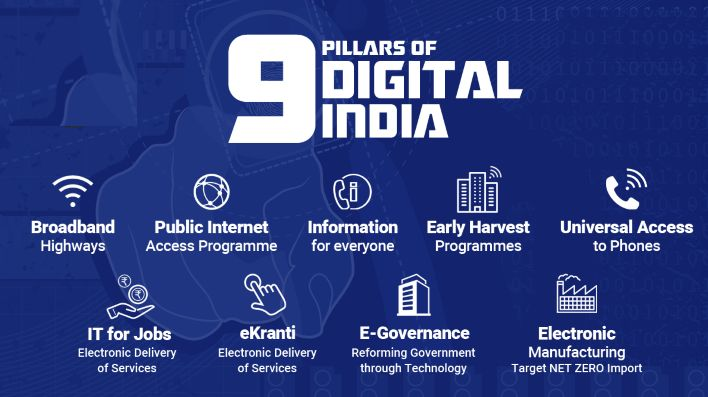
- Nine Pillars: The implementation framework is structured around 9 pillars:
What are the Key Challenges in India's Digital Growth Story?
- Persistent Digital Divide: NSSO data reveals that only 24% of rural households have internet access compared to 66% in cities, hindering inclusive growth and access to e-health and education.
- According to the National Family Health Survey (2019-21), only 1 in 3 women (33%) in India have ever used the internet. Only 31.2% of people taking online AI courses in India in 2025 were women.
- Tribal populations and backward classes remain disadvantaged, creating a "digital underclass".
- Cybersecurity Challenges: The country witnessed 13.91 lakh cybersecurity incidents in 2022 and emerged as the 2nd most targeted nation globally for cyber attacks. Compounding this, India faces a severe shortage of about 7,90,000 cybersecurity professionals.
- Infrastructure and Connectivity Bottlenecks: India's digital infrastructure lags global standards, ranking 25th globally for mobile internet speeds as of November 2024. Issues like low broadband speeds, patchy 5G rollout, and insufficient fiber-optic networks, particularly in remote areas, limit effective access to digital services.
- E.g., BharatNet has faced repeated deadline delays (from 2014–15 to beyond 2025), major cost overruns (from Rs 20,000 crore to over Rs 1.39 lakh crore), and frequent fiber cuts leading to widespread downtime.
- Inefficiencies in Public Digital Systems: Key public platforms face challenges related to scalability, data accuracy, and technical glitches. For instance, Aadhaar has experienced instances of identity fraud, while systems like CoWIN have highlighted gaps in usability for non-urban populations.
- Digital Literacy and Skill Gaps: The NSS 78th Round Survey (2020-21) indicates a computer literacy rate of only 24.7% among individuals aged 15 and above. A National Skill Development Corporation report estimates a deficit of 29 million skilled workers, particularly in high-demand sectors like Information Technology (IT), Banking, Financial Services, and Insurance (BFSI).
- Environmental Impact of Digital Expansion: Rapid digitalization has led to a surge in e-waste, rising from 1.01 million metric tonnes (MT) in 2019-20 to 1.751 million MT in 2023-24. High energy consumption by data centers raise serious environmental sustainability concerns.
What Steps are Needed to Boost India's Digital Growth Story?
- Enhancing Cybersecurity Infrastructure: Promote R&D of indigenous cybersecurity technologies and encryption standards to enhance data sovereignty. Create a dedicated Cyber Security Service cadre similar to other civil services for handling national-level cyber threats.
- Strengthening DPI: Conduct regular, mandatory security audits of all DPI components (Aadhaar, UPI, DigiLocker, GSTN) by independent agencies to ensure robust oversight. Establish geographically distributed backup and disaster recovery centres for all critical DPI systems for uninterrupted service during emergencies.
- Digital Literacy and Cyber Awareness: Launch PMGDISHA 2.0 with focus on cybersecurity awareness, safe online practices, and protection against financial frauds. Create a network of "Cyber Jagrukta Champions" at gram panchayat level and integrate mandatory cyber hygiene modules in school curricula under National Education Policy (NEP), 2020 framework.
- Strengthening Legal and Regulatory Framework: Comprehensively revise the Information Technology Act, 2000 to address emerging challenges like deepfakes, AI-generated misinformation, and crypto-related crimes. Establish regulatory sandboxes for emerging technologies (AI, blockchain, IoT) to test security implications.
- Strengthening Rural Digital Ecosystem: Rural digital infrastructure must be strengthened by continuously augmenting bandwidth, implementing robust security for PM-WANI hotspots, and establishing block-level cybersecurity cells connected to district units.
Conclusion
India's decade-long Digital India journey has successfully built world-class Digital Public Infrastructure (DPI), connecting over a billion people and fostering innovation. However, to sustain this momentum, the nation must urgently bridge the persistent digital divide, tackle escalating cybersecurity threats, and implement robust data protection frameworks. A comprehensive strategy focused on digital literacy, indigenous technology, and inclusive access is essential to ensure a secure and equitable digital future for all.
|
Drishti Mains Question: Despite rapid digital expansion, India continues to face a digital divide. Analyse the challenges and suggest policy measures to address them. |
Frequently Asked Questions (FAQs)
1. What is the objective of the Digital India Programme?
It aims to transform India into a digitally empowered society and knowledge economy through digital infrastructure, e-governance, and digital empowerment.
2. What is BharatNet and why is it important?
BharatNet (2011) is a rural broadband project connecting over 2.15 lakh Gram Panchayats with optical fibre, enabling digital services and internet connectivity in rural India.
3. What is PM-WANI?
PM-WANI (2020) promotes licence-free public Wi-Fi hotspots through Public Data Offices, expanding affordable broadband access and local entrepreneurship.
UPSC Civil Services Examination Previous Year Question (PYQ)
Prelims
Q. Consider the following: (2022)
- Aarogya Setu
- CoWIN
- DigiLocker
- DIKSHA
Which of the above are built on top of open-source digital platforms?
(a) 1 and 2 only
(b) 2, 3 and 4 only
(c) 1, 3 and 4 only
(d) 1, 2, 3 and 4
Ans: (d)
Q. Which of the following is/are the aim/aims of “Digital India” Plan of the Government of India? (2018)
- Formation of India’s own Internet companies like China did.
- Establish a policy framework to encourage overseas multinational corporations that collect Big Data to build their large data centres within our national geographical boundaries.
- Connect many of our villages to the Internet and bring Wi-Fi to many of our schools, public places and major tourist centres.
Select the correct answer using the code given below:
(a) 1 and 2 only
(b) 3 only
(c) 2 and 3 only
(d) 1, 2 and 3
Ans: (b)
Q. Regarding ‘DigiLocker’, sometimes seen in the news, which of the following statements is/are correct? (2016)
- It is a digital locker system offered by the Government under Digital India Programme.
- It allows you to access your e-documents irrespective of your physical location.
Select the correct answer using the code given below:
(a) 1 only
(b) 2 only
(c) Both 1 and 2
(d) Neither 1 nor 2
Ans: (c)
Mains
Q. “The emergence of the Fourth Industrial Revolution (Digital Revolution) has initiated e-Governance as an integral part of government”. Discuss. (2020)
Q. How can the ‘Digital India’ programme help farmers to improve farm productivity and income? What steps has the Government taken in this regard? (2015).



