


Indian Economy
Fiscal Health Index 2026
- 14 Mar 2026
- 15 min read
For Prelims: Fiscal Health Index, NITI Aayog, Comptroller and Auditor General, Gross State Domestic Product (GSDP), Fiscal deficit
For Mains: Fiscal federalism and the role of states in India’s public finance architecture, Debt sustainability and fiscal discipline in Indian states, Significance of Fiscal Health Index for improving state finances
Why in News?
NITI Aayog released the second edition of the Fiscal Health Index (FHI) 2026 to evaluate the fiscal performance of Indian states. The index provides a data-driven framework to assess fiscal sustainability, compare state finances, and guide reforms.
- The report gains significance as global public debt has surged to about USD 102 trillion in 2024, increasing pressure on public finances worldwide.
Summary
- Fiscal Health Index (FHI) 2026, released by NITI Aayog, evaluates the fiscal performance of Indian states using five pillars—Quality of Expenditure, Revenue Mobilisation, Fiscal Prudence, Debt Index, and Debt Sustainability—and expands coverage to include North-Eastern and Himalayan states, highlighting wide variations in fiscal discipline and debt levels.
- The report stresses that strong state finances are crucial for India’s macroeconomic stability, recommending measures such as improving tax mobilisation, controlling committed expenditure, enhancing capital spending, strengthening fiscal transparency, and adopting medium-term fiscal planning.
What is the Fiscal Health Index?
- About: The FHI is a comprehensive framework developed by NITI Aayog to assess and compare the fiscal performance of Indian states.
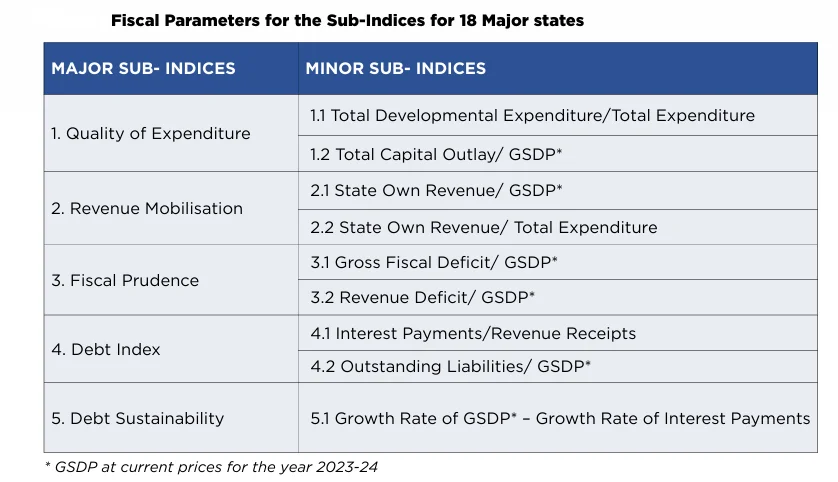
- It evaluates states across five key pillars: Quality of Expenditure, Revenue Mobilisation, Fiscal Prudence, Debt Index, and Debt Sustainability.
- The index uses data verified by the Comptroller and Auditor General (CAG), ensuring rigour and transparency.
- The goal is to guide reforms, encourage evidence-based policymaking, and enable peer benchmarking across states.
- FHI 2026: It analyses fiscal trends over a decade from FY 2014-15 to FY 2023-24 providing a longitudinal perspective on how states are progressing or regressing.
- The second edition expands coverage from 18 General Category States to also include 10 North-Eastern and Himalayan States, making the index more inclusive of India's diverse fiscal landscape.
- Sub-indicators for NE states have been refined to reflect their unique challenges such as geographic remoteness, sparse population density, limited own-revenue capacity, elevated committed expenditures, and greater dependence on Union transfers.
- NE and Himalayan states are ranked separately from general category states to ensure fair and contextually appropriate comparison.
- The edition retains the same five pillars for major states while improving the depth of narrative insights and trend analysis.
- The second edition expands coverage from 18 General Category States to also include 10 North-Eastern and Himalayan States, making the index more inclusive of India's diverse fiscal landscape.
What are the Key Highlights of the FHI 2026?
18 Major States
- Achievers (Top Performers): Odisha, Goa, Jharkhand.
- Odisha continues to lead the rankings, driven by controlled deficits, stable revenues, and improving scores year-on-year.
- Achiever states share common traits: own-tax shares above 60%, capital outlay of around 4–5% of Gross State Domestic Product (GSDP), fiscal deficits below 3% of GSDP, moderate debt levels under 25% of GSDP, and contained interest burdens.
- Goa and Odisha record high State Own Revenue ratios, reflecting strong tax bases and greater fiscal autonomy.
- Front-Runners: Gujarat, Maharashtra, Chhattisgarh, Telangana, Uttar Pradesh, Karnataka.
- Gujarat and Maharashtra maintain low debt levels and contain interest burdens, supporting fiscal sustainability.
- Performers: Madhya Pradesh, Haryana, Bihar, Tamil Nadu, Rajasthan.
- Bihar has improved from Aspirational to Performer, signalling better deficit management.
- Karnataka and Telangana moved from Front Runner to Performer, highlighting slight fiscal slippage.
- Tamil Nadu has slipped from Performer to Aspirational, indicating emerging fiscal pressures.
- Aspirational (Bottom Performers): West Bengal, Kerala, Andhra Pradesh, Punjab.
- These states face persistent revenue and fiscal deficits, often breaching FRBM (Fiscal Responsibility and Budget Management) norms.
- Debt levels range between roughly 35–45% of GSDP, significantly above the national comfort zone.
- Committed expenditure accounts for about 50–60% of revenue receipts, leaving little room for developmental spending.
- Interest payments exceed 15–20% of revenue receipts, further compressing fiscal flexibility.
- Punjab, Kerala, and West Bengal face the most elevated debt and interest commitments among all major states.
.webp)
North-Eastern and Himalayan States
- Achievers: Arunachal Pradesh and Uttarakhand.
- Arunachal Pradesh ranks first due to high expenditure quality, prudent debt management, and controlled deficits, occasionally recording fiscal surpluses.
- Uttarakhand performs strongly because of relatively higher own-revenue mobilisation, giving it greater fiscal autonomy.
- Performers: Assam, Meghalaya, Mizoram, Sikkim, Tripura.
- Tripura performs well in debt sustainability, while Mizoram faces challenges due to weaker debt sustainability indicators.
- Sikkim shows lower performance in fiscal prudence, and Nagaland struggles with weak revenue mobilisation and expenditure quality.
- Aspirational: Himachal Pradesh, Manipur, Nagaland.
- Himachal Pradesh and Manipur remain at the bottom due to weak revenue bases, high committed expenditure (salaries and pensions), and persistent deficits.
- Their debt levels are high, around 40–50% of GSDP, increasing debt-servicing pressures and limiting fiscal flexibility.
.webp)
What is the Significance of the Fiscal Health of States?
- Macroeconomic Stability of India: States account for about one-third of India’s total government debt, making their fiscal position crucial for national fiscal sustainability.
- When states face fiscal stress, it can trigger inflationary pressures, crowd out private investment, and force the central government to step in with bailouts, destabilising the broader economy.
- India’s overall public debt is around 82% of GDP, so responsible fiscal management by states is essential to keep the debt burden under control.
- Large Role in Public Spending and Development: State governments undertake a large share of spending on health, education, infrastructure, and welfare programmes, which directly affect citizens’ well-being and development outcomes.
- Strong fiscal health allows states to invest more in capital expenditure, helping reduce regional disparities and supporting long-term economic growth.
- Rising Debt and Fiscal Pressures: The debt-to-GSDP ratio of states increased from about 16.7% in 2013-14 to nearly 23% in 2022-23, indicating rising borrowing pressures.
- The combined fiscal deficit of states increased to around 3.2% of GDP in FY25, reflecting growing fiscal pressures on state governments which can threaten fiscal sustainability if not managed carefully.
What Policy Measures are Recommended by the FHI 2026 to Strengthen State Finances?
- Boost Revenue: Broaden the GST tax base, improve tax compliance, and strengthen state own-tax revenues such as property tax, excise, and stamp duties. Improve digital tax administration and data analytics to reduce tax evasion.
- Control Spending: Curb "committed expenditures" (like massive pension and salary bills) and rationalise subsidies to restore fiscal flexibility.
- The 16th Finance Commission (2026–31) called for rationalising subsidies, particularly unconditional cash transfers that account for about 20.2% of total subsidy spending.
- Improve Capital Outlay: Focus on improving the composition and quality of capital spending to drive long-term growth.
- Plan for the Future: Follow FRBM targets by keeping the state fiscal deficit around 3% of GSDP.
- The 16th Finance Commission (2026–31) also recommended reducing the Centre’s fiscal deficit to 3.5% of GDP by 2030–31 to maintain fiscal discipline and sustainable debt levels.
- Enhance Transparency: Implement tighter controls on off-budget borrowings, improve cash management, and utilize verified CAG data for better public financial management.
Conclusion
The Fiscal Health Index 2026 highlights that strong state finances are vital for India’s macroeconomic stability. By using this benchmarking tool, states can identify fiscal weaknesses, undertake targeted reforms, reduce regional disparities, and strengthen fiscal governance to support the vision of Viksit Bharat @2047.
|
Drishti Mains Question: “Fiscal health of states is central to India’s macroeconomic stability.”Examine in the context of the Fiscal Health Index 2026. |
Frequently Asked Questions (FAQs)
1. What is the Fiscal Health Index (FHI)?
The FHI is a framework developed by NITI Aayog to assess and compare the fiscal performance of Indian states based on indicators such as revenue mobilisation, expenditure quality, fiscal prudence, and debt sustainability.
2. Which pillars are used to evaluate states under the Fiscal Health Index?
The index evaluates states across five pillars: Quality of Expenditure, Revenue Mobilisation, Fiscal Prudence, Debt Index, and Debt Sustainability.
3. Which states are the top performers in the Fiscal Health Index 2026?
Among major states, Odisha, Goa, and Jharkhand are ranked as Achievers due to strong revenue mobilisation, low fiscal deficits, and moderate debt levels.
4. Why are North-Eastern and Himalayan states ranked separately in FHI 2026?
They face structural constraints such as difficult terrain, sparse population, limited revenue capacity, and higher service delivery costs, requiring context-specific evaluation.
UPSC Civil Services, Previous Year Questions (PYQ)
Prelims
Q1. In the context of governance, consider the following: (2010)
- Encouraging Foreign Direct Investment inflows
- Privatization of higher educational Institutions
- Down-sizing of bureaucracy
- Selling/offloading the shares of Public Sector Undertakings
Which of the above can be used as measures to control the fiscal deficit in India?
(a) 1, 2 and 3
(b) 2, 3 and 4
(c) 1, 2 and 4
(d) 3 and 4 only
Ans: D
Q2. Which one of the following is likely to be the most inflationary in its effect? (2021)
(a) Repayment of public debt
(b) Borrowing from the public to finance a budget deficit
(c) Borrowing from the banks to finance a budget deficit
(d) Creation of new money to finance a budget deficit
Ans: (d)
Q3. Which of the following is/are included in the capital budget of the Government of India? (2016)
- Expenditure on acquisition of assets like roads, buildings, machinery, etc.
- Loans received from foreign governments
- Loans and advances granted to the States and Union Territories
Select the correct answer using the code given below:
(a) 1 only
(b) 2 and 3 only
(c) 1 and 3 only
(d) 1, 2 and 3
Ans: (d)
Mains
Q1. One of the intended objectives of the Union Budget 2017-18 is to ‘transform, energise and clean India’. Analyse the measures proposed in the Budget 2017-18 to achieve the objective. (2017)
Q2. Distinguish between Capital Budget and Revenue Budget. Explain the components of both these Budgets. (2021)
Q.3 Do you agree with the view that steady GDP growth and low inflation have left the Indian economy in good shape? Give reasons in support of your arguments. (2019)



