


Biodiversity & Environment
Conservation of Grasslands
- 13 Jan 2026
- 13 min read
For Prelims: Grasslands, UNFCCC, International Year of Rangelands and Pastoralists (IYRP), Carbon sinks, Sustainable Development Goals
For Mains: Grasslands as carbon sinks and their role in climate mitigation, Forest-centric bias in global and national climate policies, Institutional and legal gaps in grassland conservation in India
Why in News?
Grasslands remain underrepresented in global and national climate plans, as discussions at the UNFCCC COP30 continued to prioritise forests, even as the United Nations declared 2026 as the International Year of Rangelands and Pastoralists (IYRP).
Summary
- Grasslands are critical for climate regulation, biodiversity, and livelihoods, yet remain underrepresented in climate and conservation policies due to forest-centric approaches, institutional silos, and weak legal protection.
- Recognising grasslands as distinct ecosystems, integrating them into climate commitments, and empowering pastoral communities—especially under IYRP 2026—is essential for sustainable and inclusive ecosystem governance.
What are Grasslands?
- About: Grasslands are open terrestrial ecosystems dominated by grasses, with sparse or no tree cover, adapted to seasonal droughts, grazing, and fires. They include savannas, rangelands, and pasture commons.
- UNESCO defines them as land with less than 10% tree and shrub cover, while wooded grasslands have 10–40% cover.
- Grasslands are among the largest ecosystems, covering about 40.5% of Earth’s terrestrial area (excluding Greenland and Antarctica), far exceeding the extent of woody savannahs, shrublands, and tundra.
- They play a crucial ecological role, with tropical and sub-tropical grasslands storing nearly 15% of global terrestrial carbon.
- They support the livelihoods of around 20% of the world’s population, especially pastoral and agro-pastoral communities, and rely on natural disturbance regimes such as fire and grazing to maintain biodiversity and ecosystem balance.
- Grasslands in India: They occupy about 24% of India’s geographical area, yet they have witnessed severe decline over time.
- Major grassland regions in India are found in Rajasthan, Gujarat, Maharashtra, Madhya Pradesh, Karnataka, Telangana, Andhra Pradesh, the Terai–Duar belt of Uttar Pradesh, Uttarakhand, Assam and West Bengal, and the alpine grasslands of Himachal Pradesh and Ladakh.
- Banni Grassland, located in Kutch district of Gujarat, is the largest grassland in Asia.
- Despite their ecological and livelihood value, less than 1% of India’s grasslands are protected under the formal conservation network.
- Role of Grasslands:
- Climate Regulation: Act as major carbon sinks, especially tropical grasslands, helping mitigate climate change.
- Livelihood Support: Sustain pastoral and agro-pastoral communities by providing grazing land, fodder, fuel, and food.
- Biodiversity Conservation: Serve as habitats for diverse plant species, birds, and grassland-dependent wildlife.
- Water & Soil Regulation: Aid groundwater recharge, reduce soil erosion, and regulate local hydrology.
- Ecosystem Stability: Depend on natural fire and grazing regimes that maintain ecological balance and resilience.
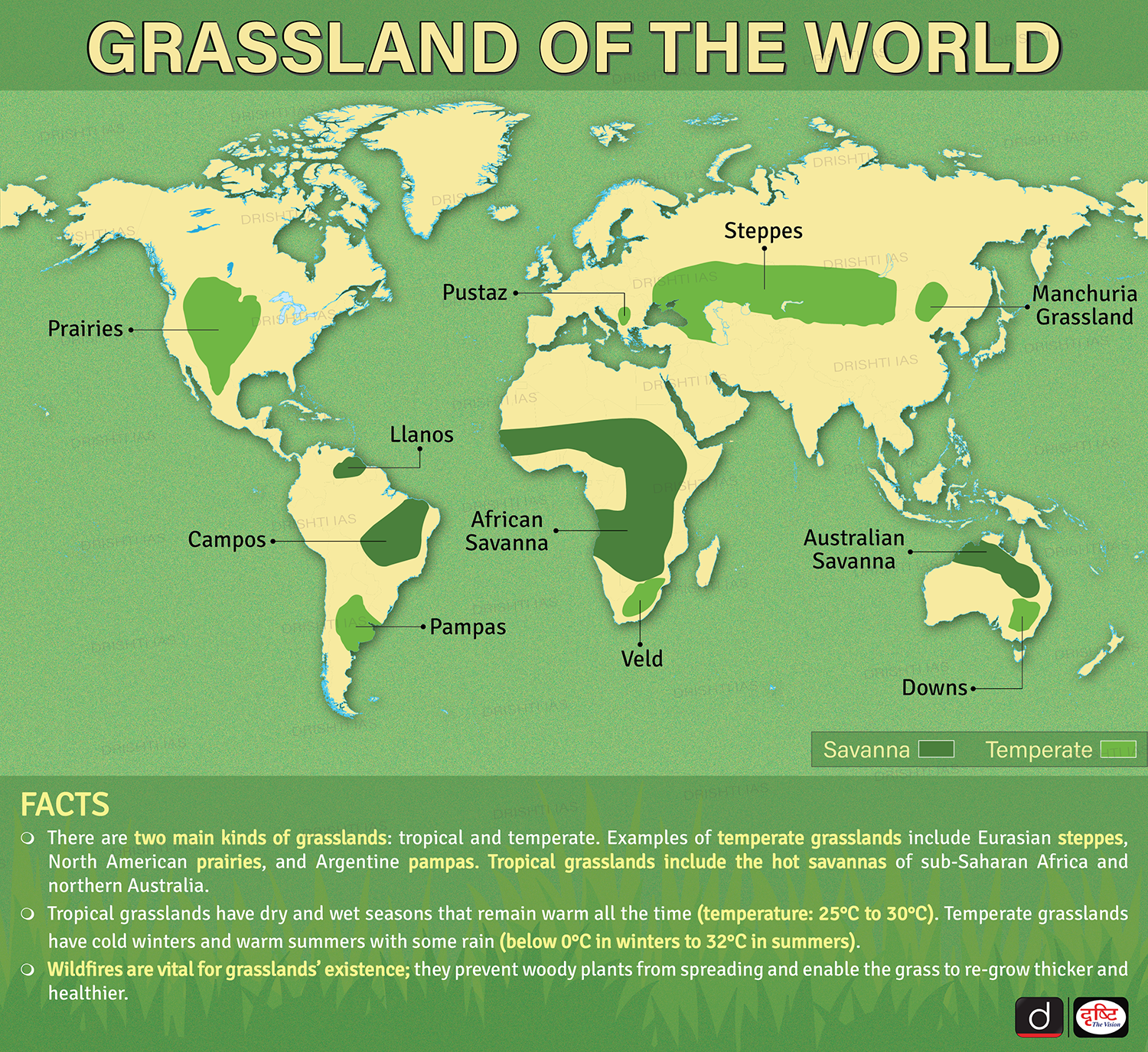
Note: The United Nations General Assembly declared 2026 as the International Year of Rangelands and Pastoralists, led by the Food and Agriculture Organization.
- Rangelands consisting of grasslands, savannahs, deserts, and shrublands, are vital for biodiversity, ecosystem regulation, and climate resilience.
- Rangelands cover over half of the Earth’s land surface and support more than 500 million pastoralists (communities that depend on rangelands for herding livestock).
- The initiative seeks to raise awareness, promote responsible investment, secure pastoralists’ land and mobility rights, strengthen inclusive governance, and improve rangeland management, contributing to sustainable livelihoods and the Sustainable Development Goals (SDGs).
What are the Gaps in Grassland Conservation?
- Misclassification and Policy Blindness: Grasslands are routinely labelled as degraded forests or wastelands, leading to afforestation, plantations, or diversion for infrastructure, despite being natural, biodiversity-rich ecosystems.
- Indian grasslands are governed by nearly 18 ministries with conflicting mandates. The Environment Ministry treats them as afforestation targets, while the Rural Development Ministry labels many as “wastelands”.
- This policy fragmentation leads to misclassification and weak protection of grasslands.
- Indian grasslands are governed by nearly 18 ministries with conflicting mandates. The Environment Ministry treats them as afforestation targets, while the Rural Development Ministry labels many as “wastelands”.
- Institutional Silos: Climate action (UNFCCC), biodiversity (Convention on Biological Diversity), and land degradation (UN Convention to Combat Desertification) are handled separately, preventing integrated ecosystem protection and leaving grasslands trapped in governance gaps.
- Despite the UN Convention to Combat Desertification (COP16) formally recognising rangelands as complex socio-ecological systems and Resolution L15 calling for prioritised investment and improved land-tenure security, grasslands still lack a dedicated legal framework, unlike forests and wetlands.
- In India, laws such as the Forest (Conservation) Act, 1980 are inconsistently applied to naturally occurring grasslands, leaving them legally vulnerable and weakly protected.
- Forestry-Centric Climate Policies: Climate and carbon policies prioritise tree cover (REDD+, afforestation drives), often promoting plantations on ecologically unsuitable grasslands, causing biodiversity loss and altered fire regimes.
- Neglect of Disturbance Ecology: Suppression of natural processes like controlled burning and grazing ignores the ecological reality that grasslands depend on disturbance regimes for regeneration and resilience.
- Inadequate Data and Monitoring: There is no comprehensive national inventory or standardised indicators to assess grassland extent, condition, or ecosystem service value, weakening evidence-based policymaking.
- Marginalisation of Pastoral Communities: Traditional pastoral and indigenous management systems are sidelined, despite their proven role in sustainable grazing, fire management, and biodiversity conservation.
- Developmental Bias in Land-Use Decisions: Large-scale diversion for defence, energy, and industrial projects is often justified by branding grasslands as “unused” land, bypassing ecological impact assessments and local consent.
What Measures Can Strengthen Grassland Conservation?
- Correct Ecological Classification: Officially recognise grasslands as distinct natural ecosystems, not degraded forests or wastelands, and classify them as a major land-use category alongside forests and wetlands.
- Explicitly include grasslands in India’s Nationally Determined Contributions (NDCs) as carbon sinks, focusing on soil carbon, native species, and ecosystem resilience rather than tree plantations.
- Dedicated Legal Protection: Enact a National Grassland Conservation and Grazing Policy, and extend safeguards under existing laws such as the Forest Conservation Act and Wildlife Protection Act to naturally occurring grasslands.
- Adopt Ecosystem-Based Management: Use systems approaches like the Driver-Pressure-State-Impact-Response Framework (DPSIR) to guide land-use decisions, assess cumulative impacts, and align conservation with livelihoods and development needs.
- DPSIR explains environmental change as a cause–effect chain from driving forces and pressures to state changes, impacts, and policy responses. It helps policymakers assess environmental quality and design informed interventions, though applying it is complex due to multiple interacting causes.
- Empower Pastoral and Indigenous Communities: Secure tenure rights over commons, revive customary grazing and fire management practices, and legally recognise community-led stewardship models.
- Science-Driven Restoration: Prioritise restoration of native grass species, regulate invasive plants, and avoid afforestation in ecologically inappropriate grassland landscapes.
- Strengthen Data and Monitoring Systems: Create a national grassland inventory with standardised indicators for biodiversity, carbon storage, fodder capacity, and hydrological services.
- Make environmental impact assessments mandatory for grassland diversion and ensure Gram Sabha consent for the use of common lands.
Conclusion
Grasslands are vital for climate resilience, biodiversity, and livelihoods but remain poorly recognised and protected. Correcting policy blind spots, empowering pastoral communities, and integrating grasslands into climate and legal frameworks is essential. IYRP 2026 provides a crucial window to mainstream grassland conservation.
|
Drishti Mains Question: Grasslands are victims of policy invisibility rather than ecological fragility.Examine the statement in the context of climate governance in India and globally. |
Frequently Asked Questions (FAQs)
1. Why are grasslands often misclassified in policy frameworks?
Grasslands are labelled as wastelands or degraded forests, leading to afforestation, plantations, and diversion despite being natural, biodiversity-rich ecosystems.
2. What is the significance of the International Year of Rangelands and Pastoralists 2026?
It aims to raise awareness, promote responsible investment, secure pastoral land rights, and improve sustainable rangeland management aligned with the SDGs.
3. Why do grasslands fall through global governance gaps?
Climate, biodiversity, and land degradation are handled separately under UNFCCC, CBD, and UNCCD, preventing integrated ecosystem protection.
4. What is the status of grassland protection in India?
Grasslands cover about 24% of India’s area, but less than 1% are under formal protection, with laws like the Forest (Conservation) Act, 1980 applied inconsistently.
UPSC Civil Services Examination, Previous Year Question (PYQ)
Prelims:
Q. In the grasslands, trees do not replace the grasses as a part of an ecological succession because of (2013)
(a) Insects and fungi
(b) Limited sunlight and paucity of nutrients
(c) Water limits and fire
(d) None of the above
Ans: C
Q. The vegetation of savannah consists of grassland with scattered small trees, but extensive areas have no trees. The forest development in such areas is generally kept in check by one or more or a combination of some conditions. Which of the following are such conditions?(2021)
- Burrowing animals and termites
- Fire
- Grazing herbivores
- Seasonal rainfall
- Soil properties
Select the correct answer using the code given below.
(a) 1 and 2
(b) 4 and 5
(c) 2, 3 and 4
(d) 1, 3 and 5
Ans: C



