
Economy
Women-led India- The Next Frontier of Development
This editorial is based on “From women’s development to women-led development: The journey to Viksit Bharat” which was published in The Indian Express on 08/03/2026. The article brings into picture India’s shifting development narrative, from empowering women to being powered by women, reflected in the rising participation of women in STEM, research, and higher education.
For Prelims: Women's Reservation Act, 2023, Lakhpati Didi initiative, Self-Help Groups, PM Jan Dhan Yojana, Womaniya, Government e-Marketplace (GeM), Female Labour Force Participation Rate, PM Matru Vandana Yojana.
For Mains: Key Strides that India has Taken Towards Women-led Development, Key Issues Hindering Effective Women-led Development in India.
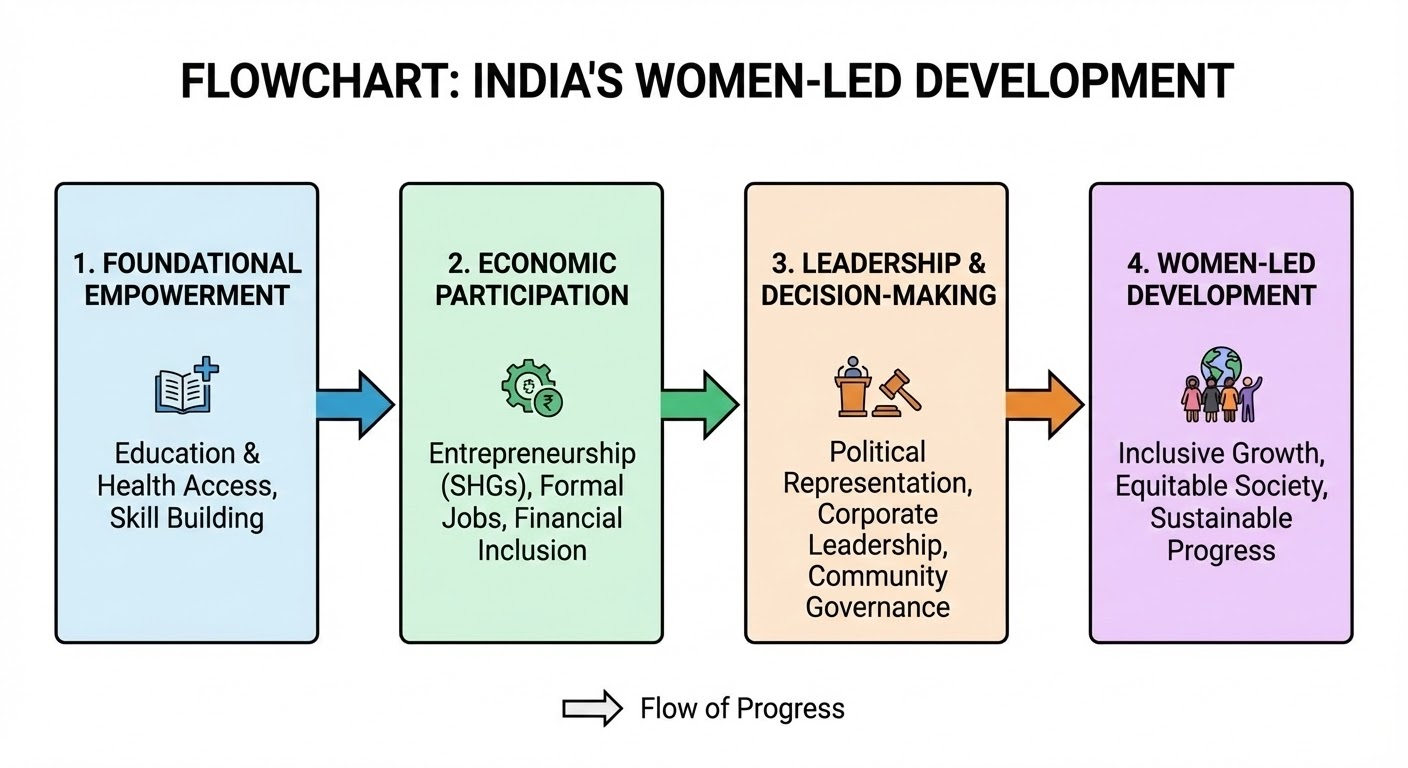
India's development narrative has decisively shifted from empowering women to being powered by women. From classrooms to cutting-edge research labs, women are claiming their space in STEM at an unprecedented pace with 43% of higher education STEM enrolment and over 53% of UGC-NET research fellowships in 2024-25. Female enrolment in higher education has surged from 1.57 crore to 2.18 crore, while doctoral enrolment has grown by over 135% in under a decade. As India marches toward Viksit Bharat 2047, nari shakti is no longer a welfare goal, it is the engine of the nation's economy.
What are the Key Strides that India has Taken Towards Women-led Development?
- Political Agency and Legislative Empowerment: The enactment of the Nari Shakti Vandan Adhiniyam (Women's Reservation Act, 2023) represents a monumental stride toward formalizing women’s roles in the highest echelons of Indian law-making.
- By mandating a 33% reservation for women in the Lok Sabha and State Legislative Assemblies, India is moving beyond tokenism to ensure that gender-sensitive policymaking becomes a structural reality.
- India’s local governance already boasts over 14.5 lakh elected women representatives in Panchayati Raj Institutions.
- Rural Economic Transformation via Lakhpati Didis: The Lakhpati Didi initiative has redefined rural entrepreneurship by integrating women-led Self-Help Groups (SHGs) into high-value value chains, shifting the focus from mere subsistence to sustainable wealth creation.
- This scheme leverages collective financial power to empower women in sectors like drone technology, organic farming, and solar energy management, ensuring decentralized economic growth.
- The government’s goal is to create 3 crore "Lakhpati Didis" (women earning Rs 1 lakh or more annually) by helping women scale up businesses and contribute to sustainable development across rural India.
- So far, more than 2 crore SHG women are Lakhpati Didis in the country.
- Bridging the STEM and Innovation Gap: India is aggressively closing the gender divide in Science, Technology, Engineering, and Mathematics (STEM) through targeted scholarships and research grants like WISE-KIRAN and Vigyan Jyoti.
- By creating a robust pipeline from school to post-doctoral research, the nation is ensuring that women lead the "Fourth Industrial Revolution" and contribute to India’s global scientific competitiveness.
- As per the Research and Development Statistics Report 2023, women account for 18.6% of the national R&D workforce, and targeted initiatives are increasingly focused on strengthening the pipeline from education to research careers.
- Financial Inclusion and Digital Sovereignty: The democratization of digital finance through the PM Jan Dhan Yojana and the Womaniya initiative on the Government e-Marketplace (GeM) has provided women with direct control over their assets.
- This digital sovereignty reduces dependency on male intermediaries, enhances creditworthiness, and allows women-led Micro, Small, and Medium Enterprises (MSMEs) to access the national procurement market directly.
- According to the Finance Ministry, out of total accounts 56% of accounts belong to women.
- Labor Force Participation and Formalization: Recent government data indicates a structural "U-turn" in the Female Labour Force Participation Rate (FLFPR), particularly driven by rural women entering the workforce through diverse avenues such as MGNREGA and entrepreneurship.
- The focus has moved toward providing better workplace infrastructure, including the expansion of the Nirbhaya Fund for safety and enhanced maternity benefits, to sustain this upward momentum in the formal economy.
- For instance, Female LFPR, in the age group 15 years and above, recorded a sustained increase since June, 2025 and stood at 35.3% in December 2025, marking the highest level observed during the year.
- Strategic Leadership in Defense and National Security: The Indian Armed Forces have undergone a structural metamorphosis by transitionally opening all combat and command roles to women, moving beyond auxiliary services to core strategic leadership.
- This shift is institutionalized through the permanent induction of women into the National Defence Academy (NDA) and the opening of fighter streams, signaling a "gender-neutral" approach to national sovereignty.
- The number of women officers in the armed forces has risen from nearly 3,000 in 2014 to over 11,000, exemplified by Colonel Sofiya Qureshi and Wing Commander Vyomika Singh leading the historic 2025 high-profile media briefing for Operation Sindoor.
- Gender-Inclusive Urban Mobility and Infrastructure: The PM-eBus Sewa and various state "Pink Bus" initiatives are redefining urban spaces by actively recruiting women as drivers, conductors, and technical staff, thus creating a safer public transport ecosystem.
- By integrating women into the "green mobility" workforce, India is addressing both climate goals and the safe mobility needs that are critical for increasing female labor force participation.
- Also, to promote women’s empowerment and inclusivity in toll operations, NHAI has deployed over 5,100 female staff during day shifts to manage toll booths at over 1,140 toll plazas across the National Highways and Expressway networks in the country.
- Life-Cycle Healthcare and Nutritional Sovereignty: India has adopted a robust "life-cycle approach" to women’s health via Mission Shakti 2.0, focusing on reproductive rights, nutritional autonomy, and maternal financial security through Direct Benefit Transfers (DBT).
- This ensures that health barriers do not impede a woman's economic potential, particularly by reducing the burden of out-of-pocket health expenditures through schemes like the PM Matru Vandana Yojana.
What are the Key Issues Hindering Effective Women-led Development in India?
- Systemic Time Poverty and the Unpaid Care Burden: The disproportionate responsibility of unpaid domestic and care work creates a "time poverty" trap that prevents women from engaging in high-value leadership or entrepreneurial activities.
- Despite their massive contribution to the social fabric, this labor remains invisible in national accounting, effectively serving as a "gender tax" on women's professional and political aspirations.
- For instance, women perform nearly 84% of unpaid care work in India, yet this essential labour remains unrecognised and excluded from GDP calculations.
- Its imputed economic value is estimated at 15–17% of GDP, comparable to or even exceeding major sectors like manufacturing or trade.
- The "Stained Glass Ceiling" in Capital Access: Women entrepreneurs face profound credit rationing due to a lack of collateral (land/property ownership) and systemic bias within the traditional venture capital and banking ecosystems.
- Even with stronger financial returns, women-led startups are often perceived as high-risk, leading to a "funding drought" that restricts their ability to scale from micro-enterprises into global leaders.
- Recent reports indicate that women-led startups in India receive only ₹4 out of every ₹100 raised by founders.
- Persistent "Leaky Pipelines" and Pay Gaps: The structural disconnect between educational attainment and workplace retention leads to a "leaky pipeline" where women drop out at mid-management levels due to the motherhood penalty and lack of flexible work infrastructure.
- This is further exacerbated by a persistent gender pay gap, where women are often relegated to low-paying, informal sectors with zero social security or upward mobility.
- India slipped to 131st in the 2025 Global Gender Gap Index, with a parity score of just 64.1%, furthermore, while female STEM graduates are at 43%, their representation in senior leadership roles remains stagnant.
- Implementation Gaps and "Sarpant-Pati" Syndromes: Legislative milestones like the Women’s Reservation in elections face "last-mile" implementation hurdles where social norms allow male relatives to exercise de-facto power behind elected women representatives (the Sarpant-Pati phenomenon).
- This tokenism undermines the quality of women-led development at the grassroots level, turning institutional empowerment into a symbolic victory rather than a functional shift in decision-making power.
- Also, underutilization of funds in flagship schemes like Beti Bachao Beti Padhao continues to stall regional progress.
- Climate Vulnerability and the "Triple Burden" of Drudgery: Climate-induced shocks, such as recurrent droughts and heatwaves, disproportionately impact women who act as the primary, yet unrecognized, backbone of India's rural and primary sectors.
- As men migrate to urban centers due to climate distress, women face a "triple burden" of manual farm labor, unpaid domestic care, and managing resource scarcity with zero legal land titles.
- Research indicates that 85% of rural women are engaged in agriculture, only 13% own land since they do not have land holdings in their name and are unable to avail farm loans.
- Occupational Segregation and the "Sticky Floor": Women in India remain trapped on a "sticky floor," concentrated in low-paying, repetitive, and informal roles within agriculture and textiles that offer minimal social security or career progression.
- This occupational segregation is reinforced by a lack of female-centric ergonomic tools and the persistent "Boys' Club" culture in high-growth sectors like deep-tech and manufacturing.
- As of January 2026, nearly 54% of the 31 crore workers on the e-Shram portal are women, yet a staggering 94% of all working women remain in the informal sector, earning less than their male counterparts for identical labor.
- Technology-Facilitated Abuse and Digital Harassment: The rise of the digital economy has brought a new frontline of abuse, where technology-facilitated violence, such as deepfakes and online harassment, targets women to silence their voices.
- This digital insecurity with the rise of AI discourages women from utilizing online platforms for business expansion or political advocacy, reinforcing the existing digital gender divide.
- A key concern in AI is the underrepresentation of women in its design and development.
- Women constitute only about 22% of AI professionals and less than 14% in senior roles, leading to limited diverse perspectives and tools that often overlook women’s safety concerns.
What Measures can India Adopt to Move Towards Effective Women-led Development?
- Institutionalizing "Gender-Responsive Urbanism": India should adopt Gender-Responsive Urban Planning that transcends basic safety to focus on "Experience-led Infrastructure."
- This involves conducting "Women’s Safety and Utility Audits" to design transit-oriented developments with high-visibility zones and integrated "Care-Corridors" (proximity-based schools, clinics, and markets).
- By embedding these into City Master Plans, urban centers can reduce the "Shadow Cost of Mobility" and reclaim the night for female economic participation.
- Scaling "SHE-Mart" District Cooperatives: To move beyond micro-subsistence, India must operationalize SHE-Mart Community Retail Hubs in every district as structured platforms for "Collective Branding."
- These hubs act as specialized logistics and marketing aggregators for products made by rural SHGs, providing direct access to high-footfall urban markets like airports and malls.
- This "Value-Chain Integration" ensures that rural women move from being mere producers to "Self-Employed Entrepreneurs" (SEEs) with global market visibility.
- Mandating "Returnship" Governance in Corporations”: To fix the "Leaky Pipeline," the government should incentivize a Statutory Returnship Framework that mandates corporations to offer structured "Re-entry Pathways" for women after career breaks.
- This includes implementing "Performance Normalization" policies where returning mothers are evaluated only for active working months, eliminating the "Motherhood Penalty."
- Such "Continuity-Guaranteed" cultures would protect the mid-career leadership trajectory and preserve high-value human capital.
- Deploying "Climate-Resilient Agri-Tech" for Women: With the "Feminization of Agriculture," there is an urgent need to deploy Women-Centric Ergonomic Tools and precision agri-tech like "Drone Didi" modules.
- Measures must focus on providing "Technical Sovereignty" to women farmers through localized "Climate-Smart Custom Hiring Centers" managed by Mahila Kisan unions.
- This shift ensures that women are not just manual laborers but "Agri-Managers" leading the transition to sustainable, high-yield organic farming.
- Mainstreaming the "Care Economy" Infrastructure: India should treat "Care Infrastructure" as a Public Infrastructure Priority, similar to roads or power, by establishing "Integrated Anganwadi-cum-Creche" centers.
- By incentivizing private-sector participation through for on-site childcare, the state can effectively "Redistribute Unpaid Labor."
- This "Time-Sovereignty" measure allows women to transition from "Time Poverty" to "Strategic Employment," significantly boosting the national Female Labour Force Participation Rate (FLFPR).
- Creating "Digital Safety Shields" for Online Agency: To combat technology-facilitated abuse, India should establish a "National Digital Safety Shield", a specialized regulatory and technological framework for rapid redressal of deepfakes and cyber-harassment.
- This measure involves creating "Gender-Responsive Algorithmic Audits" to ensure that AI and social platforms do not inadvertently silence or marginalize female voices.
- Protecting the "Digital Public Square" for women is essential to ensure they can use the internet as a tool for political advocacy and global commerce without fear of reprisal.
Conclusion:
Women-led development is emerging as a transformative pillar of India’s journey toward Viksit Bharat 2047, shifting women from beneficiaries to leaders of growth, innovation, and governance. Yet, structural barriers such as unpaid care burdens, workplace inequities, and digital insecurity must be systematically addressed. Strengthening institutional support, care infrastructure, and digital safety can unlock the full potential of Nari Shakti. Advancing this agenda will accelerate progress toward Sustainable Development Goal 5.
|
Drishti Mains Question: “Women-led development has emerged as a key pillar of India’s growth narrative.” Discuss the major strides taken by India to promote women-led development. Also examine the structural challenges that continue to hinder its realization. |
FAQs:
1. What does the shift from “women empowerment” to “women-led development” signify in India?
It signifies a transition where women are not merely beneficiaries of welfare policies but active drivers of economic growth, governance, innovation, and social transformation, contributing significantly to India’s knowledge economy.
2. What are the major policy initiatives supporting women-led development in India?
Key initiatives include theNari Shakti Vandan Adhiniyam (2023) for political representation, the Lakhpati Didi program for rural entrepreneurship, STEM initiatives like WISE-KIRAN and Vigyan Jyoti, financial inclusion through PM Jan Dhan Yojana, and improved participation in defence and governance.
3. How has women’s participation in education and STEM evolved in India?
Women now account for about43% of STEM enrolment in higher education and over 53% of UGC-NET research fellowships (2024–25), reflecting growing participation in research, innovation, and advanced academic fields.
4. What are the key structural barriers hindering effective women-led development?
Major challenges include theburden of unpaid care work, limited access to capital for women entrepreneurs, persistent workplace pay gaps, underrepresentation in leadership roles, climate vulnerability in agriculture, and rising digital harassment.
5. What measures can strengthen women-led development in India?
India can strengthen women-led development by investing incare economy infrastructure, promoting gender-responsive urban planning, supporting returnship programs for women professionals, deploying climate-resilient agri-tech for women farmers, and ensuring stronger digital safety frameworks.
UPSC Civil Services Examination, Previous Year Questions (PYQs)
Mains
Q.1 “Empowering women is the key to control population growth”. Discuss. (2019)
Q.2 Discuss the positive and negative effects of globalization on women in India? (2015)
Q.3 Male membership needs to be encouraged in order to make women’s organizations free from gender bias. Comment. (2013)



