
Indian Economy
Reimagining India’s Consumer Price Index
This editorial is based on “ Moving on: On India’s Consumer Price Index and a new base year” which was published in The Hindu on 15/01/2026. The article highlights the significance of recent CPI base-year revision and allied reforms in making inflation measurement more representative of India’s evolving consumption patterns.
For Prelims: CPI (C), MPC,Household Consumption Expenditure Survey 2023-24, e-NAM
For Mains: Key Issues Associated with India's Consumer Price Index, Difference between Consumer Price Index and Wholesale Price Index.
Consumer Price Index (CPI), a key measure of retail price movement, stood at 1.33% year-on-year in December 2025, significantly below the Reserve Bank of India’s range of (2% to 6%) target band, reflecting subdued price pressures in the economy. Despite this benign headline number, the CPI data masks persistent negative food inflation and divergent rural-urban trends, complicating the policy narrative. With a revised CPI series (base 2024) set to be released soon, cost-of-living concerns linger among vulnerable households, understanding CPI’s dynamics is vital for balanced policy responses.
What is the Consumer Price Index (CPI)?
- About: Consumer Price Index (CPI) is a statistical measure that tracks the average change over time in the prices paid by consumers for a fixed basket of goods and services used for daily consumption.
- The other index, Wholesale Price Index (WPI) measures the average change in prices of goods at the wholesale or producer level.
- India's retail inflation, measured by the Consumer Price Index (CPI), stood at 1.33% in December 2025.
- Key Types of CPI:
- CPI Combined (Rural+Urban): Base year: 2012, used as the headline inflation indicator and for RBI’s monetary policy (inflation targeting).
- CPI for Industrial Workers (IW): Base year: 2016, used for Dearness Allowance (DA) revision of industrial and central government employees.
- CPI for Agricultural Labourer (AL): Base year: 2019, used to track the cost of living changes (inflation) for agricultural workers in India, used for wage fixation and social security analysis.
- CPI-Rural Labourers (CPI-RL): Base year: 2019, measures price changes faced by rural labour households, used for fixing minimum wages and evaluating rural livelihood conditions.
- The National Statistical Office (NSO) releases CPI-Combined, CPI-Rural, and CPI-Urban for measuring retail inflation and policy use, while the Labour Bureau releases CPI-Industrial Workers, CPI-Agricultural Labourers, and CPI-Rural Labourers mainly for wage fixation, DA revision, and labour welfare purposes.
- Components:
- Food and Beverages (45.86%) - Highest weight
- Miscellaneous (28.32%) - Health, education, transport
- Housing (10.07%)
- Fuel and Light (6.84%)
- Clothing and Footwear (6.53%)
- Pan, Tobacco, and Intoxicants (2.38%)
What is the Difference between Consumer Price Index and Wholesale Price Index?
|
Aspect |
Consumer Price Index (CPI) |
Wholesale Price Index (WPI) |
|
Meaning |
Measures average price changes at the retail / consumer level |
Measures average price changes at the wholesale / producer level |
|
Inflation Type |
Retail or cost-of-living inflation |
Wholesale or producer inflation |
|
Compiled by |
National Statistical Office (NSO), MoSPI |
Office of Economic Adviser (OEA), Ministry of Commerce & Industry |
|
Base Year |
2012 = 100 (revision underway to 2024) |
2011–12 = 100 |
|
Use by RBI |
Used for inflation targeting |
Not used for inflation targeting |
What are the Key Issues Associated with India's Consumer Price Index?
- High Food Weight Bias: Food and beverages carry nearly 46% weight in CPI-Combined, making inflation highly sensitive to monsoon shocks, supply disruptions, and food price volatility, often overstating generalized inflation.
- For instance, in June 2024, a sharp spike in vegetable prices pushed headline CPI above the RBI’s tolerance band, even as core inflation (excluding food and fuel) remained relatively moderate.
- The "Digital Blindspot"- Invisible Modern Services: Rapid urbanisation and rising digital services consumption are not adequately reflected in CPI, leading to limited representation of urban middle-class inflation pressures.
- The index excludes the post-2016 digital revolution, ignoring essential modern expenditures like smartphones, 5G data packs, OTT subscriptions, and gig-economy.
- By failing to track these "new necessities," the CPI significantly underreports the true cost of living for the average Indian family today, especially in urban areas.
- The index excludes the post-2016 digital revolution, ignoring essential modern expenditures like smartphones, 5G data packs, OTT subscriptions, and gig-economy.
- Supply-Side Driven Inflation Dominance: CPI inflation in India is frequently driven by supply shocks (food, fuel, logistics) rather than demand, reducing the effectiveness of interest rate–based monetary policy.
- India imports nearly 85% of its crude oil requirement, making domestic inflation highly vulnerable to global price shocks.
- For instance, the post-Ukraine war surge in crude prices in 2022 sharply raised fuel and transport costs, feeding into CPI despite subdued domestic demand.
- India imports nearly 85% of its crude oil requirement, making domestic inflation highly vulnerable to global price shocks.
- Limited Regional Granularity: CPI provides national and broad rural-urban estimates but fails to capture sharp inter-state and city-level price differentials, limiting its usefulness for state-specific policy responses.
- For instance, food inflation in urban centres such as Bengaluru and Hyderabad surged sharply during the 2022–23 vegetable price shocks, while several eastern and northern states experienced relatively milder price increases, yet CPI reported only an averaged national trend.
- This masking of inter-state and city-level price stress limits the ability of state governments to design targeted fiscal, tax, or market interventions based on local inflation realities.
- For instance, food inflation in urban centres such as Bengaluru and Hyderabad surged sharply during the 2022–23 vegetable price shocks, while several eastern and northern states experienced relatively milder price increases, yet CPI reported only an averaged national trend.
- Disconnect with Wage Inflation: CPI inflation does not always align with wage growth, especially in the informal sector, leading to erosion of real incomes despite moderate headline inflation.
- For instance, even as headline CPI inflation fell to around 1.3% in December 2025, weak wage growth, reflected in average monthly earnings of about ₹24,400 in urban areas and ₹17,000 in rural areas (PLFS 2023–24) meaning that many informal and low-paid workers continued to face an erosion of real incomes, exposing the disconnect between price stability and livelihood security.
- Structural Underestimation of Housing Inflation: The CPI Housing index, with a weight of 10.07%, relies heavily on outdated frozen rentals and government housing data instead of reflecting dynamic, market-linked rental trends.
- It also excludes “imputed rent” for rural households. As a result, the index significantly understates the true cost of living, where real estate cycles substantially erode household purchasing power.
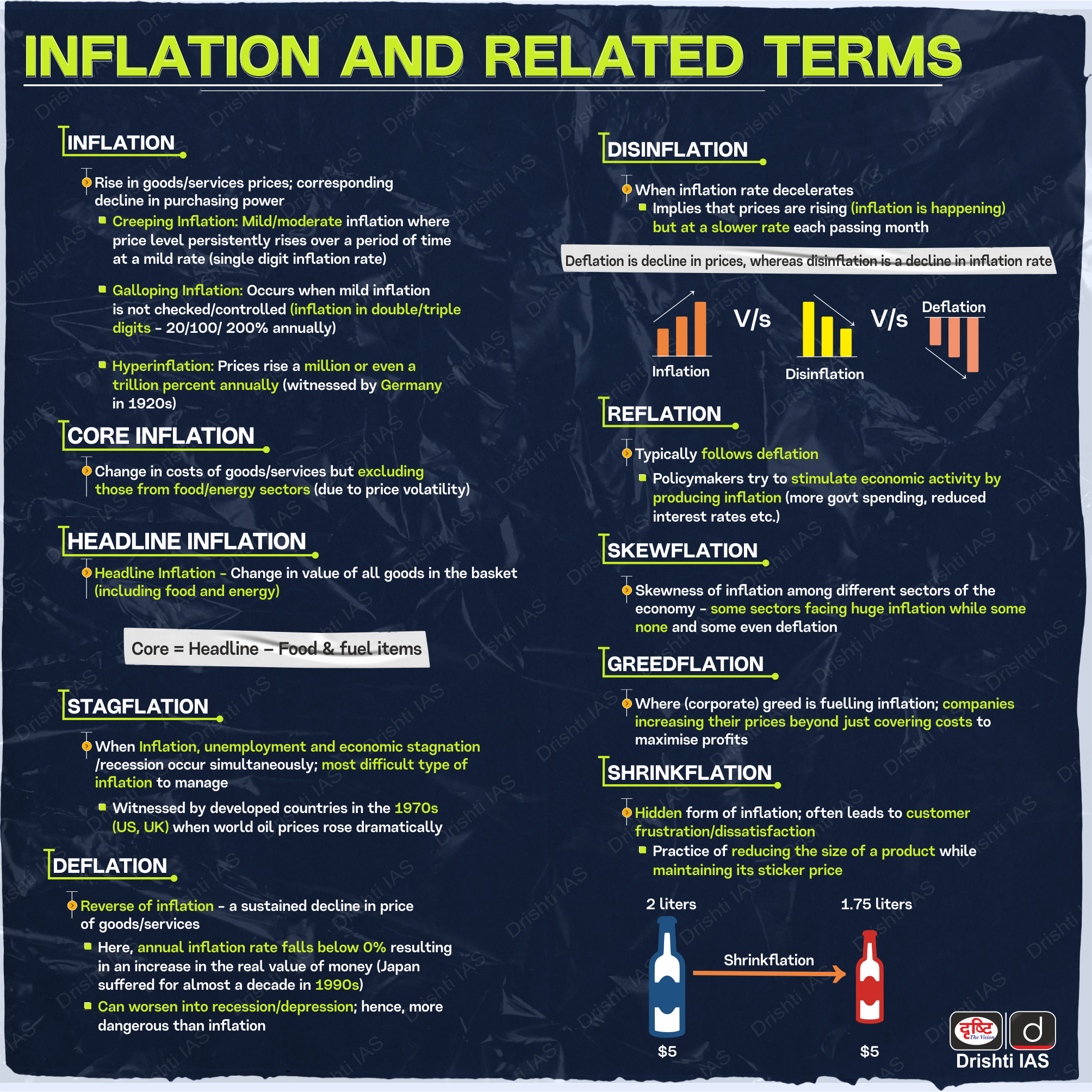
- Informal Market Issues: Price collection from informal markets makes it difficult to adjust for quality improvements, shrinkflation, and disguised price rises, affecting accuracy.
- For example, in informal retail markets, packaged food items often experience shrinkflation( ie, reduced quantity at the same price or silent quality downgrades) which are not fully captured in recorded prices.
- As a result, households face a higher effective cost of living than CPI indicates, leading to an underestimation of real inflation pressures.
- For example, in informal retail markets, packaged food items often experience shrinkflation( ie, reduced quantity at the same price or silent quality downgrades) which are not fully captured in recorded prices.
What Measures are Needed to Strengthen India’s Consumer Price Index?
- Rebalancing Excessive Food Weight: With food and beverages accounting for nearly 46% of CPI-Combined, India’s headline inflation remains disproportionately influenced by supply-side shocks.
- A gradual rebalancing of weights, consistent with Engel’s Law (that states that as a household's income increases, the percentage of income spent on food decreases, even if the absolute amount spent on food rises) and rising incomes, along with greater emphasis on core inflation for policy signalling, would improve monetary transmission without ignoring food security concerns.
- Strengthening Regional CPI: India’s CPI framework largely provides national and broad rural–urban indices, masking significant inter-state and intra-urban inflation variations.
- Expanding the network of price collection centres and publishing state-level and major city-level CPI indices would enable decentralised inflation management and improve Centre–State coordination in addressing region-specific price pressures.
- Improved Measurement of Housing and Services Inflation: Despite rapid urbanisation, housing and services inflation remains underrepresented in CPI due to limited rental market coverage and methodological constraints.
- There is a need to better capture urban rental trends, private education fees, healthcare costs, and transport services.
- Integrating administrative datasets such as municipal rental records, school fee structures, and insurance premiums, along with strengthening urban price surveys, would align CPI more closely with real cost-of-living conditions.
- Managing Supply-Side Inflation: A significant portion of CPI volatility in India stems from supply-side factors, which are beyond the immediate control of monetary policy.
- Such inflation episodes require non-monetary interventions including buffer stock management, calibrated trade policies, logistics improvements, and market reforms.
- Strengthening institutional coordination between the RBI and line ministries dealing with agriculture, food, and commerce would prevent over-reliance on interest rate tools to address structurally induced price pressures.
- Such inflation episodes require non-monetary interventions including buffer stock management, calibrated trade policies, logistics improvements, and market reforms.
- Unmask Hidden Inflation in Informal Markets: CPI price collection in India relies heavily on informal markets, where quality variation, shrinkflation, and product substitution are common, often leading to understated inflation.
- Drawing on recommendations from the OECD Manual on CPI Measurement, India needs to adopt hedonic pricing methods and digital price tracking to adjust for quality changes.
- Leveraging GST data, e-commerce prices, and scanner data would improve accuracy and ensure CPI reflects real changes in consumer purchasing power rather than nominal price stability.
- Reducing Seasonal Volatility Through Structural Reforms: Seasonal fluctuations in agricultural prices continue to cause sharp month-to-month volatility in CPI readings, complicating policy responses.
- The Dalwai Committee on Doubling Farmers’ Income have emphasised investments in cold storage, food processing, post-harvest infrastructure, and market integration through platforms such as e-NAM.
- These structural reforms would reduce wastage, smoothen supply chains, and stabilise consumer prices, making CPI a more reliable indicator for macroeconomic management.
Conclusion:
While CPI remains India’s official measure of retail inflation, its long reliance on the 2012 base year limited its ability to reflect changing consumption patterns, services inflation, and urban cost pressures. The ongoing base revision to 2024, based on the latest Household Consumption Expenditure Survey, marks a crucial step toward improving representativeness, weights, and item coverage. Along with better regional granularity and use of core inflation indicators, this reform will strengthen monetary policy transmission. A regularly updated CPI will thus better capture real cost-of-living changes in a rapidly transforming Indian economy.
|
Drishti Mains Question: Updating price indices is as much an economic governance issue as a statistical exercise. Discuss this statement in the context of India’s CPI reforms, including base-year revision, regional granularity, and use of alternative inflation indicators. |
FAQs
1. What does CPI measure?
It measures changes in retail prices faced by consumers, reflecting cost-of-living inflation.
2. Why is India’s CPI often volatile?
Due to high food weight and supply-side shocks like monsoon and logistics disruptions.
3. Why was CPI base revision needed?
The 2012 base year no longer reflected current consumption patterns and services inflation.
4. What is the significance of the new CPI base (2024)?
It improves representativeness using latest consumption data and updated weights.
5. Why does the RBI track core inflation along with CPI?
To filter out food and fuel volatility and assess underlying demand pressures.
UPSC Civil Services Examination Previous Year Question (PYQ)
Prelims:
Q. With reference to India, consider the following statements: (2010)
- The Wholesale Price Index (WPI) in India is available on a monthly basis only.
- As compared to Consumer Price Index for Industrial Workers (CPI(IW)), the WPI gives less weight to food articles.
Which of the statements given above is/are correct?
(a) 1 only
(b) 2 only
(c) Both 1 and 2
(d) Neither 1 nor 2
Ans: (b)
Q. Consider the following statements: (2020)
- The weightage of food in Consumer Price Index (CPI) is higher than that in Wholesale Price Index (WPI).
- The WPI does not capture changes in the prices of services, which CPI does.
- The Reserve Bank of India has now adopted WPI as its key measure of inflation and to decide on changing the key policy rates.
Which of the statements given above is/are correct?
(a) 1 and 2 only
(b) 2 only
(c) 3 only
(d) 1, 2 and 3
Ans: (a)



