







.jpg)

.png)

.jpg)

 PCS Parikshan
Madhya Pradesh Switch to Hindi
BSF Launches Durga Drone Squadron
Why in News?
The Border Security Force (BSF) is embarking on a historic initiative by establishing its first all-women drone operations unit, named the Durga Drone Squadron.
- The initiative marks a significant milestone in women's empowerment within the BSF and other security forces.
Key Features
- About: This pioneering effort blends women's power with advanced technology, aiming to enhance border security operations on both the western and eastern fronts of India.
- Location: The training is conducted at the School of Drone Warfare (SDW), situated at the BSF Academy in Gwalior, a premier institution for drone technology training within the BSF.
- Training Programme:
- The squadron is undergoing advanced training in aerial surveillance, intelligence gathering, reconnaissance, and counter-drone operations.
- In addition to drone operation, the trainees are learning to:
- Conduct search and rescue operations.
- Use electronic detection and neutralisation systems to counter cross-border drone threats.
- Goals of the Squadron:
- The squadron is aimed at strengthening a technologically advanced and intelligent border security framework, enhancing overall effectiveness.
- Women personnel will significantly boost surveillance coverage along India's borders, improving real-time intelligence gathering, and will play a key role in anti-infiltration and disaster response operations.
Border Security Force (BSF)
- The BSF was raised in 1965, after the India-Pakistan war.
- It is one of the seven Central Armed Police Forces of the Union of India under the administrative control of the Ministry of Home Affairs (MHA).
- Other Central Armed Police Forces are: Assam Rifles (AR), Indo-Tibetan Border Police (ITBP), Central Industrial Security Force (CISF), Central Reserve Police Force (CRPF), National Security Guards (NSG) and Sashastra Seema Bal (SSB).
- The 2.65-lakh force is deployed along the Pakistan and Bangladesh borders.
- It is deployed on the Indo-Pakistan International Border, Indo-Bangladesh International Border, and Line of Control (LoC) along with the Indian Army and in Anti-Naxal Operations.
Rajasthan Switch to Hindi
Rajasthan Launches "Khushi Shala" Programme
Why in News?
The Rajasthan State Council of Educational Research and Training (RSCERT) has launched a pioneering mental health and well-being initiative, Khushi Shala, aimed at students in classes 1-5.
- Rajasthan is the first state in India to introduce such a programme in primary education.
Key Features
- Objective: The programme seeks to promote mental well-being among young students by teaching them how to handle both success and failure.
- It encourages children to embrace their learning journey without getting demotivated by setbacks.
- Core Components:
- Mindfulness Exercises: Activities to foster awareness of the connection between body and mind.
- Compassion Development: Activities designed to nurture compassion among students.
- Self-Discovery Guidance: Helping students identify their personal values and pursue what matters to them.
- Pilot Project (2024): Conducted in 30 schools each in the Sirohi and Banswara districts, training 120 teachers to observe changes in students.
- Teacher Training:
- After the pilot project, 165 teachers were trained to form a State Resource Group. These teachers are now training additional educators at the district level.
- By December 2025, the department plans to have 40 trained teachers in every district, with an eventual target of training approximately 12,000 teachers statewide.
- The goal is to ensure at least one trained teacher in every panchayat.
- Teacher Handbooks:
- Specialized handbooks for classes 1-5 have been developed in partnership with Kshamtalaya Foundation and Brio, a US-based non-profit organization.
- These handbooks have been designed, reviewed, approved, and printed for master trainers.
- Mobile-friendly versions of the handbooks will be available to all primary school teachers starting December.
Rajasthan Switch to Hindi
Launch of Adarsh Veda Vidyalayas in Rajasthan
Why in News?
In a bid to promote and expand Sanskrit education across the state, Rajasthan's Sanskrit Education Minister Madan Dilawar announced the launch of Adarsh Veda Vidyalayas at all divisional headquarters starting from 1st April 2026.
Key Points
- About: The initiative aims to promote Sanskrit education at the divisional level across Rajasthan.
- In the first phase, four Adarsh Veda Vidyalayas have been established, currently functioning from temporary campuses in Sanskrit Education Department buildings or other government structures.
- The current centres are in Hathoj (Jaipur), Taratara Math (Barmer), Pushkar (Ajmer), and Pili Village (Bharatpur).
- Infrastructure Development:
- Each Veda Vidyalaya will have four expert teachers in Vedic education and can deploy five departmental personnel for administrative support.
- Land has been allocated for the construction of permanent campuses for the Adarsh Veda Vidyalayas across all seven divisions, including locations in Hathoj (Jaipur), Pushkar (Ajmer), Pili (Bharatpur), Chechat (Kota), Gomrakh (Jodhpur), Bhatewar (Udaipur), and Nalbari (Bikaner).
- Vedic Traditions:
- Vedic Gurukuls and Vedic Tourism Centers must operate in full accordance with traditional Vedic practices.
- Trained personnel with knowledge of Vedic traditions and the Vedas will be appointed to these centers.
- Formation of the Vedic Sanskar and Education Board: In April 2025, the Rajasthan government established the Vedic Sanskar and Education Board to oversee the operation of all Vedic schools, including newly established Vedic schools at the divisional level and three Vedic Gurukuls.
Uttar Pradesh Switch to Hindi
NCRTC Launches India's First 'Solar on Track' System
Why in News?
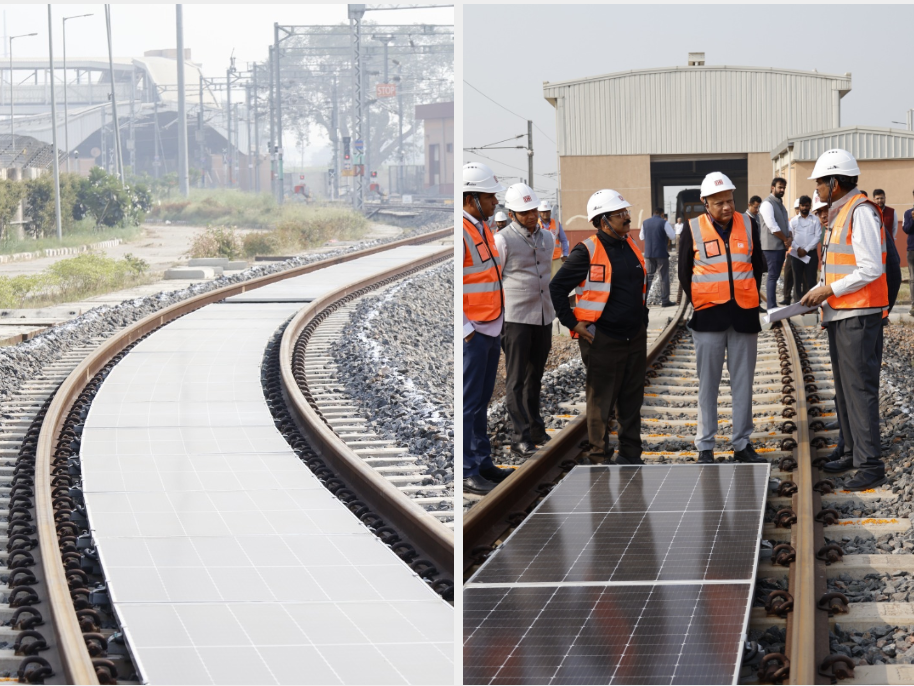
In a significant step towards sustainable transport infrastructure, the National Capital Region Transport Corporation (NCRTC) has implemented a pioneering 'Solar on Track' system at the Namo Bharat Depot in Duhai, Ghaziabad.
- This initiative marks the first-ever installation of such a system in any RRTS (Regional Rapid Transit System) or Metro network in India.
Key Features
- About: The 'Solar on Track' project is part of NCRTC's broader solar policy, which aims to meet 70% of its energy requirements through renewable sources.
- Currently, NCRTC has operationalized 5.5 MW of rooftop solar capacity across various stations, depots, and buildings.
- The organization has set an ambitious target to achieve a 15 MW peak in-house solar generation.
- Solar Panel Installation: The project involves the installation of solar panels on a 70-meter stretch of the Pit Wheel Track.
- A total of 28 solar panels, each with a capacity of 550 Wp (Watt peak), have been installed, creating a total system capacity of 15.4 kWp.
- Energy Generation and Environmental Impact: The Solar on Track system is expected to generate around 17,500 kWh of electricity annually.
- This energy generation will contribute to reducing carbon dioxide emissions by an estimated 16 tonnes per year.
- Future Plans: NCRTC is also working towards integrating renewable energy into the traction systems for its rapid transit services, further reducing reliance on conventional energy sources.
- Rainwater Harvesting & Sewage Treatment: As part of its broader sustainability efforts, NCRTC has implemented rainwater harvesting systems and sewage treatment plants at its facilities, promoting water conservation and efficient waste management.
- Regenerative Braking Technology: NCRTC has incorporated regenerative braking technology in its Namo Bharat trains.
- This technology converts kinetic energy into electrical energy during braking, contributing to energy savings and enhancing the overall efficiency of operations.
Rajasthan Switch to Hindi
Kusum Scheme Saves Over Rs 282 Crore
Why in News?
Rajasthan power distribution companies (Discoms) have saved over Rs 282 crore in the last 18 months through the Kusum scheme, which focuses on solarising agricultural connections and enabling farmers to generate income from barren and semi-barren land.
Key Points
- About: Rajasthan is leading the country in Component-A of the scheme, which allows farmers to set up plants with capacities up to 2 MW. The state also ranks third in Component-C.
- Infrastructure: The state has accelerated the implementation of the scheme, with 942 solar plants installed, having a combined capacity of 2,100 MW in just 20 months.
- To date, 1.36 lakh solar pumps are operational across 41 districts, powered by 1,034 solar plants. In 22 districts, these pumps operate in two shifts.
- Rajasthan targets 11,632 MW of solar capacity by March 2026, which is expected to further reduce power purchase costs.
PM-KUSUM Scheme
- About:
- Launched in 2019, the PM-KUSUM (Pradhan Mantri Kisan Urja Suraksha evam Utthaan Mahabhiyan) scheme is a flagship initiative by the Government of India, aimed at transforming the agricultural sector through solar energy solutions.
- The scheme promotes the use of solar energy in farming and seeks to increase farmers' income by reducing irrigation costs and enabling them to sell surplus solar power to the grid.
- Components:
- Component-A: Installation of 10,000 MW decentralized solar power plants on barren, fallow, pasture, marshy, and cultivable lands of farmers.
- Component-B: Installation of 20 lakh stand-alone solar pumps in off-grid areas for irrigation.
- Component-C: Solarisation of 15 lakh grid-connected agricultural pumps, which includes both individual pump solarisation and feeder-level solarisation.
- Objectives:
- Reduce Dependence on Diesel: The scheme encourages the use of solar-powered pumps for irrigation, reducing reliance on costly diesel-powered pumps.
- Increase Farmers' Income: By enabling farmers to sell excess solar energy to the grid, the scheme enhances their financial stability.
- Enhance Water and Energy Security: Solar pumps and community irrigation projects improve water and energy security for farmers.
- Environmental Impact: By replacing conventional energy sources with solar energy, the scheme reduces environmental pollution and promotes clean energy.
Maharashtra Switch to Hindi
Maharashtra to Take Over Iconic 'India House'
Why in News?
Maharashtra's Cultural Affairs Minister Ashish Shelar announced that the state government will take over the historic ‘India House’ in London, which was once home to prominent Hindu ideologue Vinayak Damodar Savarkar.
Key Points
- About: The Maharashtra government has initiated the process of acquiring India House with assistance from the central government.
- Following the acquisition, efforts will be made to conserve the property and develop it as a memorial that commemorates its role in the anti-colonial movement.
- Joint Review Meeting: A joint review meeting was held in Mumbai which resulted in the decision to set up a multi-departmental committee to assess and prepare for the takeover and preservation of India House.
- Committee Formation: The committee will consist of representatives from the General Administration, Cultural Affairs, Archaeology, and Finance Departments.
- The committee will prepare a comprehensive report on the legal, financial, and administrative aspects of acquiring India House, which will be submitted to Chief Minister Devendra Fadnavis for further action.
- Historical Significance: India House was founded in the early 20th century as a student residence but later became a hub for Indian revolutionary activity.
- The building is historically linked with several nationalist figures, including Vinayak Damodar Savarkar and other freedom fighters who played key roles in India's struggle for independence.


