


Economy
Strengthening India’s FDI Attractiveness
- 29 Dec 2025
- 22 min read
This editorial is based on “Fragile attractiveness: on the latest FDI data and India which was published in The Hindu on 26/12/2025. The article highlights how India’s status as a global investment destination rests on a fragile foundation, while underscoring the need for deeper structural reforms to strengthen and sustain its FDI attractiveness.
For Mains:Foreign Direct Investment trends and sectorwise contribution, key issues and measures
.
India’s recent foreign direct investment (FDI) trends reveal how fragile global investor confidence can be, as even a single external shock, such as the U.S. tariff announcement, triggered capital outflows. While India remains one of the world’s fastest-growing economies, the sudden dip in FDI shows that growth narratives alone cannot sustain investor trust. At the same time, India continues to attract long-term interest due to its large market, reform push, and manufacturing potential. Strengthening policy certainty and structural reforms can help convert this underlying potential into stable and sustained investment inflows.
What is Foreign Direct Investment ?
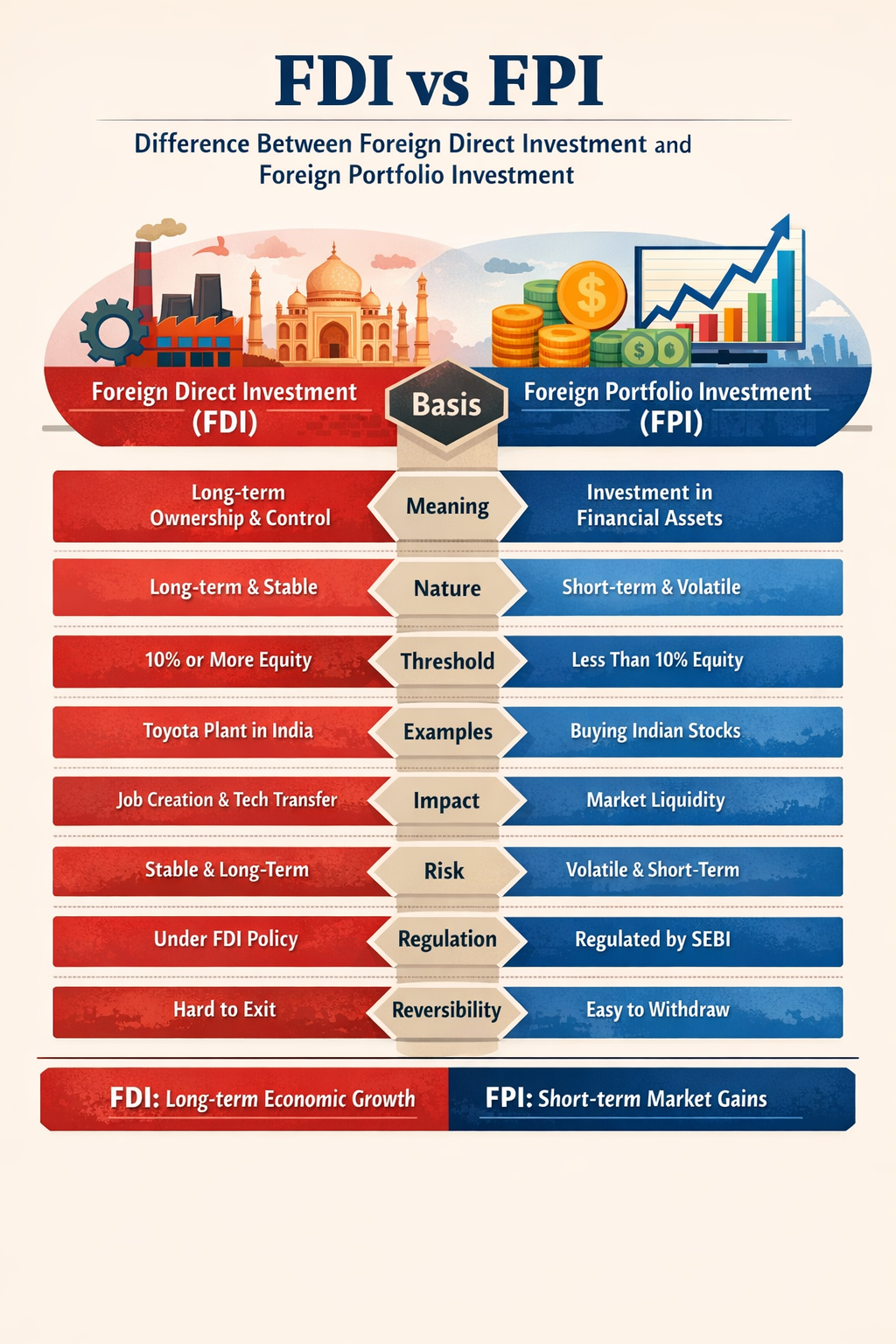
- About: Foreign Direct Investment (FDI), as defined by the Organisation for Economic Co-operation and Development (OECD), refers to an investment made by a resident entity in one economy with the objective of establishing a lasting interest and a significant degree of influence or control over the management of an enterprise in another economy.
- It is different from FPI, or Foreign Portfolio Investment, that refers to foreign entities investing in a country's financial assets like stocks, bonds, mutual funds, or ETFs, without gaining control of local businesses
- Foreign Direct Investment (FDI) is recorded in the financial account of the Balance of Payments as it involves long-term cross-border capital flows. It signifies a stable, enduring stake in the host economy through ownership, management control, and technology transfer.
- For instance, Toyota setting up a manufacturing plant in India constitutes FDI, generating employment, boosting productivity, and integrating India into global value chains.
- Routes of FDI in India
- Automatic Route : FDI is allowed without prior approval from the Government or RBI in most sectors. For example, renewable energy , IT and software services, etc.
- Government Route : FDI requires prior approval from the Government of India, usually through the relevant ministry or department. For example, defence manufacturing.
- Prohibited Sectors for FDI
- FDI is not permitted in certain sensitive areas, including atomic energy, lottery business, gambling and betting, chit funds, nidhi companies, real estate business (except development), trading in transferable development rights (TDRs) and manufacturing of tobacco and tobacco substitutes.
What is the Current Trend in Foreign Direct Investment (FDI) in India?
- Trends: In recent years, India has continued to be an important destination for global Foreign Direct Investment. Although short-term fluctuations have occurred, including periods where net FDI turned negative due to higher outflows compared with inflows, the overall trend shows robust gross inflows and strong investor interest in strategic sectors.
- For example, between April and October 2025, India’s gross FDI inflows increased by around 15.4% to approximately $58.3 billion, highlighting continued investor confidence despite volatility.
- Major Sources Of FDI: Singapore (30% in FY24-25) and Mauritius(17% FY24-25) have traditionally been among the top sources of FDI, due in large part to treaty benefits and the presence of investment vehicles routed through these jurisdictions.
- Other important contributors include the United States, United Kingdom, Netherlands, and the United Arab Emirates.
- Top Sectors Attracting FDI
- Service Sector: The services sector remained the largest recipient of FDI in FY 2024–25, accounting for 19% of total equity inflows.
- It was followed by computer software and hardware (16%) and trading (8%).
- Notably, FDI inflows into the services sector recorded a strong growth of 40.77%, rising from USD 6.64 billion in the previous year to USD 9.35 billion.
- Manufacturing: Manufacturing has also shown strong traction as a key destination for foreign capital.
- In FY 2024–25, FDI inflows into the manufacturing sector grew by 18% year-on-year, reaching about USD 19.04 billion, up from USD 16.12 billion in the previous fiscal.
- Service Sector: The services sector remained the largest recipient of FDI in FY 2024–25, accounting for 19% of total equity inflows.
- Major Recipient States: Maharashtra accounted for the highest share, receiving 39% of total FDI equity inflows in FY 2024–25, followed by Karnataka with 13% and Delhi NCR with 12%.
- Other significant recipient states include Gujarat and Tamil Nadu, which together account for a substantial share of total foreign investment in the country.
What Factors are Driving the Inflow of Foreign Direct Investment into India?
- Large and Growing Domestic Market: India’s vast consumer base continues to attract FDI as companies seek scale and demand opportunities.
- India secured over USD 81.04 billion (provisional) in FY 2024–25, reflecting sustained interest from global investors in tapping into the Indian market despite volatility.
- Also, India’s digital market is maturing as the world’s third-largest startup ecosystem, coupled with its "India Stack" (UPI, ONDC), is attracting massive "future-shaping" capital.
- Sectoral Liberalisation and Business Reforms: Relaxation of FDI norms in major sectors has expanded investment opportunities.
- For instance, the government raised the FDI cap in insurance to 100% in the 2025 budget and liberalised several sectors, simplifying access for foreign investors.
- Also reforms, such as the Jan Vishwas Bill 2.0, have decriminalized 288 minor industry offences to reduce the "compliance tax" on foreign firms.
- Strategic Policy Initiatives and Incentives: Initiatives such as Make in India, Production Linked Incentive (PLI) schemes, and expansion of free trade agreements have made India more attractive for global supply chains and investment commitments.
- Cumulative FDI inflows have crossed $1 trillion since 2000, indicating policy effectiveness in attracting capital.
- Also, actual realized investments under PLI reached ₹1.88 lakh crore by June 2025 across 14 sectors.
- Preferential Investment Agreements and Enhanced Market Access: Expanding trade agreements and improved global engagement boost investor confidence.
- For example, India-UAE CEPA committed USD 100 Billion investment by providing tariff advantages and predictable market entry opportunities.
- Also, the recent India-EFTA pact secured a commitment of $100 billion in investment over 15 years.
- The "China Plus One" Strategic Realignment: Global corporations are aggressively diversifying their supply chains away from China to mitigate geopolitical risks and rising labor costs. India is the primary beneficiary of this shift, offering a vast domestic market and a competitive, large-scale labor pool that provides long-term operational resilience.
- For instance, Apple’s iPhone exports from India hit $12.1 billion in 2024, signaling a massive shift in high-tech assembly hubs.
- Massive Infrastructure and Logistics Scaling: The PM GatiShakti National Master Plan is addressing India’s long-standing logistics inefficiencies by enabling integrated, multimodal connectivity across road, rail, ports, and air networks, reducing transit time, improving supply-chain reliability, and enhancing ease of doing business.
- As a result, India’s logistics cost has declined to about 7.97% of GDP, strengthening export competitiveness and making India a more attractive destination for foreign investment.
What are the Key Issues Affecting FDI Inflows in India?
- Policy Uncertainty and Frequent Regulatory Changes: Sudden amendments in e-commerce rules, data localisation norms, and taxation policies create uncertainty for foreign investors who prefer long-term stability.
- Sudden legislative shifts in sunrise sectors like the Promotion and Regulation of Online Gaming Act, 2025 and e-commerce "marketplace" tweaks, create a perception of high regulatory risk for digital capital.
- Although most sectors follow the automatic FDI route, investments from countries sharing land borders, mainly China, face strict screening under Press Note 3 (2020).
- This requirement for prior government approval has delayed around 200 proposals as of August 2025, slowing the entry of critical suppliers and hindering the growth of India’s electronics and EV manufacturing.
- Such unpredictability increases perceived risk and discourages large, long-gestation investments, especially in sectors like digital services and retail.
- Global Economic and Geopolitical Uncertainty: Global developments such as geopolitical tensions, supply chain disruptions, and monetary tightening by advanced economies have significantly impacted capital flows.
- Rising interest rates in the U.S. and Europe have prompted investors to pull funds from emerging markets, including India, in search of safer returns.
- For instance, the US imposed 50% tariffs on certain Indian imports in late 2025, contributing to net FDI turning negative for three consecutive months ending October 2025,highlighting that capital inflows are not fully translating into long-term domestic investment.
- Infrastructure and Logistics Bottlenecks: Although logistics costs have come around 7–8% of GDP, inadequate last-mile connectivity, port congestion, and uneven infrastructure development across states continue to affect investor confidence, especially in manufacturing and export-oriented sectors.
- Despite India’s jump to 38th in the World Bank’s Logistics Performance Index (LPI), major ports face "vessel bunching" and yard congestion as cargo volumes outpace terminal automation.
- The PM Gati Shakti National Master Plan has successfully mapped about 1,700 data layers, but the "on-ground" synchronization between rail, road, and air remains incomplete.
- Land Acquisition and Labour Market Challenges: Despite reforms, land acquisition remains time-consuming due to legal complexities, rehabilitation issues, and state-level variations.
- Similarly, while labour laws have been consolidated, their implementation remains uneven across states, creating uncertainty for investors planning large-scale industrial operations.
- Despite the creation of the India Industrial Land Bank (IILB), which has mapped over 4,500 industrial parks, challenges related to land availability, clear titles, and last-mile connectivity persist.
- Intense Global Competition for Investment: India faces stiff competition from countries such as Vietnam, Indonesia, and Mexico, which offer faster approvals, lower logistics costs, and investor-friendly ecosystems.
- For example, Vietnam has attracted major electronics manufacturers such as Samsung and Apple suppliers due to its efficient special economic zones and trade agreements like CPTPP and EVFTA, diverting some investments away from India.
- Sector-Specific Regulatory Restrictions: Several sectors, including multi-brand retail, defence production, media, and insurance, still have caps or approval requirements that limit foreign participation. Such restrictions reduce the attractiveness of these sectors compared to fully liberalised markets.
- For instance,while the Union Budget 2025 raised the insurance FDI cap to 100%, it introduced a mandatory clause requiring foreign firms to reinvest the entire premium income within India.
- Skill Gaps and Technology Constraints: Although India has a large workforce, only about 5% of the workforce is formally skilled, compared to over 50% in advanced economies.
- There is a critical shortage of "Industry 4.0" ready talent—specialists in wafer fabrication, mechatronics, and advanced AI, needed for high-value manufacturing.
- As a result, investors often prefer countries with deeper skill ecosystems and established supply chains.
- Low R&D Intensity and Intellectual Property (IP) Risks: India’s Gross Expenditure on R&D (GERD) remains significantly below the global average, which discourages "Innovation-led FDI" that seeks to build high-end laboratories rather than just assembly lines.
- For instance, India's GERD as a percentage of GDP remained between 0.6% to 0.7% which is below global average and lower than countries like China (nearly 2.4%) and the USA (around 3.5%).
- Also, concerns regarding the speed of patent enforcement and the protection of trade secrets in high-tech joint ventures remain a persistent barrier for biotech and aerospace firms.
How can India Sustain and Increase Foreign Direct Investment Inflows?
- Ensure Policy Stability and Regulatory Predictability: India must provide a stable and transparent policy environment to boost investor confidence. Frequent changes in taxation, e-commerce rules, or compliance norms create uncertainty for long-term investors.
- For example, retrospective tax issues in the past affected India’s credibility, prompting the government to later withdraw such provisions.
- A stable, predictable regulatory regime is essential to attract long-term greenfield investments.
- For example, retrospective tax issues in the past affected India’s credibility, prompting the government to later withdraw such provisions.
- Improve Ease of Doing Business at the State Level: While India has improved its national ranking, inter-state disparities persist. Simplifying land acquisition, digitising approvals, and ensuring time-bound clearances can significantly reduce project delays.
- States like Gujarat and Telangana, which offer single-window clearance systems, have attracted higher FDI, demonstrating the importance of administrative efficiency.
- Strengthen Infrastructure and Logistics Efficiency: Accelerating projects under PM Gati Shakti, expanding multimodal logistics parks, and modernising ports and railways can lower costs and improve ease of movement for goods and raw materials.
- Deepen Manufacturing and Global Value Chain Integration: India must move beyond assembly-based manufacturing to deeper value addition.
- Expanding and refining Production Linked Incentive (PLI) schemes, especially in electronics, semiconductors, and electric vehicles, can help India integrate into global value chains and attract high-quality FDI.
- Reform Land and Labour Markets: Land acquisition delays and uneven implementation of labour codes discourage large-scale investments.
- Streamlining land acquisition through digitised land records and ensuring uniform adoption of labour codes across states can enhance investor confidence and project execution.
- Enhance Skill Development and Human Capital: Despite a large workforce, skill mismatches remain a major constraint.
- Strengthening vocational training, industry–academia collaboration, and skilling programs aligned with advanced manufacturing and digital technologies can attract high-value FDI in sectors like semiconductors, AI, and renewable energy.
- Promote Stable and Transparent Taxation Regime: Ensuring consistency in tax policies, faster dispute resolution, and reducing litigation through mechanisms like faceless assessment and advance pricing agreements can improve investor sentiment. Predictable taxation is critical for long-term capital commitments.
- Encourage Innovation and R&D Investment: India should gradually raise R&D expenditure to at least 1.5–2% of GDP, with a clear roadmap and outcome-based funding.
- The government can expand tax credits and production-linked incentives (PLI) to R&D-intensive sectors, strengthen the Anusandhan National Research Foundation (ANRF) to crowd in private investment, and develop sector-specific innovation clusters in areas like semiconductors, AI, biotechnology, and green technologies.
- Further, faster patent processing, stronger IP enforcement, and deeper academia–industry collaboration will enhance investor confidence and attract high-value, technology-driven FDI.
- Strengthen Trade Agreements and Global Integration: Signing high-quality trade agreements and aligning standards with global markets can improve market access for investors.
- Recent FTAs with the UAE and Australia are steps in this direction, but deeper integration with global value chains remains essential.
- Ensure Policy Coordination and Centre–State Cooperation: Effective coordination between the Centre and states is vital to reduce policy fragmentation.
- Competitive federalism, backed by performance-based incentives for states, can help create a more predictable and investor-friendly ecosystem.
Conclusion:
To realise the goals of Viksit Bharat @2047, India must move beyond being a market for investment to becoming a global hub for manufacturing, innovation, and value creation. This requires stable policies, world-class infrastructure, skilled human capital, and deep integration into global value chains. If supported by consistent reforms and cooperative federalism, FDI can become a powerful driver in transforming India into a resilient, inclusive, and globally competitive economy by 2047.
|
Drishtiias Mains Question: Discuss the changing trends and sectoral composition of Foreign Direct Investment in India. How can FDI contribute to achieving India’s Vision 2047 of becoming a developed economy? |
FAQs
- What is FDI?
FDI refers to investment made by a foreign entity in India with long-term ownership and management control. - Why is FDI important for India?
It brings capital, technology, employment, and global market access, supporting economic growth. - Which sectors receive the highest FDI in India?
Services, manufacturing, information technology, and financial services receive the highest FDI inflows. - What are the main challenges affecting FDI inflows?
Policy uncertainty, infrastructure gaps, global economic slowdown, and regulatory complexities. - How does FDI support India’s Vision 2047?
FDI strengthens industrial capacity, boosts exports, creates jobs, and supports India’s goal of becoming a developed economy
UPSC Civil Services Examination, Previous Year Questions (PYQs)
Q. Consider the following: (2021)
1.Foreign currency convertible bonds
2.Foreign institutional investment with certain conditions
3.Global depository receipts
4.Non-resident external deposits
Which of the above can be included in Foreign Direct Investments?
(a) 1, 2 and 3
(b) 3 only
(c) 2 and 4
(d) 1 and 4
Ans: (a)
Mains
Q. Justify the need for FDI for the development of the Indian economy. Why is there a gap between MOUs signed and actual FDIs? Suggest remedial steps to be taken for increasing actual FDIs in India. (2016)



