


Indian Economy
Gig Economy- Balancing Growth with Worker Protection
- 02 Jan 2026
- 20 min read
This editorial is based on “Gig workers’ strike reveals intolerable working conditions” which was published in The Hindu on 01/01/2026. The article highlights, for the first time, a nationwide collective assertion by gig workers demanding dignity, regulation, and accountability in India’s platform economy.
For Prelims: Gig Economy,NITI Aayog,New Labour Codes,E-Commerce ,Minimum Wage,SDGs Digital Personal Data Protection Act (DPDPA), 2023,DPI
For Mains:Gig Economy and its importance in the economy, key issues and practical measures
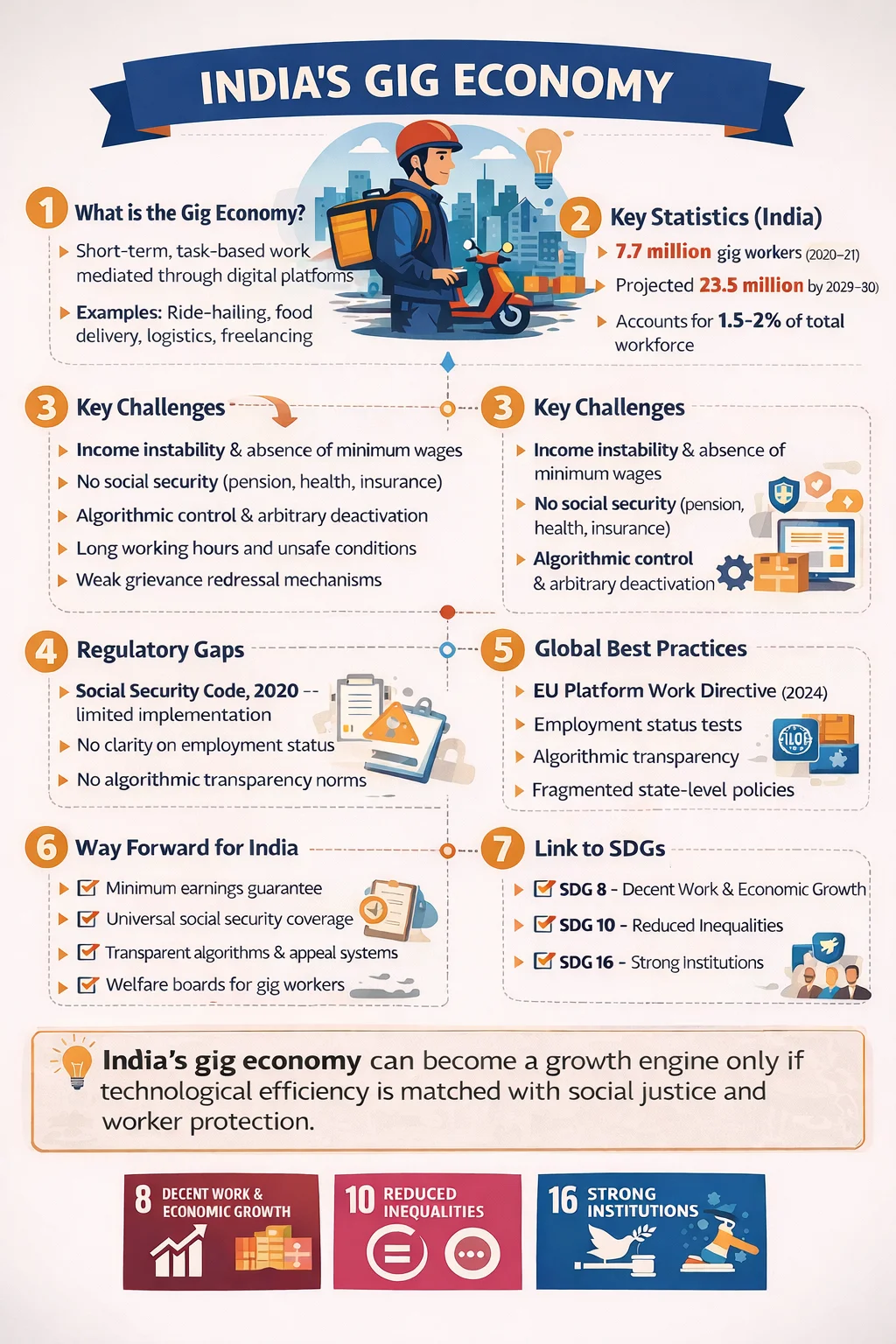
India’s gig economy has emerged as a major feature of its labour market, with an estimated 7.7 million workers engaged in platform-based work in 2020-21, expected to grow towards 23.5 million by 2029-30. The recent nationwide New Year’s Eve strike by tens of thousands of app-based delivery and transport workers has starkly revealed the harsh realities behind the convenience economy-long hours, low pay, and unsafe conditions. This protest highlights how crucial gig workers have become to everyday urban services across India. At the same time, it underscores regulatory gaps that leave these millions without basic rights or protections. The gig economy now stands at a crossroads between rapid expansion and the urgent need for labour justice.
What is the Gig Economy?
- About: The gig economy refers to a labour market where work is performed through short-term, flexible, and task-based engagements rather than traditional full-time employment.
- In this system, individuals often called gig or platform workers, earn income by providing services such as food delivery, ride-hailing, logistics, freelance work, or home services through digital platforms like Uber, Swiggy, Zomato, Urban Company, or Ola.
- Status of the Gig Economy in India: India’s gig economy has grown significantly in recent years, with an estimated 12 million gig workers by FY 2024-25, up from around 7.7 million in 2020-21.
- This segment now makes up over 2% of the total workforce and is expanding due to digital connectivity, urbanisation, and the rise of on-demand services like food delivery and ride-hailing.
- According to government estimates, the number of gig and platform workers could rise to about 23.5 million by 2029-30, representing a larger share of India’s non-agricultural workforce.
- Union Budget 2025 introduces identity cards and healthcare benefits for gig workers, ensuring better social security and financial inclusion.
- Regulation in India: The Code on Social Security (2020) formally recognised gig and platform workers and allowed for social security schemes, but enforceable standards on wages, working hours, grievance redressal, and algorithmic accountability remain weak or unimplemented.
- States like Rajasthan and Karnataka have passed welfare legislation, though implementation is lagging.
- Draft rules under the Social Security Code, released in January 2026 propose that gig and platform workers must be engaged with an aggregator for at least 90 days in a financial year to qualify for social security benefits established by the Centre.
- For those working with more than one aggregator, the required period increases to 120 days.
How does the Gig Economy Contribute to India's Development Journey?
- Employment Generation & Youth Absorption: The gig economy provides livelihoods to over 7–8 million workers (projected to reach 23.5 million by 2030), absorbing surplus labour from agriculture and informal sectors.
- It plays a crucial role in urban employment, especially for youth, migrants, and semi-skilled workers, thereby reducing open unemployment.
- Boost to Services Sector & GDP: Gig platforms significantly contribute to the services sector, which accounts for over 55% of India’s GDP.
- Sectors such as ride-hailing, food delivery, logistics, e-commerce, home services, and digital freelancing have expanded rapidly, supporting service-consumption driven growth.
- Promotion of Digital Economy & Innovation: Gig platforms accelerate digitalisation, cashless payments, GPS-based logistics, and AI-driven service delivery.
- They support India’s Digital Public Infrastructure (DPI) ecosystem—UPI, Aadhaar, and mobile connectivity—enhancing economic efficiency and formalisation.
- With this, India's digital economy is expected to grow almost twice as fast as the overall economy, contributing to nearly one-fifth of national income by 2029-30.
- Support to MSMEs and Entrepreneurship: Gig platforms enable micro-entrepreneurship by lowering entry barriers, workers can earn with minimal capital investment.
- Small businesses and MSMEs benefit from last-mile delivery, digital marketing, and logistics support.
- It enhances labour market flexibility by allowing workers to choose their hours and diversify income sources, while also absorbing displaced workers during economic shocks such as the post-COVID recovery.
- Driving Female Labor Force Participation (FLFPR): Platform-based work dismantles traditional "9-to-5" barriers, allowing women to balance domestic responsibilities with income generation through flexible, often home-based, digital tasks.
- By providing a safe and autonomous environment, the gig economy is the primary driver behind the recent surge in urban and peri-urban female employment.
- India's FLFPR has seen a notable uptick with women making up approximately 28% of the gig workforce.
- Platforms like Urban Company and various "beauty-at-home" services have empowered thousands of women to earn 40-50% more than traditional salon roles.
- Engine for Regional Economic Decentralization: The aggressive expansion of "Quick Commerce" and logistics into Tier-2 and Tier-3 cities is decentralizing economic growth away from saturated metros like Bengaluru and Delhi.
- For instance, in 2025-26, India’s Q-Commerce market surged to ₹64,000 crore.
- By utilizing a "Dark Store" model and AI-driven route optimization, the gig economy converts latent urban demand into immediate economic activity, fueling a cycle of high-frequency consumption.
- This shift creates localized job hubs, preventing distressed migration and stimulating "hyper-local" economies through increased consumption and last-mile delivery networks.
- In 2026, an estimated 20 lakh (2 million) new gig jobs are expected, primarily driven by the expansion of platforms like Blinkit and Zepto into smaller cities. During the 2025 festive season, these platforms reported a massive 120% surge in orders, directly boosting rural and semi-urban incomes.
- Catalyst for Structural Transformation and Formalization:The gig economy acts as a "formalization bridge" by pulling millions of unregistered manual laborers into a digital ecosystem that tracks income, skills, and work history.
- This transition provides the government with granular data to design targeted welfare schemes, effectively reducing the historical "invisibility" of India's unorganized workforce.
- As of December 2025, over 31.2 crore workers are registered on the e-Shram portal. Also, EPFO records the highest net addition of 20.06 lakh members in May 2025, signaling increased employment opportunities and awareness.
What are the Key Issues Associated with India’s Gig Economy?
- Income Instability and Job Insecurity: Unlike regular salaried jobs, gig work depends on demand, platform policies, and competition.
- Many workers find their earnings fluctuate widely from week to week, making it difficult to plan financially or secure credit and loans.
- The report “Prisoners on Wheels” highlights severe work stress in the gig economy: about 55% of delivery workers work 10–12 hours daily, while nearly 20% work 12–14 hours.
- Despite long hours, over one-third take home less than ₹10,000 per month after deducting expenses like EMIs, maintenance, and fines..
- Occupational Health and "Hustle" Risks: The pressure of "10-minute delivery" targets and the "always-on" nature of the apps lead to severe physical and mental health risks.
- Workers often ignore safety protocols to meet delivery windows, leading to a high rate of road accidents that are often not compensated because the worker was technically "off-duty" between gigs.
- The report “Prisoners on Wheels” reveals severe health stress: over 80% work more than 10 hours daily, nearly half get no weekly day-off, and over 99% report physical and mental health issues, often aggravated by long hours, income insecurity, and arbitrary ID deactivations.
- Lack of Adequate Regulation and Legal Protection: India currently lacks a comprehensive regulatory framework that protects gig workers’ rights.
- Gig workers are predominantly treated as “independent contractors” rather than formal employees.
- The Social Security Code, 2020 recognises gig workers for the purpose of social security, but standards on minimum wages, working hours, fair payment mechanisms, and grievance redressal are yet to be implemented effectively.
- As a result, over 82% of gig workers in India remain in the informal sector without access to basic employment safeguard.
- State efforts like the Rajasthan Platform Based Gig Workers (Registration & Welfare) Act, 2023 and similar laws in Karnataka aim to improve protections, but implementation remains uneven.
- Gig workers are predominantly treated as “independent contractors” rather than formal employees.
- Algorithmic Management and Lack of Transparency: Platforms largely manage work through opaque algorithms that decide pay, ratings, and incentives.
- Workers often lack visibility into how these algorithmic decisions are made and have no formal appeal mechanism when affected by penalties or deactivations.
- This creates a "black box" environment where workers face "algorithmic anxiety", the constant stress of not knowing why their ratings dropped or why they were suddenly "shadow-banned" or blocked from the app.
- This lack of algorithmic accountability perpetuates bias and unfair treatment, which workers cannot challenge easily.
- Workers often lack visibility into how these algorithmic decisions are made and have no formal appeal mechanism when affected by penalties or deactivations.
- Embedded Gender and Social Gaps in Gig Employment: Women gig workers face additional barriers such as limited career progression, lower pay, and safety concerns, especially during night shifts or in high-risk environments.
- The World Economic Forum (WEF) notes a 30% gender wage gap in the gig economy, higher than in traditional jobs; in India, structural informality and caregiving burdens are likely to widen this gap further.
- Social factors such as caste and class quietly influence access to gig work, often determining who is concentrated in lower-paid roles and who has the economic cushion to participate in the sector.
What Measures can be Adopted to Strengthen India’s Gig Economy?
- Promote Active Implementation of Social Security Code: Operationalise the Social Security Fund and schemes promised for gig/platform workers (health cover, accident insurance, maternity benefits, pension).
- Create a “Minimum Pay Floor”: Pay should be based on time and distance based, not incentive games. Set a statutory minimum earning standard (per hour/per km plus waiting time), with periodic indexation (inflation/fuel costs).
- For example, New York City’s minimum pay standards for app-based delivery workers pay floor wage and periodic adjustment.
- Fair Process Before Deactivation: To protect gig workers from sudden loss of livelihood, platform companies should treat ID deactivation on par with employment termination.
- This means providing clear written reasons for deactivation, giving prior notice except in cases of serious misconduct, and allowing workers a fair opportunity to explain or defend themselves.
- Additionally, an independent grievance or appeal mechanism should be in place so that workers can challenge unfair decisions. Such safeguards promote transparency, accountability, and basic job security in the gig economy.
- This directly addresses one of the biggest livelihood risks in platform work (sudden “log-out unemployment”).
- This means providing clear written reasons for deactivation, giving prior notice except in cases of serious misconduct, and allowing workers a fair opportunity to explain or defend themselves.
- Algorithmic Transparency and Data Rights: Mandate that platforms disclose how ratings, incentives, penalties, and job-allocation work in worker-friendly language; provide audit trails for disputes.
- For instance, Telangana’s draft gig workers law proposes algorithm transparency and structured grievance redressal.
- India can draw valuable lessons from the European Union’s Platform Work Directive (2024), which strengthens safeguards against opaque algorithmic management and introduces clearer tests to determine employment status.
- Aligning domestic regulations with the International Labour Organization’s (ILO) framework on algorithmic management would help ensure transparency, accountability, and fair treatment of platform workers while balancing innovation with labour rights.
- Ensure National Standards with State-Led Implementation: India should adopt a unified Gig Workers Welfare & Rights Framework that sets minimum national standards on wages, working hours, social security, safety, and grievance redressal, while allowing states to implement them through dedicated boards and welfare funds.
- The Rajasthan Platform Based Gig Workers Act, 2023 serves as a model by mandating worker registration, creating a welfare board, and levying a welfare fee on digital platforms to finance social security benefits.
- Promote Occupational Safety: Gig workers should be provided mandatory accident insurance, emergency support, and protective gear to ensure their safety. Platform work must be recognized as a safety-regulated occupation, with helmets, reflective jackets, vehicle fitness checks, and limits on work hours.
- City-level enforcement should create safe delivery zones, designated pick-up/drop points, and coordinate with traffic authorities to protect workers.
- Moreover for Quick Delivery Models, mandate risk assessment, realistic timelines and prohibit penalty structures that force speeding.
- Strengthen Worker Voice And Grievance Redressal: Create tripartite platforms (Govt–Platform–Worker reps) at state level for rate revision, disputes, and welfare design, similar to boards under other labour welfare laws.
- Ensure collective representation is protected (no retaliation for union activity).
Conclusion:
India’s gig economy can remain sustainable only if growth is matched with worker protection and fair regulation. Aligning with ILO principles can ensure transparency, dignity, and accountability in digital labour. Strengthening social security, regulating algorithms, and ensuring fair pay are essential to prevent exploitation. Such reforms advance SDG 8 (Decent Work) and SDG 10 (Reduced Inequalities).
|
Drishtiias Mains Question The growth of the gig economy has outpaced the development of labour protections in India.Examine the challenges faced by gig workers and suggest policy measures to ensure fair and sustainable employment. |
FAQs
1.What is the gig economy?
A labour market based on short-term, task-based work mediated through digital platforms.
2.Why is India’s gig economy important?
It provides employment to millions and supports urban services, logistics, and digital growth.
3.What is the main problem faced by gig workers?
Lack of job security, social protection, and fair wages due to weak regulation.
4.How does algorithmic management affect workers?
Algorithms control pay, ratings, and work allocation without transparency or appeal mechanisms.
5.What can India learn from the EU Platform Work Directive?
Clear employment classification, transparency in algorithms, and stronger worker protections.
UPSC Previous Year Questions
Prelims
Q. With reference to casual workers employed in India, consider the following statements: (2021)
- All casual workers are entitled for Employees Provident Fund coverage.
- All casual workers are entitled for regular working hours and overtime payment.
- The government can by a notification specify that an establishment or industry shall pay wages only through its bank account.
Which of the above statements are correct?
(a) 1 and 2 only
(b) 2 and 3 only
(c) 1 and 3 only
(d) 1, 2 and 3
Ans: B
Mains
Q. Examine the role of ‘Gig Economy’ in the process of empowerment of women in India. (2021)



