


Governance
WEF Global Risks Report 2026
- 17 Jan 2026
- 16 min read
For Prelims: World Economic Forum, Cybersecurity, Protectionism, Artificial Intelligence, Trojans, Gini Index
For Mains: Emerging global risks and their implications for India, Cybersecurity as a national security and governance challenge, Geoeconomic fragmentation and India’s economic resilience, Inequality as a risk multiplier for social and political stability
Why in News?
The World Economic Forum (WEF) Global Risks Report 2026 has identified cybersecurity as the biggest risk for India in 2026, while geoeconomic confrontation has emerged as the single most severe global risk, overtaking armed conflict and climate threats.
Summary
- The Global Risks Report 2026 identifies cybersecurity as India’s biggest risk and geoeconomic confrontation as the most severe global threat, with rising inequality, weak public services, and strategic instability amplifying the impact of external shocks on India’s governance and economy.
- Addressing these risks requires stronger digital and economic resilience, treating inequality as a macro-risk, countering hybrid threats and disinformation, and embedding climate resilience into India’s long-term development and security strategy.
What are the Key Findings of the Global Risks Report 2026?
Global Risk Outlook
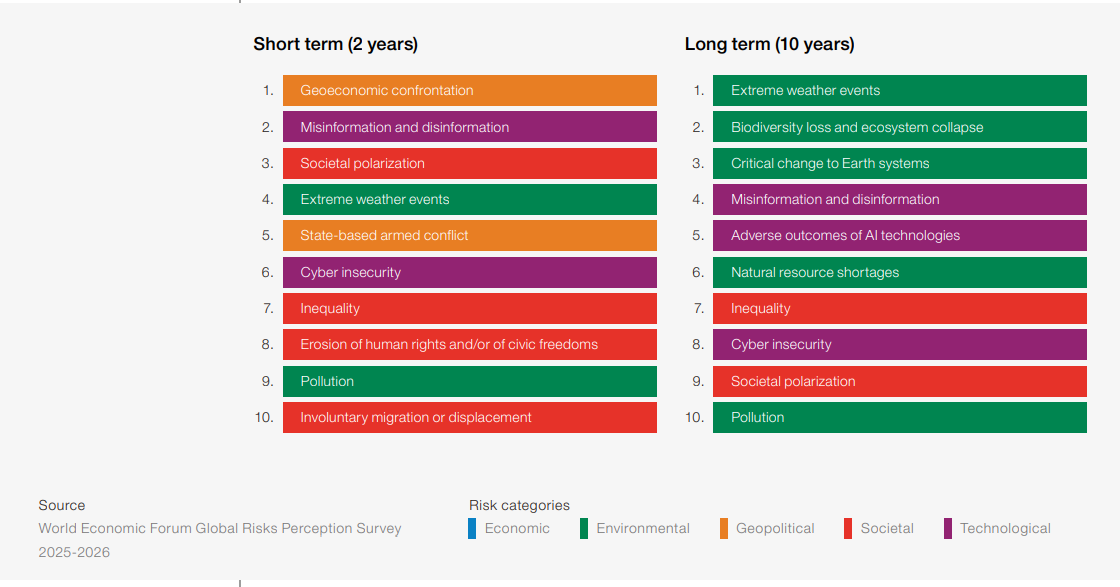
- In the immediate term (2026), Geoeconomic Confrontation has emerged as the biggest global risk, overtaking armed conflict and extreme weather events as the most likely trigger of a global crisis.
- Geoeconomic Confrontation refers to the strategic use of economic tools such as trade restrictions, sanctions, investment controls, and technology bans by states to advance geopolitical interests and constrain rivals, weakening multilateralism and rising protectionism.
- State-based armed conflict ranks second globally, reflecting ongoing wars and regional spillover risks.
- Climate-related risks like extreme weather events rank next, alongside societal polarisation.
- Technological risks are rising globally, with misinformation and disinformation ranking 5th worldwide, reflecting growing threats to democratic processes and social trust.
- At the same time, adverse outcomes of Artificial Intelligence (AI) technologies have entered the top 10 global risks, highlighting concerns over job displacement, ethical misuse, and security challenges.
- Cyber insecurity ranks 9th globally, underscoring increasing digital vulnerability as economies and governance systems become more digitally dependent.
- Over the long term (next ten years), climate-related risks dominate, with extreme weather events, biodiversity loss, and critical changes to Earth systems at the top.
India Risk Outlook
- Cybersecurity is the top risk for India in 2026, reflecting dependence on digital governance, fintech, and critical digital infrastructure.
- Income and wealth inequality is the second biggest risk for India, highlighting social and regional disparities.
- Other key risks for India include:
- Insufficient public services and social protections (this includes concerns regarding education, infrastructure, and pensions).
- Economic downturn (fears of recession or stagnation).
- State-based armed conflict (this includes proxy wars, civil wars, coups, or terrorism).
- India’s risk profile shows a stronger focus on societal and governance-related risks compared to the global geopolitical emphasis.
- The findings underline the need for strong digital security, inclusive growth, and resilient public service delivery in India.
World Economic Forum (WEF)
- The World Economic Forum (WEF) is an international public–private cooperation body headquartered in Geneva (Switzerland), founded in 1971 by Klaus Schwab (a German professor), which promotes stakeholder capitalism and provides a global platform for dialogue on economic, social, and governance issues, most notably through its annual Davos meeting.
- WEF regularly publishes globally recognized reports, including the Global Competitiveness Report and the Global Gender Gap Report, Energy Transition Index, and Global Risk Report.
Global Risk
- It is defined as the possibility of the occurrence of an event or condition that, if it occurs, would negatively impact a significant proportion of global GDP, population or natural resources.
What are the Major Risks Facing India in the Emerging Global Risk Landscape?
- Cybersecurity Risk as a Systemic National Vulnerability: According to the Data Security Council of India, India recorded 369.01 million malware detections in 2025, highlighting persistent exposure to cyber threats.
- Trojans (43.38%) and Infectors (34.23%) dominate attacks, indicating a shift towards targeted and sophisticated campaigns, while mobile threats remain significant, driven by malware (42%) and adware (26%), reflecting the commercialisation of cybercrime.
- India’s rapid digital leap in governance (DBT, Aadhaar-linked services), finance (UPI, fintech), and critical infrastructure has outpaced cyber resilience.
- Cyber threats have evolved into systemic risks that can undermine elections, financial systems, power grids, and public trust, going far beyond isolated IT failures.
- The growing concentration of data and digital platforms creates single-point vulnerabilities, turning cyber insecurity into a strategic national risk rather than a purely technical issue.
- Income and Wealth Inequality as a Risk Multiplier: While the World Bank’s Gini Index for India stands at about 25.5 (2022–23) placing India among countries with relatively lower measured income inequality.
- The Oxfam report highlights that in 2022, the top 1% of Indians captured 22.6% of national income, pointing to deep and widening disparities that are not fully reflected in consumption-based Gini measures.
- Rising inequality in India amplifies economic shocks for informal and marginalised workers, increasing the risks of social unrest, political polarisation, and institutional distrust while eroding the social contract and weakening the state’s ability to mobilise public cooperation during crises.
- Insufficient Public Services and Social Protection Capacity: It remains a key vulnerability for India, as public health expenditure is only 1.9% of GDP, well below the 2.5% target set for 2025 under the National Health Policy, 2017.
- India spends around 5% of GDP on social protection (excluding health), compared to the global average of around 13% (World Social Protection Report 2024-26, ILO).
- Combined with capacity gaps in health, education, urban infrastructure, and social security, this weakens shock absorption and transforms climate extremes, economic volatility, and external disruptions into domestic governance challenges.
- Geoeconomic Shocks: India’s deep integration with global trade, energy markets, and capital flows exposes it to geoeconomic shocks, evident in the record Foreign portfolio investment (FPI) outflow of USD 18.9 billion in 2025, driven by global trade tensions, currency volatility, fears of US tariffs, and stretched market valuations, which heightened volatility in equities and the rupee.
- Slowdowns in major economies quickly spill over into India through weaker exports, investment uncertainty, job losses, and rising fiscal pressure on welfare and subsidies.
- State-Based Armed Conflict and Strategic Instability: Regional geopolitical tensions have intensified India’s security risks, as reflected in the 2025 Pahalgam attack, the blast near Delhi’s Red Fort, and continued cross-border terrorism by Pakistan-backed groups.
- At the same time, rising urban terrorism, lone-wolf and white-collar terrorism, and persistent internal insurgencies strain border security, defence spending, and investor confidence.
- Prolonged instability can divert state capacity from development and heightens exposure to hybrid threats like cyber warfare, misinformation, and economic coercion.
What Steps are Needed to Reduce India’s Vulnerability to Emerging Global Risks?
- Strengthen Economic Resilience: Reduce supply-chain and capital-flow vulnerabilities by scaling up domestic manufacturing under Make in India and PLI schemes.
- Diversifying trade through Free Trade Agreement (FTA) and maintaining strong buffers via forex reserves and counter-cyclical fiscal policy, in line with IMF recommendations.
- Treat Inequality As A Macro-Risk: Address inequality through formalisation and income security using PM-JDY, and Ayushman Bharat, since high inequality has amplified distress among informal workers during crises like the pandemic and inflationary episodes.
- Build Capacity Against Hybrid Threats: India must adopt a whole-of-government and whole-of-society approach to counter hybrid threats that blend terrorism, cyber attacks, disinformation, and economic coercion.
- Building capacity against hybrid threats requires real-time intelligence fusion through a statutory Multi-Agency Centre, stronger cyber and financial surveillance under the PMLA, 2002 and integrated security responses via a National Security Strategy, especially in urban areas.
- Protect Information Integrity: Counter disinformation through 'FACT Principle' strategy adopted by Election Commission of India, IT Rules 2021, institutionalised fact-checking, and digital literacy initiatives such as PM-DISHA, aligned with OECD and EU approaches that treat information integrity as a national security concern.
- Strengthening counter-disinformation and information warfare capabilities is equally vital to address cyber and psychological dimensions of hybrid threats.
- Embed Climate Resilience In Development: Mainstream adaptation via the National Action Plan on Climate Change, Mission LiFE, National Disaster Management Plan, climate-resilient infrastructure under Gati Shakti, and urban reforms through Smart Cities, consistent with reducing long-term fiscal and conflict risks.
Conclusion
The Global Risks Report 2026 makes clear that India’s vulnerability lies in the convergence of cyber insecurity, inequality, geoeconomic shocks, and security threats, where external disruptions can rapidly spill over into domestic instability without stronger resilience and governance capacity.
|
Drishti Mains Question: Evaluate India’s preparedness to deal with hybrid threats combining terrorism, cyber attacks, and disinformation. |
Frequently Asked Questions (FAQs)
1. What is the biggest risk for India in 2026 according to the Global Risks Report 2026?
Cybersecurity is identified as India’s top risk due to deep dependence on digital governance, fintech, and critical digital infrastructure.
2. Why is geoeconomic confrontation considered the most severe global risk?
Rising protectionism, trade fragmentation, and capital flow volatility increase the risk of global economic crises and spillovers to emerging economies.
3. How does inequality increase India’s vulnerability to global shocks?
High income concentration weakens social cohesion, amplifies distress among informal workers, and erodes public trust during crises.
4. Why are cyber threats termed systemic risks?
Cyber attacks can disrupt elections, financial systems, power grids, and public trust, creating single-point failures across governance and economy.
5. What measures are critical to reduce India’s global risk exposure?
Strengthening digital security, reducing inequality, building economic resilience, countering hybrid threats, and embedding climate resilience in development are key.
UPSC Civil Services Examination, Previous Year Questions (PYQs)
Prelims
Q. The Global Competitiveness Report is published by the (2019)
(a) International Monetary Fund
(b) United Nations Conference on Trade and Development
(c) World Economic Forum
(d) World Bank
Ans: (c)
Q. Which of the following gives ‘Global Gender Gap Index’ ranking to the countries of the world? (2017)
(a) World Economic Forum
(b) UN Human Rights Council
(c) UN Women
(d) World Health Organization
Ans: (a)



