


Important Facts For Prelims
Weapons in the US–Israel–Iran Conflict
- 10 Mar 2026
- 12 min read
Why in News?
The US–Israel bloc and Iran conflict has spotlighted a new era of warfare, marked by one of the most technologically complex drone and missile battles in modern military history.
What Major Weapons and Defence Systems Used in the US–Israel–Iran Conflict?
Iran's Arsenal:
- Shahed-136 & Shahed-131 Drones: Low-cost loitering munitions (often called kamikaze drones) deployed in massive "swarm tactics."
- They are designed to fly low and slow, acting as decoys to saturate and financially exhaust expensive enemy air defense systems.
- Shahab-3 Missile: A medium-range ballistic missile with a range of approximately 2,000 km. It forms the backbone of Iran's long-range deterrence and strike capability across the Middle East.
- Fattah Missile: Claimed by Iran to be a next-generation hypersonic weapon capable of reaching speeds of up to Mach 15 and hit targets at distances of up to 1,400 km.
- Fattah’s purported maneuverability is designed to bypass traditional anti-missile shields.
- Khorramshahr Missile: A highly destructive ballistic missile deployed in recent barrages against military installations.
- Bavar-373: Long-range air defence system designed to intercept aircraft and ballistic missiles, comparable to advanced surface-to-air missile systems.
- Sevom-e-Khordad: Mobile air defence system capable of targeting aircraft and cruise missiles, enhancing survivability through rapid relocation.
- Tor-M1: Short-range system used to intercept precision-guided munitions, drones, and low-flying cruise missiles.
- Majid & Azarakhsh: Systems designed to counter drones and low-flying aerial threats, protecting critical facilities.
- Paveh Cruise Missile: It is a land-attack cruise missile. It has a range of 1,650 km and can alter its course mid-flight, making it a severe threat to US regional bases.
- Sejjil & Emad Missiles: The Sejjil is a solid-fueled medium-range ballistic missile (making it much faster to launch than the liquid-fueled Shahab-3, reducing the time the US/Israel has to detect it).
- The Emad is Iran’s first precision-guided, long-range ballistic missile with a maneuverable re-entry vehicle (MaRV).
US Arsenal
- B-2 Spirit Stealth Bomber: A highly advanced, low-radar-signature aircraft used to penetrate heavily defended airspace.
- B-2 Stealth Bombers bat-like flying wing design reduces detection and evades enemy air defenses.
- GBU-57 MOP (Massive Ordnance Penetrator): A 30,000-pound "bunker-buster" bomb.
- The B-2 bomber is the only aircraft capable of delivering this weapon, which is specifically used to destroy deeply buried and hardened Iranian nuclear facilities (e.g., at Fordow and Natanz).
- Tomahawk Cruise Missiles: Subsonic, low-altitude precision missiles launched to strike inland targets while avoiding radar.
- The Tomahawk Cruise Missile uses GPS, Inertial Navigation System (INS), TERCOM (terrain mapping), and DSMAC (digital scene matching) for high precision.
- LUCAS Drone (Low-Cost Uncrewed Combat Attack System): US's newly debuted one-way attack drone. It is an inexpensive, expendable munition designed as a direct counter-tactic to Iran's Shahed swarms.
- The drone can be launched from runways, ground vehicles, or ships for low-cost precision strikes.
- PrSM (Precision Strike Missile): A short-range ballistic missile recently making its combat debut, fired from US M-142 HIMARS systems to hit targets up to 400 km away.
- THAAD (Terminal High Altitude Area Defense): An advanced US anti-ballistic missile system designed to intercept short-, medium-, and limited intermediate-range ballistic missiles during the final stage of their flight, both inside and outside the Earth’s atmosphere, providing a critical high-altitude defensive layer.
- THAAD uses “hit-to-kill” kinetic interception technology, where interceptor missiles destroy incoming targets by directly colliding with them at extremely high speeds.
- THAAD is also highly mobile and rapidly deployable, allowing the US to position it in regions facing missile threats.
- Patriot Missile System (PAC-3): A heavily utilized US-made defense system that successfully intercepts lower-altitude threats like cruise missiles and drones.
- APKWS (Advanced Precision Kill Weapon System): A cost-effective defense solution.
- It converts standard unguided Hydra rockets into USD 25,000 laser-guided weapons, allowing forces to destroy slow-moving drones without wasting multi-million dollar interceptors.
- Coyote Anti-Drone System: Alongside the APKWS, the US relies heavily on Coyote—a radar-guided, jet-powered interceptor drone that actively hunts and crashes into Shahed drones.
- SM-3 & SM-6 (US Navy): Sea-based interceptors. SM-3 destroys ballistic missiles during midcourse flight, while SM-6 targets missiles, aircraft, and drones in the terminal phase.
- Indirect Fire Protection Capability (IFPC): Uses AIM-9X (a premier, short-range, infrared-tracking, air-to-air, and surface-launched interceptor missile) to defend bases from drones and rockets, helping conserve expensive Patriot missiles.
- MQ-9 Reaper Drones: Long-endurance uncrewed aerial vehicles used for continuous surveillance, target painting, and carrying precision Hellfire missiles.
- Boeing P-8I: A multi-mission, long-range maritime patrol aircraft designed for Anti-Submarine Warfare (ASW), Anti-Surface Warfare, Intelligence, Surveillance and Reconnaissance (ISR), Maritime Domain Awareness, and Search and Rescue operations.
Israel Arsenal
- Blue Sparrow missile: It is an air-launched quasi-ballistic missile, part of the Sparrow missile family (which also includes the Black Sparrow and Silver Sparrow).
- Originally designed as a practice target for Israel’s Arrow missile defence system, it was later adapted for offensive air-to-surface missions.
- The missile has a range of nearly 2,000 km. It is typically launched from fighter aircraft such as F-15 jets and follows a quasi-ballistic trajectory, briefly exiting the atmosphere before re-entering to strike its target, making interception by air-defence systems more difficult.
- Jericho Missile Family:
- Jericho-2: A medium-range ballistic missile (MRBM) with a range of 1,500–3,000 km.
- Jericho-3: An intermediate-range ballistic missile (IRBM) capable of striking targets 4,800–6,500 km away, forming the core of Israel's strategic deterrence.
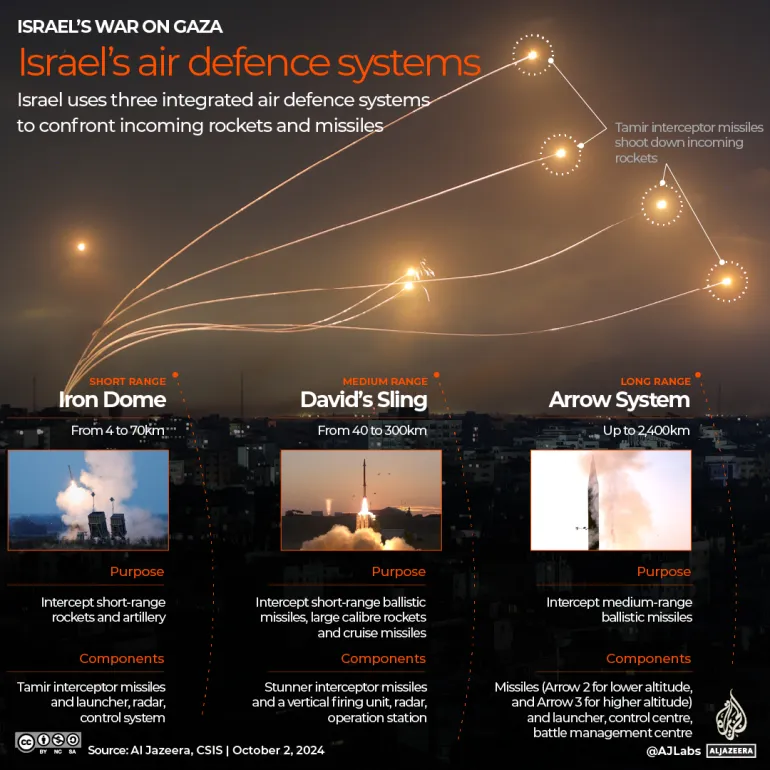
- Arrow-2 & Arrow-3: Long-range ballistic missile defence. Arrow-3 intercepts missiles outside the atmosphere (exo-atmospheric), while Arrow-2 operates within the atmosphere.
- David’s Sling: Designed to intercept medium- to long-range rockets, cruise missiles, and tactical ballistic missiles, bridging the gap between Arrow and Iron Dome.
- Iron Dome: Short-range defence system effective against rockets, artillery shells, and drones, with high success rates against low-speed threats.
- Iron Beam: Directed-energy laser system that destroys drones and small projectiles at low cost, reducing reliance on expensive interceptors.
- C-Dome: The naval version of the Iron Dome, deployed on Israel's Sa'ar 6-class corvettes to protect its offshore gas rigs and maritime borders from Houthi and Iranian drone swarms.
- F-35I “Adir”: Israel is the only Middle Eastern country operating this fifth-generation stealth fighter, enabling deep strikes inside Iranian airspace by evading air-defence systems such as Bavar-373.
|
Read more: US-Israel Attack on Iran |
Frequently Asked Questions (FAQs)
1. What are Shahed-136 drones used by Iran?
Shahed-136 arelow-cost loitering munitions (kamikaze drones) used in swarm attacks to overwhelm enemy air defence systems.
2. What is the role of the Iron Dome system?
Iron Dome is Israel’sshort-range air defence system designed to intercept rockets, artillery shells, and drones with high success rates.
3. What is the Blue Sparrow missile?
Blue Sparrow is anair-launched quasi-ballistic missile developed by Israel, originally designed as a target for the Arrow defence system and later adapted for offensive strikes.
4. What is THAAD and how does it work?
THAAD (Terminal High Altitude Area Defense) is aUS anti-ballistic missile system that intercepts incoming missiles during their high-altitude terminal phase.
5. Why is the F-35I “Adir” significant for Israel?
The F-35I is afifth-generation stealth fighter jet that enables Israel to conduct deep strikes while evading advanced air defence systems.
UPSC Civil Services Examination, Previous Year Questions (PYQs)
Prelims
Q. With reference to Unmanned Aerial Vehicles (UAVs), consider the following statements:(2025)
- All types of UAVs can do vertical landing.
- All types of UAVs can do automated hovering.
- III. All types of UAVs can use battery only as a source of power supply.
How many of the statements given above are correct?
(a) Only one
(b) Only two
(c) All the three
(d) None
Ans: (d)
Q. What is "Terminal High Altitude Area Defence (THAAD)", sometimes seen in the news? (2018)
(a) An Israeli radar system
(b) India's indigenous anti-missile programme
(c) An American anti-missile system
(d) A defence collaboration between Japan and South Korea.
Ans: (c)



