


International Relations
US Intervention in Venezuela and the Revival of the Monroe Doctrine
- 06 Jan 2026
- 11 min read
For Prelims: Venezuela, Monroe Doctrine, Multilateralism, United Nations Charter
For Mains: Monroe Doctrine and its relevance in the 21st century, Impact of great power rivalry on the Global South
Why in News?
The US conducted a military operation in Venezuela,, codenamed Operation Absolute Resolve, resulting in the capture of President Nicolás Maduro, his wife Cilia Flores, and other senior officials. The action, justified under a “Trump Corollary” to the Monroe Doctrine (1823), marks a sharp escalation in US interventionism in Latin America.
Summary
- The US military intervention in Venezuela and the capture of President Nicolás Maduro signal a revival of the Monroe Doctrine, reflecting renewed American interventionism to counter rival powers and secure strategic interests, especially energy resources, in the Western Hemisphere.
- For India, the conflict has limited economic impact due to low trade and reduced oil imports, but it raises concerns over strategic autonomy, global sovereignty norms, and the stability of a multipolar world order.
What is Monroe Doctrine?
- About: The Monroe Doctrine, articulated by President James Monroe in 1823, laid down the following principles:
- Non-colonisation: European powers should not establish new colonies in the Americas.
- Non-interference: Any attempt by external powers to influence Western Hemisphere nations would be viewed as hostile to the US.
- US Restraint in Europe: The US would not interfere in European wars or internal affairs.
- Evolution:
- Roosevelt Corollary (1904): President Theodore Roosevelt, it expanded the Monroe Doctrine by asserting the US right to exercise “international police power” in Latin American countries to address chronic wrongdoing, instability, or governance failures, thereby justifying direct US intervention.
- Cold War Era: Invoked to counter Soviet influence in Cuba, Central America, and South America.
- Post–Cold War: Largely de-emphasised in favour of multilateralism, until its recent revival.
- Contemporary Phase: Revived selectively to assert US strategic dominance in the Western Hemisphere, as seen in recent actions toward Venezuela.
- “Trump Corollary” to the Monroe Doctrine is projected as a restoration of US power and strategic priorities, aimed at safeguarding American security interests in the Western Hemisphere.
Why Did the US Intervene in Venezuela?
- Narco-terrorism and Security Narrative: US charged Maduro and senior officials with narco-terrorism and drug trafficking, portraying the regime as a direct security threat to the US and linking it to the US fentanyl crisis, thereby providing a legal-political justification for action.
- Oil and Resource Geopolitics: Venezuela possesses the world’s largest proven crude oil reserves (over 300 billion barrels or a fifth of the proven oil reserves all over the world), yet it accounts for less than 1% of global oil production.
- Years of US sanctions, economic crisis, and infrastructure decay have sharply limited output.
- The US views control over Venezuelan oil infrastructure as critical for energy security, price stability, and strategic leverage in global energy markets
- Countering Extra-Regional Powers: Venezuela’s deepening ties with China, Russia, and Iran were viewed as a challenge to US dominance in the Western Hemisphere, prompting Washington to reassert its primacy under a revived Monroe-style framework.
- However, the US–Venezuela conflict has raised serious concerns in Mexico, Colombia, and Cuba, signalling a renewed phase of US interventionism in the region.
- It highlights fears of sovereignty erosion through military pressure, sanctions, and under the pretext of counter-narcotics and security based justifications.
- However, the US–Venezuela conflict has raised serious concerns in Mexico, Colombia, and Cuba, signalling a renewed phase of US interventionism in the region.
Use of Military Force Under International Law
- General Prohibition: Article 2(4) of the United Nations Charter prohibits states from using or threatening military force against another state’s territorial integrity or political independence.
- Self-defence: Article 51 of the UN Charter allows force only in response to an armed attack, subject to necessity and proportionality, and actions must be reported to the UN Security Council.
- Former Enemy States: Article 107 of the UN Charter once allowed force against WWII enemy states, but it is now obsolete.
- Collective Security: Under Articles 24 and 25, the UN Security Council may authorise collective military action to address threats to international peace.
- Humanitarian Operations: The UN Security Council can authorise limited force in peacekeeping or humanitarian missions.
What is the Impact of the US-Venezuelan Conflict on India?
- Minimal Trade Impact: According to Global Trade Research Initiative (GTRI), the conflict will have a negligible impact on India’s trade, as bilateral commerce has already collapsed under US sanctions.
- India’s exports to Venezuela stood at just USD 95.3 million in FY2025, mainly pharmaceuticals.
- Limited Energy Exposure: India’s crude oil imports from Venezuela fell by 81.3% in FY2025, declining to USD 255.3 million, compared to USD 1.4 billion in FY2024.
- As a result, the current conflict is unlikely to materially affect India’s energy security in the short term.
- If sanctions on Venezuela are eased or recalibrated, discounted Venezuelan crude could re-enter global markets, strengthening India’s long-term crude supply diversification and procurement flexibility.
- This would enhance India’s bargaining power with West Asian suppliers and offer an alternative amid US pressure to reduce reliance on Russian oil.
- Strategic Autonomy: India has consistently advocated for non-interventionism and regime change through democratic processes rather than external military force.
- The US action complicates India's balancing act between the Global South (which opposes intervention) and its strategic partnership with the US.
Venezuela
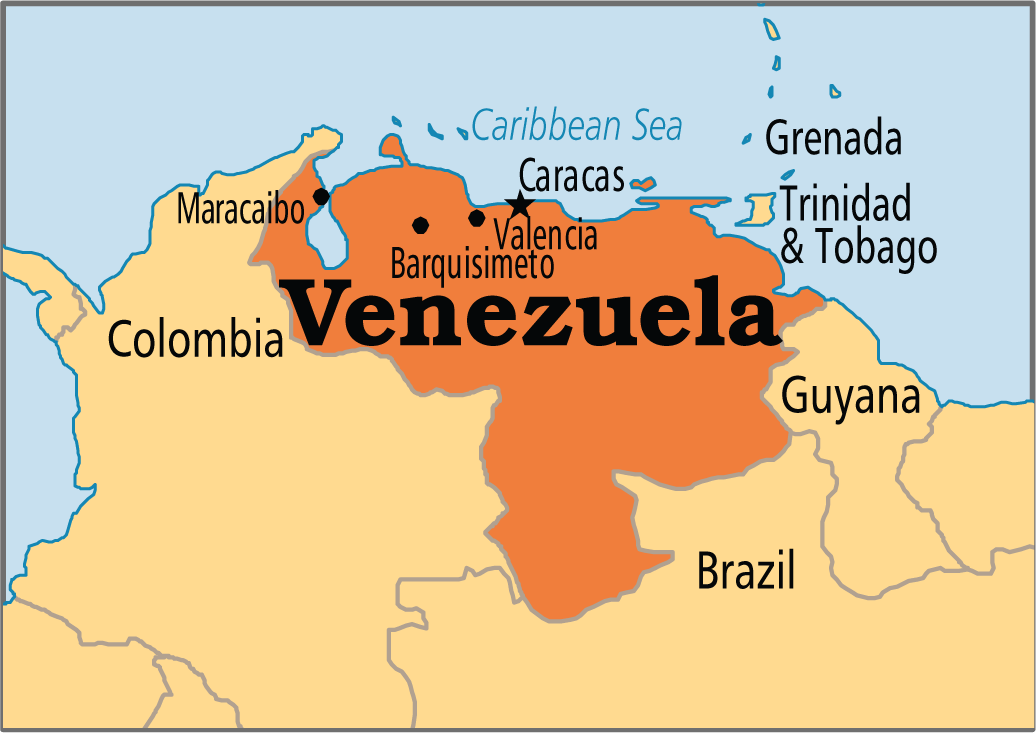
- Location & Boundaries: Venezuela is located at the northern end of South America, with coastlines along the Caribbean Sea and the Atlantic Ocean, and shares land borders with Guyana to the east, Brazil to the south, and Colombia to the southwest and west .
- Political System & Capital: It is a federal multiparty republic with a unicameral legislature, and Caracas serves as the capital.
- Natural Resources & Economy: Venezuela is resource-rich, possessing petroleum, natural gas, iron ore, gold, bauxite, and diamonds, with the economy historically dominated by oil.
- The country holds the world’s largest proven crude oil reserves and is a founding member of OPEC, making it strategically critical in global energy geopolitics.
- Physical Geography: Venezuela features diverse landforms including the Andes Mountains, Lake Maracaibo, the Llanos plains, the Guiana Highlands, and the Orinoco River system, which shapes its ecology and economy.
- The country’s highest point is Pico Bolívar, and the world’s highest waterfall, Angel Falls, is located in the Guiana Highlands.
- Its major rivers include the Orinoco and Rio Negro, while Lake Maracaibo, the largest lake in South America.
- Cultural & Ecological Importance: Venezuela hosts UNESCO-recognised sites like Canaima National Park and Angel Falls, highlighting its ecological and natural heritage.
- Islands & Territorial Disputes: It administers several Caribbean islands such as Margarita and Los Roques, and has a long-standing territorial dispute with Guyana over the Essequibo region, along with maritime disputes with Colombia.
Conclusion
The US intervention marks a bold revival of the Monroe Doctrine, reasserting American hegemony to counter external influence and challenge the global multipolar order. While aiming to restore democracy, this unilateral action risks destabilizing Latin America and raising sovereignty concerns across the Global South.
|
Drishti Mains Question: Q. The revival of the Monroe Doctrine in the 21st century presents a challenge to the emerging multipolar world order.Discuss |
Frequently Asked Questions (FAQs)
- What is the Monroe Doctrine?
It is a 1823 US foreign policy doctrine opposing European colonisation or interference in the Western Hemisphere and asserting US security interests in the region. - What is the “Trump Corollary” to the Monroe Doctrine?
It refers to a contemporary reinterpretation asserting US political, economic, and military dominance in Latin America to counter rival powers and hostile regimes. - Why did the US intervene in Venezuela?
The US cited narco-terrorism charges, energy security concerns, and Venezuela’s ties with China, Russia, and Iran as key justifications.
UPSC Civil Services Examination, Previous Year Questions (PYQs)
Prelims
Q. Consider the following statements : (2024)
Statement-I: Recently, Venezuela has achieved a rapid recovery from its economic crisis and succeeded in preventing its people from fleeing/emigrating to other countries.
Statement-II: Venezuela has the world’s largest oil reserves.
Which one of the following is correct in respect of the above statements?
- Both Statement-I and Statement-II are correct and Statement-II explains Statement-I
- Both Statement-I and Statement-II are correct, but Statement-II does not explain Statement-I
- Statement-I is correct, but Statement-II is incorrect
- Statement-I is incorrect, but Statement-II is correct
Ans: D



