


Social Issues
Towards Prohibition of Polygamy
- 01 Dec 2025
- 14 min read
For Prelims: Polygamy in India, Hindu Marriage Act, 1955, NFHS, Indian Penal Code, 1860, Muslim Personal Law Application Act of 1937, Anti-Polygamy Bill
For Mains: Polygamy in India among religious groups.
Why in News?
The Chief Minister of Assam introduced the Assam Prohibition of Polygamy Bill, 2025 in the Assam Legislative Assembly, aiming to criminalize polygamy across the state, with severe punishments for those violating the law.
Key Provisions of Assam’s Anti-Polygamy Bill 2025
- Criminalization of Polygamy: The Bill makes polygamy a criminal offence, prescribing imprisonment of up to 7 years and a fine for anyone entering into, or concealing, a second marriage while the first marriage remains valid.
- Exemptions and Jurisdiction: The law excludes the Sixth Schedule areas of Assam, where customary laws permit polygamy.
- Scheduled Tribes under Article 342 of the Constitution are not covered by this law.
- The law applies to Assam residents and extends its jurisdiction to those involved in polygamous marriages outside the state or who benefit from Assam’s welfare schemes.
- Accountability of Key Actors: Village heads, qazis (Muslim clerics), parents, and legal guardians of individuals entering into polygamous marriages will be held accountable.
- Compensation for Affected Women: A compensation mechanism will be established for women who are adversely affected by polygamous marriages.
- Impact on Convicts: Individuals convicted under this law will be ineligible for government jobs, benefits, and government schemes. Election eligibility will be barred for such individuals.
- Grandfather Clause: Polygamous marriages contracted before the law’s enactment will not be impacted as long as they comply with existing personal or customary laws and have valid proof.
What is Polygamy?
- About: It refers to the practice of having more than one spouse simultaneously. In this context, polygamy involves a marriage where one person may have multiple partners at the same time.
- Traditionally, polygamy has been practiced in various cultures, with polygyny (a man having multiple wives) being more common in many societies.
- In India, polygamy was widely practiced in the past, especially among men, but the Hindu Marriage Act of 1955 formally prohibited it.
- The Special Marriage Act (SMA), 1954, permits inter-religious marriages, but also explicitly bans polygamy. Many Muslim women have used this Act to prevent or challenge polygamous practices.
- Traditionally, polygamy has been practiced in various cultures, with polygyny (a man having multiple wives) being more common in many societies.
- Types of Polygamy:
|
Type of Marriage |
Description |
|
Polygyny |
A form of polygamy where a man has multiple wives. Historically more common, with ancient rulers and emperors (e.g., in the Indus Valley) practicing this form. |
|
Polyandry |
A practice where a woman has more than one husband. It is relatively rare and typically occurs in specific cultural contexts like in certain tribal or cultural communities. |
|
Bigamy |
Occurs when an individual, already married to one person, enters into a second marriage while the first marriage remains legally valid. The person is called a bigamist. Considered a criminal offense in many countries, including India. |
What is the Status of Polygamy in India?
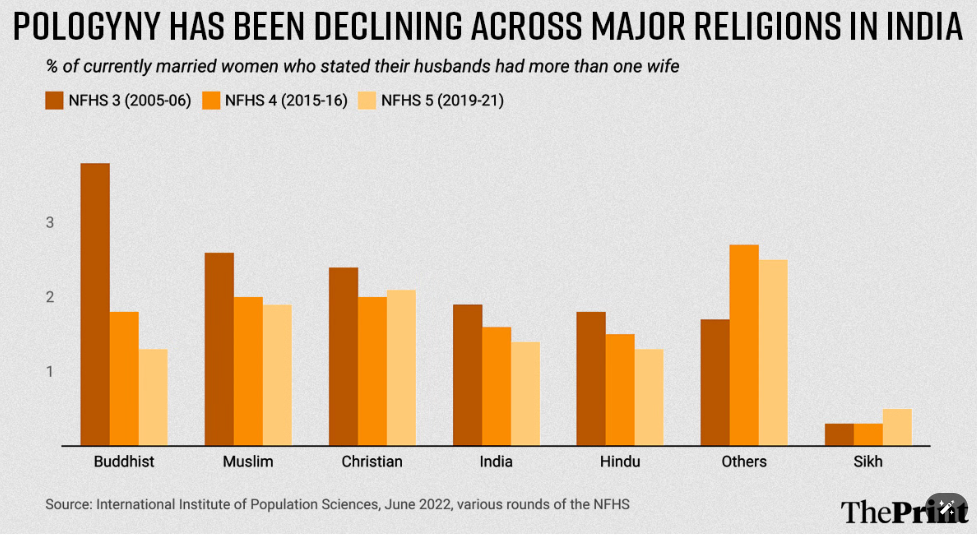
- Polygamy in India: The National Family Health Survey(NFHS-5) (2019-2021) reveals that in Assam, 1.8% of Hindu women and 3.6% of Muslim women experience polygamy, with an overall prevalence rate of 2.4%.
- Notably, Meghalaya reports the highest polygamy rate in India at 6.1%.
- Nationally, polygamy rates are 2.1% among Christians, 1.9% among Muslims, 1.3% among Hindus and Buddhists, 0.5% among Sikhs, and 2.5% among other religions or castes.
- Notably, Meghalaya reports the highest polygamy rate in India at 6.1%.
- Prevalence Among Communities:
- Polygamy in Hindus: The Hindu Marriage Act, 1955 abolished and criminalized polygamy, mandating monogamous marriages under Section 11, which declares polygamous marriages void.
- Polygamy in Parsis: The Parsi Marriage and Divorce Act, 1936 outlawed bigamy, making it illegal for Parsis to remarry during the lifetime of their spouse without legal divorce or invalidation of the previous marriage.
- Polygamy in Muslims: Polygamy is not prohibited in Muslim law (Muslim Personal Law Application Act (Shariat) of 1937) however, if polygamy is found to violate fundamental rights under the Constitution, it could be challenged and overturned.

Judicial Pronouncement on Polygamy
- Parayankandiyal v. K. Devi & Others (1996): The Supreme Court (SC) concluded that monogamous relationships were the standard and ideology of Hindu society, which scorned and condemned a second marriage.
- Polygamy was not allowed to become a part of Hindu culture due to the influence of religion.
- State of Bombay v. Narasu Appa Mali (1951): The Bombay High Court ruled that the Bombay (Prevention of Hindu Bigamy Marriage) Act, 1946 was not discriminatory.
- The SC ruled that a state legislature has the authority to enact measures for public welfare and reforms, even if it violates the Hindu religion or custom.
- Javed & Others v. State of Haryana & Others (2003): The Supreme Court ruled that freedom of religion under Article 25 is subject to considerations of social harmony, dignity, and well-being.
- While Muslim law permits marrying up to four women, it is not mandatory, and choosing not to marry four women does not violate religious practice.
What are the Implications of Polygamy in India?
- Personal Laws and Fundamental Rights: India’s legal system faces inconsistencies, as personal laws allow polygamy for some communities (e.g., Muslims) while others (e.g., Hindus, Christians) enforce monogamy, raising questions about constitutional equality.
- Conflict with Gender Justice: Polygamy often conflicts with Article 21 (Right to Life and Personal Liberty), especially regarding a woman’s dignity, autonomy, and mental well-being.
- The Supreme Court in several judgments (e.g., Shayara Bano v. Union of India, 2017) emphasized the need to uphold gender rights in personal laws.
- Social and Legal Complications: Polygamy is outlawed for Hindus under the Hindu Marriage Act, 1955, but is permitted under Muslim personal law (with conditions).
- This differential treatment fuels debates on uniformity in personal laws and religious equality under Article 14 (Right to Equality) and Article 15 (Non-discrimination).
- Changing Norms: With rising awareness about gender equality, polygamy is becoming socially unacceptable, with many advocating for its legal restriction as it conflicts with modern values of individual rights and justice.
What are the Measures Needed to Address Implications of Polygamy?
- Gradual Reform: Personal laws should be amended to ensure alignment with constitutional values like equality and dignity. This gradual reform will ensure a balance between respecting religious practices and protecting women’s rights, ultimately working toward gender justice.
- Uniform Civil Code (UCC): Introducing a UCC, with broad consultations, can replace discriminatory personal laws, ensuring equal rights for all citizens. It would help standardize marriage laws, reducing legal disparities and conflicts, but should be implemented gradually and with cultural sensitivity.
- Legal Enforcement: Polygamous practices should be closely monitored and penalized under the law. Strengthening victim‑relief frameworks and providing social support will protect women from exploitation, ensuring they receive justice and compensation when affected by polygamy.
- Public Awareness: Legal reforms should be accompanied by public awareness campaigns to promote gender equality and constitutional values. NGOs, educational institutions, and community leaders can play a key role in changing attitudes toward polygamy and encouraging societal acceptance of gender justice.
- Judicial Oversight: Courts should use precedents to challenge discriminatory practices in polygamous marriages, ensuring they align with constitutional rights. Public interest litigations can further help safeguard women and children by addressing unconstitutional customs and personal laws.
Conclusion
Addressing polygamy in India necessitates a sophisticated reconciliation between preserving religious freedoms and upholding the constitutional tenets of equality and justice. A multifaceted approach—comprising incremental legal reforms, a thoughtful implementation of a Uniform Civil Code, and robust judicial intervention—can dismantle the systemic inequalities inherent in polygamous practices.
|
Drishti Mains Question: Polygamy in India raises complex issues related to religious freedom, gender equality, and constitutional rights. Comment. |
Frequently Asked Questions (FAQs)
Q. Is polygamy legal in India?
Polygamy is legal for Muslims under personal laws but prohibited for Hindus, Sikhs, and Christians by the Hindu Marriage Act, 1955.
Q. Can polygamous marriages be challenged in court?
Yes, polygamous marriages can be challenged if they violate constitutional rights, particularly regarding equality and dignity.
Q. How does polygamy impact women's rights in India?
Polygamy often results in gender inequality, emotional abuse, and limited access to resources for women.
Q. What is the government's stance on a Uniform Civil Code (UCC) in relation to polygamy?
The government has debated the UCC to replace personal laws, ensuring uniform rights but facing concerns over religious freedom.
UPSC Civil Services Examination, Previous Year Questions (PYQs)
Prelims
Q. Which Article of the Constitution of India safeguards one’s right to marry the person of one’s choice? (2019)
(a) Article 19
(b) Article 21
(c) Article 25
(d) Article 29
Ans: (b)
Exp:
- The right to marry is a component of the right to life under Article 21 of the Constitution of India which states that “No person shall be deprived of his life and personal liberty except according to the procedure established by law”.
- In Lata Singh v. State of Uttar Pradesh 2006, the Supreme Court viewed the right to marry as a component of the right to life under Article 21 of Indian Constitution.
- Therefore, option (b) is the correct answer.
Mains
Q. Customs and traditions suppress reason leading to obscurantism. Do you agree?(2020)



