


Important Facts For Prelims
Self-Defence, IHL and UNCLOS in US–Israel–Iran Conflict
- 06 Mar 2026
- 11 min read
Why in News?
The recent US and Israeli strikes on Iran, including the bombing of a girls' school (Minab, Iran), justified as a "pre-emptive" response to an imminent threat, challenge the legality of using force under the UN Charter, specifically Article 51 and the doctrine of self-defence.
- Furthermore, the torpedoing of the Iranian warship IRIS Dena outside Iran’s nautical boundary (off the coast of Sri Lanka) raises significant questions regarding the freedom of navigation under the UNCLOS (United Nations Convention on the Law of the Sea).
What is the International Law on the Use of Force?
Doctrine of Self-defence
- Core Prohibition on Use of Force: The foundation of international peace is Article 2(4) of the UN Charter, which prohibits member states from threatening or using force against the 'territorial integrity' or 'political independence' of another state.
- Exceptions to the Rule: Under the UN Charter, the use of force is only lawful in two scenarios, i.e.,
- When authorised by the UN Security Council, or
- In the exercise of the right of self-defence under Article 51.
- Exceptions to the Rule: Under the UN Charter, the use of force is only lawful in two scenarios, i.e.,
- Strict Interpretation of Article 51: The right of self-defence under Article 51 is triggered only in response to an "actual armed attack." Since Iran had not recently attacked either state, the strikes do not meet this strict criterion.
- Doctrine of Anticipatory Self-Defence: The argument of the US and Israel rests on the controversial theory of "anticipatory" self-defence. However, many geopolitical scholars argue that international law does not recognise a right to use force in self-defence against an attack that has not yet occurred.
- Even under the anticipatory self-defence theory, the use of force would be lawful only if three conditions were met, i.e., (1) Iran had decided to attack; (2) it possessed the capability to do so; and (3) this was the "last window of opportunity" to prevent that future attack.
- Moreover, US-Iran nuclear negotiations, mediated by Oman, were actively underway in Geneva, yet the US and Israel launched joint military strikes on Iran.
International Humanitarian Law (IHL)
- Core Principles of IHL: Unlike the UN Charter, which addresses the legality of starting a war (jus ad bellum), International Humanitarian Law (IHL) governs how wars are fought (jus in bello), ensuring humane conduct regardless of how the conflict began.
- The conduct of hostilities is regulated by four core principles, i.e., ‘distinction’, ‘proportionality’, ‘military necessity’, and ‘precaution’.
- Principle of Distinction: This principle requires a clear separation between ‘combatants’ and ‘military targets’ from ‘civilians’ and ‘civilian objects’ (schools, hospitals, places of worship). If there is any doubt about a target's nature, it must be presumed to be civilian.
- Civilian objects, including schools, may lose their protected status if they are used for military purposes (e.g., as a base or command post). However, there is no evidence that the Minab school (Iran, targeted by Israeli-US airstrike) was used militarily.
- Legal Protections for Children: The Convention on the Rights of the Child, 1989 (Article 38(4)) requires states to protect children affected by armed conflict.
- Furthermore, the Rome Statute, 1998 defines the intentional targeting of civilians and educational buildings as a war crime.
- Doctrine of Collateral Damage: If the school was hit incidentally during an attack on a nearby military facility, the legality depends on the principles of proportionality and precaution.
- Incidental harm to civilians is lawful only if the expected harm is not excessive in relation to the "concrete and direct military advantage" anticipated from the attack.
What is UNCLOS and its Role in Naval Warfare?
UNCLOS and Naval Warfare:
- While UNCLOS (United Nations Convention on the Law of the Sea) is the primary framework for maritime governance, it focuses on peacetime activities. However, It does not contain explicit provisions regulating the conduct of belligerent parties during armed conflict. The US is not a signatory to UNCLOS.
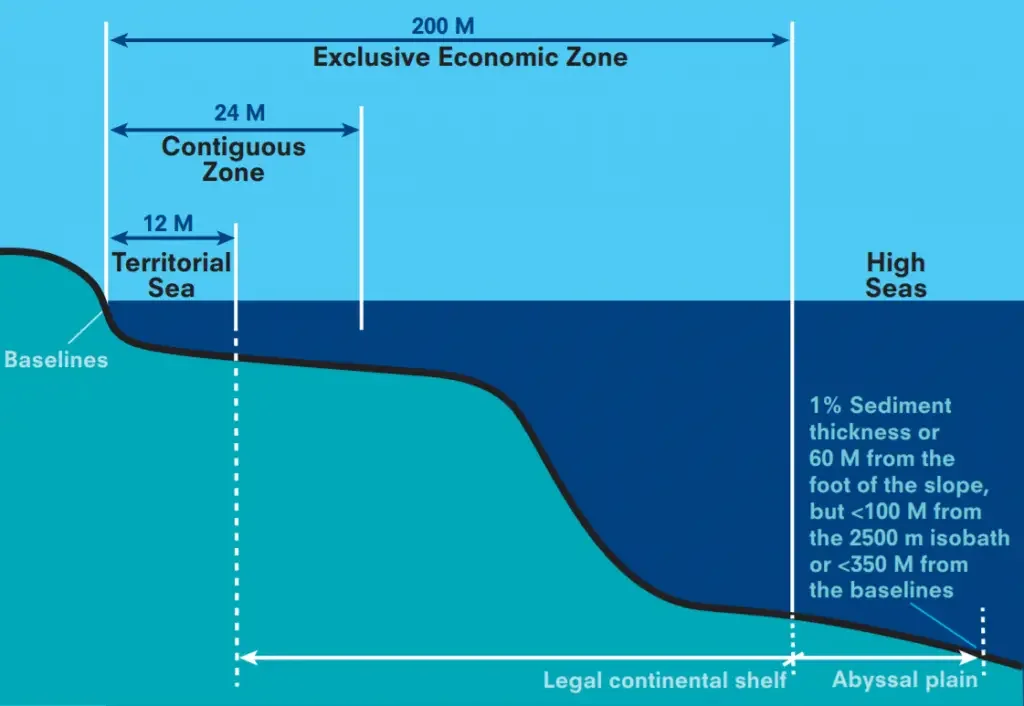
- UNCLOS (1982) (Often called the Constitution of the Oceans) is an international treaty that establishes a comprehensive legal framework governing maritime activities.
- It defines zones like territorial seas (Up to 12 nautical miles), exclusive economic zones (EEZs) (Up to 200 nautical miles), and high seas (beyond 200 nautical miles), while promoting peaceful use, resource management, navigation rights, and marine environmental protection.
- UNCLOS (1982) (Often called the Constitution of the Oceans) is an international treaty that establishes a comprehensive legal framework governing maritime activities.
Law of Naval Warfare
- During armed conflicts, the law of naval warfare operates in parallel with UNCLOS. Under this framework, a warship of a belligerent navy (like the IRIS Dena) is considered a legitimate military target, regardless of its peaceful mission at the time.
- Others contend that the use of force against a foreign warship on the high seas is "presumptively unlawful" unless clearly justified as self-defence under Article 51 or as part of an ongoing armed conflict.
- The IRIS Dena was sanctioned by the US in 2023 for alleged UAV supplies to Russia. However, sanctions primarily restrict business activities and do not, by themselves, legalise a military attack. The ship was on a peaceful passage after an international exercise (Exercise MILAN 2026).
| Read More: US Torpedo Sinks Iranian Warship in Indian Ocean |
Frequently Asked Questions (FAQs)
1. What does Article 2(4) of the UN Charter prohibit?
It prohibits threat or use of force against the territorial integrity or political independence of any state, forming the core principle of modern international peace and security.
2. What is the scope of Article 51 of the UN Charter?
Article 51 permits the use of force in self-defence only in response to an actual armed attack, until the UN Security Council takes necessary measures.
3. What are the core principles of International Humanitarian Law (IHL)?
The key principles are distinction, proportionality, military necessity, and precaution, aimed at protecting civilians and limiting suffering during armed conflicts.
UPSC Civil Services Examination, Previous Year Question (PYQ)
Q. The term “two-state solution” is sometimes mentioned in the news in the context of the affairs of (2018)
(a) China
(b) Israel
(c) Iraq
(d) Yemen
Ans: (b)
Q. What is the importance of developing Chabahar Port by India? (2017)
(a) India’s trade with African countries will enormously increase.
(b) India’s relations with oil-producing Arab countries will be strengthened.
(c) India will not depend on Pakistan for access to Afghanistan and Central Asia.
(d) Pakistan will facilitate and protect the installation of a gas pipeline between Iraq and India.
Ans: (c)
Q. Which one of the following countries of South-West Asia does not open out to the Mediterranean Sea? (2015)
(a) Syria
(b) Jordan
(c) Lebanon
(d) Israel
Ans: (b)



