


Facts for UPSC Mains
RBI Cuts Repo Rate to Sustain ‘Goldilocks Phase’
- 08 Dec 2025
- 11 min read
Why in News?
The Reserve Bank of India’s Monetary Policy Committee (MPC) has cut the repo rate by 25 basis points, reducing it to 5.25%. This marks a cumulative cut of 125 bps in 2025. RBI termed the current economic scenario as a “Goldilocks phase” — characterized by low inflation and strong GDP growth.
What is the ‘Goldilocks Phase’ in an Economy?
- About: A Goldilocks phase in the economy refers to a situation where the economy is perfectly balanced—growth is strong and sustainable without overheating, and inflation remains low and stable without slipping into weak demand or deflationary risk.
- In December 2025, RBI Governor called India’s economy a “rare Goldilocks phase” as growth stood at 8.2% in Q2 (July-September) of 2025–26 while inflation averaged 1.7% in Q2 and dipped to 0.3% in October 2025.
- Significance: In a Goldilocks phase, central banks often have more room to maneuver—they can keep rates lower for longer to boost growth, or (as in India's case) cut rates to extend the favorable cycle.
- It’s a temporary ideal window that policymakers try to protect and prolong.
What are the Key Factors that Lead to a Repo Rate Cut by the RBI?
- Sustained Disinflation: Inflation fell sharply—averaging 1.7% in Q2 of 2025-26 and dropping to 0.3% in October 2025—well below the RBI’s lower tolerance band (4% ±2%).
- This collapse in price pressures created the policy space for the RBI to cut rates without risking overheating of the economy.
- Headline inflation fell below the 2% lower tolerance band for the first time under the Flexible Inflation Targeting (FIT) regime.
- India's Goldilocks Moment: Growth remained strong at 8.2% in Q2 while inflation stayed low at 2.2%, creating ideal macroeconomic conditions for sustained economic development.
- The RBI cut rates to reinforce momentum and support domestic demand to prolong this favourable phase.
- Counterbalance External Headwinds: Weak global trade, volatile markets, and geopolitical risks threatened India’s exports and investment.
- The rate cut aimed to cushion the economy by boosting domestic demand against these external drags.
- Support for Growth Momentum: The rate cut aims to reinforce festive-season demand, the effects of GST rationalisation, and overall domestic consumption, thereby nurturing growth during this favourable macro phase.
Repo Rate
- About: The repo rate (Repurchase Agreement Rate) is the interest rate at which commercial banks borrow funds from the central bank.
- Functioning: It helps banks meet short-term liquidity needs by borrowing funds, with securities provided as collateral and repurchased later at a higher price including interest.
- Influence on Credit Costs: A higher repo rate raises loan costs and slows borrowing, while a lower repo rate lowers borrowing costs.
- Role in Monetary Policy: The central bank uses the repo rate to control money supply, inflation, and economic growth.
Flexible Inflation Targeting
- Flexible Inflation Targeting (FIT): FIT is a monetary policy framework in which the central bank’s goal is to achieve a specific medium-term inflation target, while retaining flexibility to consider short-term output and employment stabilization.
- Primary Mandate: The primary mandate of FIT is a publicly declared, specific inflation target, usually expressed as a point or a range.
- For example, in India, the RBI’s mandate is to maintain Consumer Price Index (CPI) inflation at 4%, within a band of ±2% (i.e., 2% to 6%).
- Trade-off Management: FIT formally recognizes short-term trade-offs between controlling inflation and supporting growth, giving the central bank leeway to balance these objectives while keeping inflation as the overriding nominal anchor.
What can be Implications of the RBI’s Repo Rate Cut on the Indian Economy?
- Boost to Economic Growth: Lower rates reduce borrowing costs, increase bank lending, stimulate consumption, and encourage business investment in capital expenditure.
- Inflationary Pressures: Increased liquidity may raise demand-pull inflation if the supply of goods & services is tight; the RBI’s cut reflects confidence that inflation will stay within the 2–6% target band.
- External Sector Dynamics: Reduced interest rate appeal may weaken the rupee, improving export competitiveness but raising import costs and widening the trade deficit.
- Effect on Savings: Lower interest rates reduce returns on fixed deposits and small savings, potentially discouraging household savings.
| Drishti Mains Question:
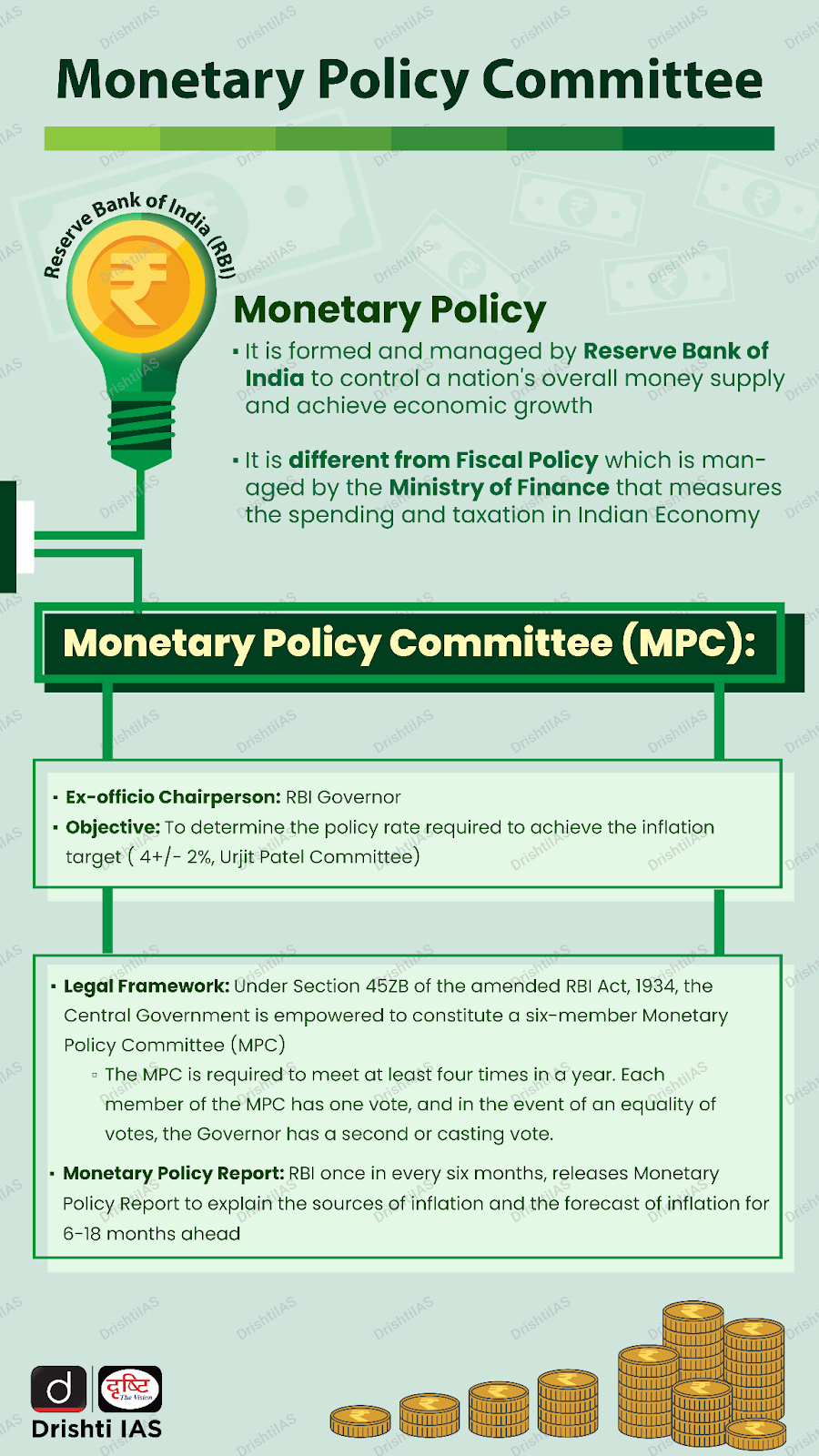
Discuss the role of the Monetary Policy Committee (MPC) in navigating the trade-off between inflation management and growth stimulation, with reference to India's recent economic data. |
Frequently Asked Questions (FAQs)
Q. What is the repo rate?
The repo rate is the interest rate at which commercial banks borrow funds from the RBI to meet short-term liquidity needs.
Q. What is a Goldilocks Moment in economics?
A period where growth is strong and inflation is low, allowing policymakers flexibility to support the economy without overheating risks.
Q. How does Flexible Inflation Targeting (FIT) work?
FIT sets a medium-term inflation target while allowing discretion to support growth and employment amidst short-term shocks.
Summary
- The RBI cut the repo rate by 25 bps to 5.25%, citing a rare Goldilocks economic phase of strong growth (~8%) and unusually low inflation (below 2%).
- The decision was enabled by sustained disinflation, which provided policy space under the Flexible Inflation Targeting framework.
- The strategic cut aims to reinforce domestic demand and prolong favorable conditions while preemptively cushioning the economy against global uncertainties.
- This reflects a calibrated move to balance growth preservation with price stability, using the flexibility within the RBI's mandate to secure the current macroeconomic momentum.
UPSC Civil Services Examination, Previous Year Questions (PYQs)
Prelims
Q. Which of the following statements is/are correct regarding the Monetary Policy Committee (MPC)? (2017)
- It decides the RBI’s benchmark interest rates.
- It is a 12-member body including the Governor of RBI and is reconstituted every year.
- It functions under the chairmanship of the Union Finance Minister.
Select the correct answer using the code given below:
(a) 1 only
(b) 1 and 2 only
(c) 3 only
(d) 2 and 3 only
Ans: (a)
Q. If the RBI decides to adopt an expansionist monetary policy, which of the following would it not do? (2020)
- Cut and optimize the Statutory Liquidity Ratio
- Increase the Marginal Standing Facility Rate
- Cut the Bank Rate and Repo Rate
Select the correct answer using the code given below:
(a) 1 and 2 only
(b) 2 only
(c) 1 and 3 only
(d) 1, 2 and 3
Ans: (b)
Mains
Q. Define potential GDP and explain its determinants. What are the factors that have been inhibiting India from realizing its potential GDP? (2020)
Q. Do you agree with the view that steady GDP growth and low inflation have left the Indian economy in good shape? Give reasons in support of your arguments (2019)



