


Science & Technology
New Delhi Declaration on AI Impact
- 24 Feb 2026
- 15 min read
For Prelims: India-AI Impact Summit 2026, Artificial Intelligence, Pax Silica, deep-tech, Graphics Processing Unit, Sarvam-30B and Sarvam-105B
For Mains: Role of AI in inclusive development and governance, India’s Digital Public Infrastructure as a global model, AI and socio-economic transformation in the Global South
Why in News?
The India-AI Impact Summit 2026 concluded with 89 countries and international organizations including major powers like the United States and China signing the New Delhi Declaration rooted in the principle of “Sarvajan Hitaya, Sarvajan Sukhaya,” emphasizing equitable sharing of Artificial Intelligence (AI) benefits.
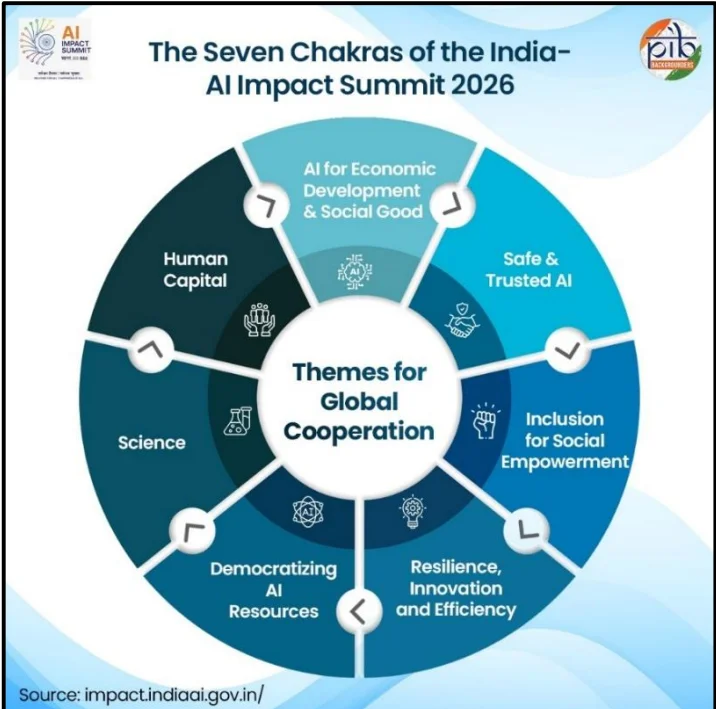
- The non-binding declaration is structured around seven ‘Chakras’ and represents the broadest multilateral consensus on AI to date.
Summary
- The New Delhi Declaration on AI Impact 2026, signed by 89 countries, promotes democratic access to AI, trusted and ethical frameworks, global research collaboration, and inclusive growth guided by Indian principles like Vasudhaiva Kutumbakam and Sarvajan Hitaya.
- India leveraged the summit to advance sovereign AI, semiconductor security, massive compute expansion, MSME AI adoption, and IndiaAI Mission 2.0, positioning itself as a global AI leader while addressing concerns around regulation, workforce disruption, and sustainability.
What are the Key Highlights of the New Delhi Declaration on AI Impact?
- Democratizing AI Resources: Affordable digital infrastructure and connectivity are essential to unlock AI’s full potential.
- Guided by Vasudhaiva Kutumbakam, the declaration stresses equitable access to AI resources so all countries can develop and deploy AI for public benefit.
- It notes the Charter for the Democratic Diffusion of AI, a voluntary framework to expand access to foundational AI tools, support local innovation, and build resilient AI ecosystems while respecting national laws.
- Economic Growth and Social Good: The declaration promotes open and accessible AI solutions to improve scalability and adaptability.
- The declaration notes the Global AI Impact Commons as a voluntary initiative that provides a practical platform to promote the adoption, replication, and scaling of successful AI use cases across regions.
- Secure and Trusted AI: The declaration recognises development of the Trusted AI Commons, a voluntary platform offering shared tools, benchmarks, and best practices to support responsible and adaptable AI.
- Science: Removing barriers and expanding AI research infrastructure can accelerate scientific innovation through global collaboration.
- The declaration notes the International Network of AI for Science Institutions as a voluntary platform to connect researchers and pool AI capabilities.
- Access for Social Empowerment: The declaration supports development of a voluntary and collaborative platform to facilitate exchange of learning, knowledge, and scalable practices to advance AI adoption for social empowerment.
- Human Capital: Harnessing AI’s potential requires strong skilling, reskilling, and AI literacy initiatives.
- The declaration highlights workforce development efforts supported by guiding principles and playbooks to prepare societies for an AI-driven economy.
- Resilience, Innovation, and Efficiency: Energy-efficient and resilient AI systems are essential to manage growing resource demands.
- The declaration emphasises that the Voluntary Guiding Principles on Resilient, Innovative, and Efficient AI will guide the development of robust and efficient AI systems. It also recognises the Playbook on Advancing Resilient AI Infrastructure as a key knowledge resource supporting resilient AI development.
|
Click here to Read: India-AI Impact Summit 2026 |
What are India's Strategic Outcomes of AI Impact Summit 2026?
- Pax Silica Alliance: India formally joined the US-led Pax Silica coalition, aiming to secure semiconductor supply chains and access to critical minerals.
- This move supports diversification and reduces reliance on any single global power.
- India also signed a Joint Statement on the 'India-US AI Opportunity Partnership' as a bilateral addendum to the declaration.
- Major Investment Commitments: Over USD 250 billion pledged for infrastructure, including data centers and semiconductor fabrication plants.
- Around USD 20 billion committed to deep-tech venture capital, strengthening India’s innovation ecosystem.
- GPU Expansion and Compute Capacity: The government announced a massive ramp-up of its compute muscle, adding 20,000 Graphics Processing Units (GPUs) to its existing 38,000, with a target to cross 100,000 GPUs by the end of 2026.
- Launch of IndiaAI Mission 2.0: The summit marked the rollout of the next phase of India’s national AI strategy, focusing on scaling compute infrastructure, datasets, and AI adoption across sectors.
- India also presented the MANAV Vision (Moral, Accountable, National Sovereignty, Accessible, Valid), a human-centric framework to guide Artificial Intelligence (AI) development with ethics, inclusivity, and national sovereignty at its core.
- UPI-Style AI Playbook for MSMEs: India plans to package AI solutions into a standardized “playbook” for small businesses and MSMEs, inspired by the success of the Unified Payments Interface (UPI), to accelerate widespread adoption.
- Push for Sovereign AI: India is prioritizing indigenous foundation models that are trained and hosted domestically, ensuring data sovereignty and strategic autonomy. Companies like Sarvam AI are central to this effort.
- At the summit, Sarvam AI unveiled two large language models Sarvam-30B (30 billion parameters) and Sarvam-105B (105 billion parameters). This milestone signals India’s entry into the group of nations capable of developing frontier AI models from scratch.
- Sarvam AI unveiled Sarvam Kaze, a made-in-India smart glasses initiative positioned as an alternative to Meta’s Ray-Ban smart glasses, integrating AI-powered vision and audio capabilities.
- BharatGen launched Param2, a 17-billion-parameter model supporting 22 Indian languages, and unveiled Sutra, an AI news anchor that converts policy discussions into multilingual reports.
- At the summit, Sarvam AI unveiled two large language models Sarvam-30B (30 billion parameters) and Sarvam-105B (105 billion parameters). This milestone signals India’s entry into the group of nations capable of developing frontier AI models from scratch.
- Global Fund for Equitable AI Access: The UN Secretary-General urged technology companies to support a USD 3-billion global fund to ensure equitable access to AI, and announced the appointment of a 40-member UN scientific panel on AI and a global dialogue on AI governance set to begin in Geneva in July 2026.
| Click here to Read: India’s M.A.N.A.V. Vision for AI |
What are the Concerns Regarding the New Delhi Declaration on AI Impact?
- Non-Binding and Voluntary Nature: The commitments are framed as "voluntary" and "non-binding." Phrases like "taking note of" and "recognizing" do not create mandatory obligations for signatory nations.
- There is no international body or verification mechanism to ensure that countries actually follow the principles of "Democratic Diffusion" or "Trusted AI."
- Absence of Redlines: Unlike the EU AI Act, the declaration does not explicitly prohibit "high-risk" or "destructive" AI practices such as predictive policing or biometric surveillance, leaving them to national laws.
- The "Silent" Labor Crisis: While "reskilling" was a priority, there was little structured discussion on the immediate threat to India’s 5.8 million IT workforce, specifically entry-level coding and administrative roles most vulnerable to Generative AI.
- The declaration was largely seen as a "government-industry" alliance, with minimal engagement from labor unions or the workforce itself.
- Infrastructure and Sustainability Challenges: India lacks advanced computing infrastructure, semiconductor manufacturing, and hyperscale data centres required for competitive AI development.
- There is a growing risk of India becoming a “data colony,” supplying data and talent while foreign firms retain ownership of high-value AI platforms.
- Data centres consume massive water resources ( around 11 lakh litres per day), intensifying stress in water-scarce regions.
- Expansion of data centres in cities like Bengaluru exacerbates urban water shortages and raises environmental sustainability concerns.
What Measures can India take to Ensure AI Serves as a Tool for Inclusive Growth?
- Operationalizing the "Three Sutras": The summit’s core principles—People, Planet, and Progress—must be translated into measurable projects:
- People (Human-Centric AI): Implementing the MANAV Vision by embedding ethical guardrails into every public-sector AI application.
- Planet (Sustainable AI): Advancing Green AI by incentivizing the development of energy-efficient algorithms and powering data centers with renewable energy, as pledged by domestic giants like Adani.
- Progress (Economic Inclusion): Launching the MSME AI Stack (on the lines of UPI) to provide small businesses with affordable, ready-to-use AI tools to boost productivity.
- Semiconductor Synergy: Aligning with ISM 2.0 (India Semiconductor Mission) to develop indigenous AI chips, reducing long-term reliance on foreign supply chains.
- Institutionalizing Global Governance: The New Delhi Declaration is a starting point for a more formal global architecture:
- India should work towards a common set of technical benchmarks within the Trusted AI Commons to move beyond "non-binding" promises to interoperable safety standards.
- Establish cross-border regulatory sandboxes where signatory nations can test AI applications in health and agriculture under shared ethical guidelines.
- Addressing the Labor and Ethics Gap: Implementing the Reskilling Playbook at a massive scale through initiatives like Bodhan AI, ensuring that the youth cohort is "AI-ready" rather than "AI-displaced."
- Passing specific legislations or guidelines to mandate a "Glass Box" approach (transparency), ensuring that AI decision-making in governance is verifiable and lawful.
Conclusion
The New Delhi Declaration 2026 marks a historic shift toward the "Democratic Diffusion" of technology, successfully bridging the global digital divide through the Three Sutras of People, Planet, and Progress. Ultimately, the success of this summit lies in transforming its voluntary frameworks into a tangible, inclusive reality for the Global South.
|
Drishti Mains Question: Q. The New Delhi Declaration on AI Impact 2026 marks a paradigm shift from 'AI Safety' to 'Democratic Diffusion' of technology. Discuss |
Frequently Asked Questions (FAQs)
1. What is the New Delhi Declaration 2026?
A voluntary global framework adopted at the AI Impact Summit to promote democratic access, trusted AI, and equitable benefits from AI technologies.
2. What is meant by “Democratic Diffusion of AI”?
It refers to expanding access to foundational AI tools and infrastructure to enable all countries, especially the Global South, to innovate and benefit.
3. What is Sovereign AI and why is it important for India?
Sovereign AI involves domestically developed and hosted AI models to ensure data sovereignty, national security, and technological independence.
4. What are the key concerns regarding the declaration?
Its non-binding nature, lack of enforcement mechanisms, absence of clear redlines on high-risk AI, and limited focus on immediate job displacement risks.
5. How does IndiaAI Mission 2.0 support inclusive growth?
It expands compute infrastructure, promotes MSME AI adoption, supports skilling initiatives, and fosters indigenous AI innovation.
UPSC Civil Services Examination Previous Year Question (PYQ)
Prelims
Q. With the present state of development, Artificial Intelligence can effectively do which of the following? (2020)
- Bring down electricity consumption in industrial units
- Create meaningful short stories and songs
- Disease diagnosis
- Text-to-Speech Conversion
- Wireless transmission of electrical energy
Select the correct answer using the code given below:
(a) 1, 2, 3 and 5 only
(b) 1, 3 and 4 only
(c) 2, 4 and 5 only
(d) 1, 2, 3, 4 and 5
Ans: (b)
Q. The terms ‘WannaCry, Petya and EternalBlue’ sometimes mentioned in the news recently are related to (2018)
(a) Exoplanets
(b) Cryptocurrency
(c) Cyber attacks
(d) Mini satellites
Ans: (c)
Mains
Q. Introduce the concept of Artificial Intelligence (AI). How does AI help clinical diagnosis? Do you perceive any threat to privacy of the individual in the use of AI in healthcare? (2023)
Q. What are the main socio-economic implications arising out of the development of IT industries in major cities of India? (2021)
Q. “The emergence of the Fourth Industrial Revolution (Digital Revolution) has initiated e-Governance as an integral part of government”. Discuss. (2020)



