


Indian Economy
National Mission on Edible Oils (NMEO)
- 10 Dec 2025
- 15 min read
For Prelims: Edible Oil, NMEO-Oil Palm, NMEO-Oilseeds, Yellow Revolution, WTO, Cooperatives, FPOs, Intercropping.
For Mains: Status of Oilseeds production, consumption and imports in India. Key features of NMEO-Oil Palm (2021) and NMEO-Oilseeds (2024) to achieve self-sufficiency in oilseed production.
Why in News?
The Government of India has launched the National Mission on Edible Oils (NMEO) through two key initiatives namely NMEO-Oil Palm (2021) and NMEO-Oilseeds (2024), to reduce heavy dependence on edible oil imports—which met 56% of domestic edible oil demand in 2023-24.
What is the National Mission on Edible Oils – Oil Palm (NMEO-OP)?
- About: NMEO-OP, approved in 2021 as a Centrally Sponsored Scheme, aims to boost domestic edible oil availability by expanding cultivation area and increasing Crude Palm Oil (CPO) production, backed by a financial outlay of Rs 11,040 crore.
- Key Features:
- Price Assurance: First-time introduction of Viability Price (VP) to protect farmers from international CPO price fluctuations.
- Increased Subsidies: Substantially hikes assistance for planting material (from Rs. 12,000/ha to Rs. 29,000/ha) and maintenance.
- Rejuvenation Support: Special assistance of Rs. 250 per plant for old garden rejuvenation.
- Focus Regions: Special emphasis on the North-Eastern states and traditional growing states like Andhra Pradesh and Telangana.
- Key Targets:
- Area Expansion: Bring 6.5 lakh hectares under oil palm plantations by 2025-26.
- Production Targets: 11.20 lakh tonnes CPO by 2025-26 and 28 lakh tonnes CPO by 2029-30.
- Consumption Awareness: Maintain a consumption level of 19 kg per person per annum till 2025-26.
- Progress: Till November 2025, 2.50 lakh hectares covered under NMEO-OP, bringing total oil palm coverage to 6.20 lakh hectares. CPO production increased from 1.91 lakh tonnes (2014-15) to 3.80 lakh tonnes (2024-25).
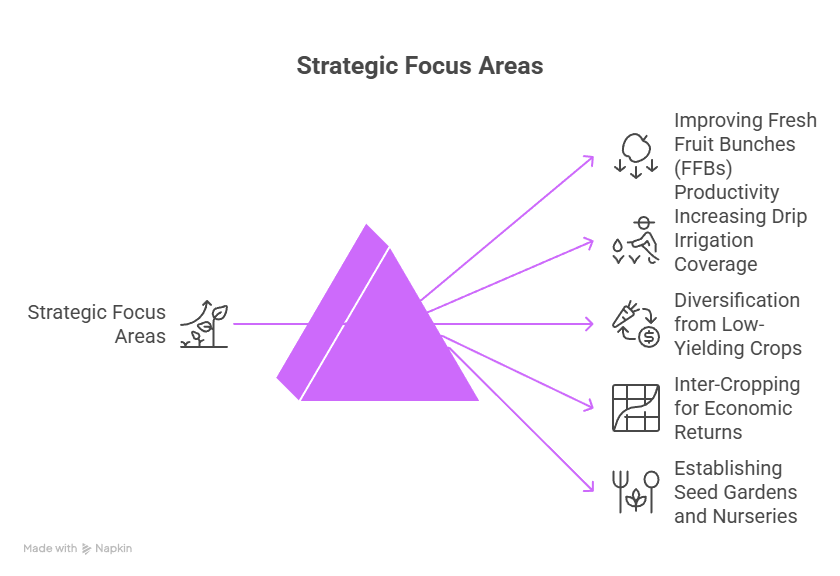
- Strategic Focus Areas:
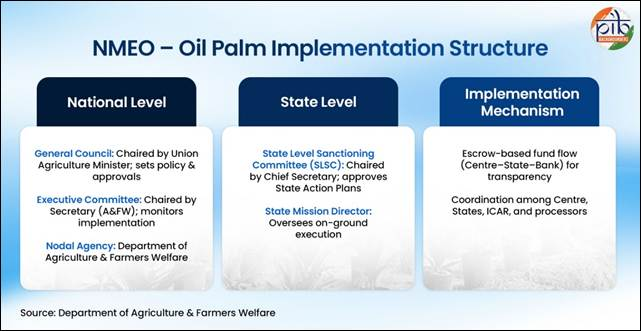
- Implementation Structure:
What is the National Mission on Edible Oils – Oilseeds (NMEO-OS)?
- About: Approved in 2024 for the period 2024-25 to 2030-31, the NMEO-OS aims to achieve self-sufficiency in edible oils.
- It focuses on boosting the production of 9 primary oilseed crops (including mustard, groundnut, and soybean) and enhancing the extraction of oils from secondary sources like cottonseed, coconut, rice bran, and Tree-Borne Oilseeds.
- Key Objectives: Bridge yield gaps by rapidly disseminating innovative technologies and seeds via cooperatives, FPOs, and private partners.
- Expand oilseed area using fallow lands and intercropping, supported by demonstrations and robust seed systems.
- Strengthen market access for farmers and boost secondary oil sources to enhance returns and production.
- Key Targets:
- Increase oilseed area coverage from 29 million ha (2022-23) to 33 million ha (2030-31) and raise primary production from 39 million tonnes to 69.7 million tonnes over the same period.
- Add 40 lakh hectares of cultivation by 2030-31 using rice/potato fallow lands, intercropping, and crop diversification.
- Together, NMEO-OP and NMEO-OS aim to produce 25.45 million tonnes of edible oil by 2030-31, meeting about 72% of domestic demand.
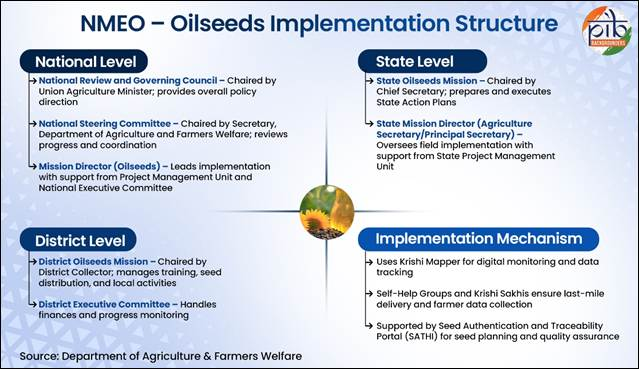
- Implementation: Self-Help Groups, particularly Krishi Sakhis, serve as key Community Agriculture Service Providers (CASP), delivering last-mile support to farmers.
- They collect and update data on the Krishi Mapper platform, enabling real-time tracking and effective grassroots implementation of the mission.
Oilseeds
- About: Oilseeds are crops grown primarily for the edible or industrial oil contained in their seeds.
- They are one of the most important groups of commercial crops in India and globally. In India, oilseeds hold the 2nd-highest acreage and production value after food grains.
- Major Oilseeds Grown in India: 9 major oilseeds—groundnut, soybean, rapeseed-mustard, sunflower, sesame, safflower, niger, castor, and linseed—cover 14.3% of gross cropped area and provide 12–13% of dietary energy.
- Besides the 9 major oilseeds, oil is also extracted from cottonseed, rice bran, coconut (copra), and Tree-Borne Oilseeds (TBOs) such as neem, jatropha, karanja, mahua, and simarouba.
- Importance of Oilseeds: Oilseeds are important for India as
- Nutritional Security: Major source of dietary fats, energy, and fat-soluble vitamins (A, D, E, K), improving calorie intake and addressing hidden hunger.
- Farmers' Welfare: Important cash crop sustaining rural incomes and employment for millions of farmers.
- Export Potential: Contribute about 8% of agricultural exports, with oil meals, oilseeds, and minor oils valued at Rs 29,587 crore in 2023-24.
- Production: India accounts for 5-6% of global oilseed production, yet its domestic edible oil output of 12.18 million tonnes (2023-24) meets only 44% of its demand, creating significant import reliance.
- Major Producing States: Production is concentrated in a few states like Rajasthan, Madhya Pradesh, Gujarat, and Maharashtra that together contribute over 77% of India’s total oilseed output.
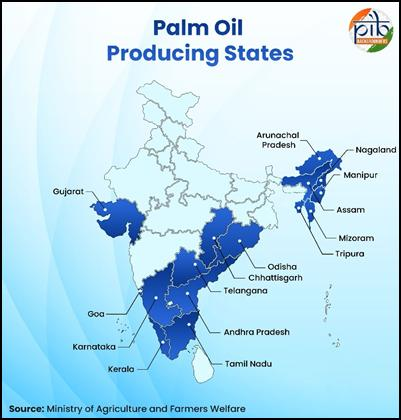
- Regional Specialization: Rajasthan leads in mustard, Madhya Pradesh in soybean, and Andhra Pradesh–Telangana dominate oil palm (98%).
- Oil palm cultivation is expanding in Arunachal Pradesh, Assam, Manipur, Tripura, and Nagaland.
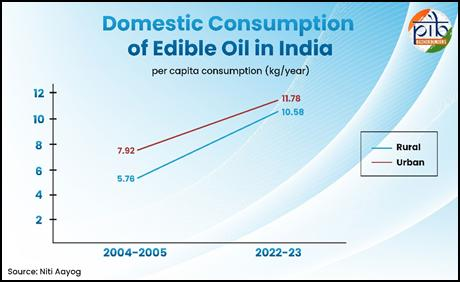
- Consumption: Consumption has grown significantly, with rural annual intake rising 83.68% and urban intake rising 48.74% from 2004-05 to 2022-23.
- Reasons for Import Dependence:
- WTO Impact: India initially achieved edible oil self-sufficiency during the 1990s Yellow Revolution, which aimed to boost oilseeds production.
- However, this was reversed after import duty reductions and price support cuts under WTO agreements.
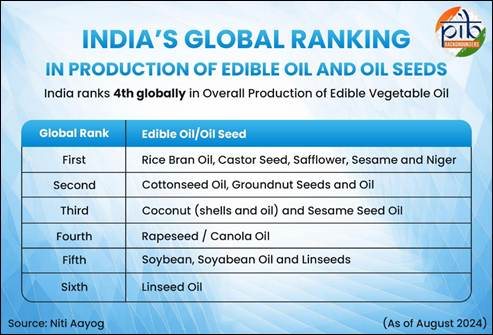
- Climatic Vulnerability: Despite being the world’s 4th-largest edible oil player (after the USA, China, and Brazil), India’s sector remains constrained by its reliance on rainfed agriculture—76% of oilseed cultivation—making yields climate-vulnerable and hindering its ability to meet rising demand.
- WTO Impact: India initially achieved edible oil self-sufficiency during the 1990s Yellow Revolution, which aimed to boost oilseeds production.
Conclusion
The National Mission on Edible Oils addresses India's critical import dependence through targeted interventions in oil palm expansion and oilseed productivity enhancement. By aiming for 72% self-sufficiency by 2030-31, the mission strengthens rural economies, conserves foreign exchange, and advances Atmanirbhar Bharat while ensuring nutritional security for millions through enhanced domestic production capacity.
|
Drishti Mains Question: Q. Analyze the challenges faced by India's oilseed sector despite being the world's fourth-largest edible oil player. How does the National Mission on Edible Oils address these structural constraints? |
Frequently Asked Questions (FAQs)
Q. What is the National Mission on Edible Oils (NMEO)?
NMEO comprises NMEO-Oil Palm (2021) and NMEO-Oilseeds (2024) targeting 72% self-sufficiency by 2030-31.
Q. Which states dominate India's oilseed and oil palm production?
Rajasthan, Madhya Pradesh, Gujarat, Maharashtra contribute 77.68% of oilseeds; Andhra Pradesh-Telangana produce 98% of oil palm with Northeast states expanding.
Q. What role do Krishi Sakhis play in NMEO implementation?
Krishi Sakhis provide last-mile support, collect data on Krishi Mapper, and facilitate market linkages for grassroots implementation.
Summary
- India faces a critical edible oil security challenge, with imports meeting 56% of domestic demand (15.66 MMT in 2023-24), creating economic vulnerability.
- The government's response is the two-pronged National Mission on Edible Oils (NMEO), comprising NMEO-Oil Palm (for area expansion) and NMEO-Oilseeds (for productivity enhancement).
- Key strategies include price assurance (Viability Price) for palm farmers, a cluster-based approach for oilseeds, leveraging fallow lands, and using community resources (Krishi Sakhis) for last-mile delivery.
- The mission aims to produce 25.45 MMT of edible oil domestically by 2030-31, meeting 72% of demand and significantly reducing import dependence to strengthen food security and farmer welfare.
UPSC Civil Services Examination, Previous Year Question (PYQ)
Prelims
Q. Consider the following statements: (2020)
- In the case of all cereals, pulses and oil-seeds, the procurement at Minimum Support Price (MSP) is unlimited in any State/UT of India.
- In the case of cereals and pulses, the MSP is fixed in any State/UT at a level to which the market price will never rise.
Which of the statements given above is/are correct?
(a) 1 only
(b) 2 only
(c) Both 1 and 2
(d) Neither 1 nor 2
Ans: (d)
Q. Consider the following statements: (2018)
- The quantity of imported edible oils is more than the domestic production of edible oils in the last five years.
- The Government does not impose any customs duty on all the imported edible oils as a special case.
Which of the statements given above is/are correct?
(a) 1 only
(b) 2 only
(c) Both 1 and 2
(d) Neither 1 nor 2
Ans: (a)
Q. Other than Jatraopha curcas, why is Pongamia Pinnata also considered a good option for the production of bio-diesel in India? (2010)
- Pongamia pinnata grows naturally in most of the arid regions of India.
- The seeds of Pongamia pinnata are rich in lipid content of which nearly half is oleic acid.
Which of the statements given above is/are correct?
(a) 1 only
(b) 2 only
(c) Both 1 and 2
(d) Neither 1 nor 2
Ans: (c)
Mains
Q. What are the present challenges before crop diversification? How do emerging technologies provide an opportunity for crop diversification?



